When Pope Vitalian needed a new archbishop for Canterbury, Adrian was among the men he considered. Adrian already led a monastery near Naples and knew both Greek and Latin. He declined the appointment. After another candidate proved unavailable, he recommended Theodore of Tarsus. The pope accepted that choice on one condition: Adrian must accompany the new archbishop to England.1
The decision brought together two learned churchmen with different Mediterranean backgrounds. Theodore became archbishop; Adrian became an abbot and teacher in Canterbury. Their work reached beyond the people who heard them speak. Some of their pupils became teachers and church leaders themselves, and one supplied material for Bede’s history. An African scholar consequently stands close to the making of a book through which much of early English history is still known.1
An African abbot in Italy
Bede identifies Adrian, also called Hadrian, as African by origin. He places him at a monastery near Naples and describes his command of Scripture and his knowledge of church and monastic practice. This is substantial information about an established adult career. Bede does not supply a birthplace, an account of Adrian’s childhood or a description of his appearance.1
Adrian is usually associated with North Africa, a region with a long history of Christian scholarship. More precise suggestions about his ancestry remain interpretations of limited evidence. African origin alone cannot establish a modern racial identity. What the early account does make clear is that his learning had earned him the confidence of the pope before he travelled to Kent.1, 2
The pope’s reasons for sending him were practical as well as scholarly. Adrian had already travelled through Gaul twice and knew the route. He could help Theodore through unfamiliar territory and work alongside him as a teacher. Vitalian also wanted someone who would ensure that Theodore’s Greek background did not lead the mission away from Roman church practice.1
A journey delayed in Gaul
Theodore was consecrated in March 668. The travellers left Rome that May, sailed to Marseille and continued through Gaul. Their progress depended on local rulers and bishops. There were permissions to obtain, places to stay and a winter to get through before the Channel crossing.1
Adrian spent time with the bishops of Sens and Meaux. Ebroin, a powerful Frankish official, detained him on suspicion that he was carrying out a mission for the emperor that could threaten Frankish interests. Bede says the suspicion proved unfounded. Adrian was eventually allowed to continue, but Theodore had gone ahead, reaching Canterbury in May 669.1
This was a journey through a network of churches and competing political authorities. Adrian’s experience and contacts helped make it possible, yet even a traveller supported by the pope could be stopped. Once he reached England, he was provided with a place at the monastery later known as St Augustine’s Abbey.1
Scripture, languages and calculation
Bede describes Theodore and Adrian gathering pupils and teaching them regularly. Their subjects included the Bible, verse, astronomy and the calculation used by the Church. Greek and Latin were central to their scholarship. Bede reports that some former pupils could use those languages as readily as the language they had grown up speaking.1
These subjects belonged together. Understanding a biblical passage required attention to language; reading verse involved recognising how words and rhythms worked. Calculation had an immediate religious purpose in establishing the church calendar. Bede links the teachers’ wider work to the observance of Easter, an issue on which different Christian communities had disagreed.1
The school offered sustained access to this learning. Its importance lay partly in the teachers’ ability to connect material from different places and traditions. A pupil in Kent could study with men whose working lives had taken them through the Mediterranean world, and who could explain texts in more than one learned language.1
Traces of the classroom
The British Library draws attention to biblical commentaries associated with the Canterbury teaching and preserved in a manuscript in Milan. They contain references connected with North Africa, including an explanation of a bird associated with Libya. Such details give a more particular sense of the knowledge that travelled with the teachers.2
Another pupil, Aldhelm, later bishop of Sherborne, praised Adrian in his letters. His surviving correspondence presents Canterbury as a place of serious study and Adrian as a respected teacher. The school can therefore be approached through the responses of its students as well as Bede’s account.2
A pupil helps to write the history
Adrian continued his work into the early eighth century. Bede records his burial in the church of the Virgin Mary within his monastery and names Albinus as his successor. Albinus had studied under Adrian and Theodore; Bede again singles out his knowledge of Greek and Latin.1
In the preface to his Ecclesiastical History, Bede explains what Albinus contributed. Through the priest Nothelm, he passed on written information and remembered accounts concerning Kent and neighbouring regions. He also encouraged Bede to undertake the work. Adrian’s teaching thus had a direct continuation in the collection and transmission of historical knowledge: one of his pupils helped another scholar decide what to record, and made the necessary evidence available.1
Sources and further reading
1. Bede, Ecclesiastical History of England. Preface; Book IV, chapters 1–2; Book V, chapter 20. A. M. Sellar’s 1907 translation, reproduced by Project Gutenberg.
2. An African Abbot in Anglo-Saxon England. Alison Hudson, British Library, 26 October 2016. Manuscript evidence and teaching traditions.
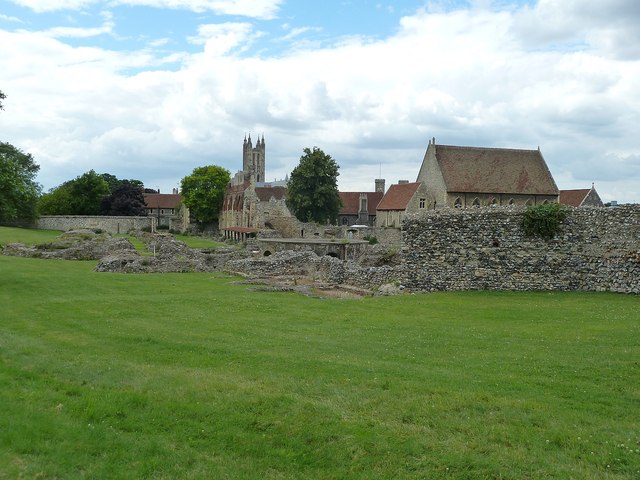
Featured image. Later remains of St Augustine’s Abbey in Canterbury, photographed in 2012. Adrian taught at the monastery in the seventh and early eighth centuries. Photograph: Rob Farrow / Geograph, 6 August 2012. Reused unchanged. Image record · CC BY-SA 2.0