On Easter Sunday, 14 April 1816, rebellion broke out in Barbados. Beginning in St Philip, it spread across southern and central plantation districts. Enslaved people challenged a system claiming ownership of their labour and bodies. Suppressed within days, the uprising exposed organisation within plantation society and the demand for freedom among people the authorities preferred to describe as contented.1
The island behind the uprising
Plantation accounts reveal something of the system against which they acted. Royal Museums Greenwich holds the Applethwaites estate accounts for 1807, recording enslaved people alongside livestock, produce, expenses, salaries and taxes. Such a document made human beings part of an owner’s calculation of property and income. Its categories show how slavery operated through routine administration as well as physical force. For the people listed, however, an account book could never contain the whole of a life: kinship, knowledge, attachment and aspirations exceeded the values assigned by the estate.2
Bayleys, the estate associated with Bussa, was also connected to property and finance beyond Barbados. Research preserved through the Enslaved.org linked-data project traces ownership through the Bayley family and records Mary Wiltshire living in London by 1803. The property’s history includes mortgages involving Thomas and John Daniel. These connections matter because plantation authority did not stop at the coastline. Enslaved labour supported arrangements involving absentee owners and creditors, linking a Barbadian estate to people whose own daily lives unfolded at a considerable distance from it.3
A print made around 1818 offers a different, carefully mediated glimpse of plantation society. In the Royal Museums Greenwich collection, it depicts dwellings, food preparation, music and recreation, with sugar-processing buildings and cane nearby. The image represents people’s social lives within a landscape organised around plantation production. It must be read as an artist’s composition, rather than a complete report of what enslaved people experienced. Even so, the proximity of leisure and processing works captures an important relationship: time beyond immediate labour was still lived within the estate’s physical reach.4
Freedom, news and the work of organising
Britain’s abolition of its transatlantic slave trade in 1807 had not freed people already enslaved. The distinction was fundamental. Parliament had prohibited a trade while the institution that treated people as property continued across the Caribbean. The later struggle over emancipation therefore concerned more than enforcing the earlier Act. For enslaved Barbadians, the end of slave-trading did not by itself remove the authority of an owner or create a right to leave an estate. This gap between metropolitan reform and continuing captivity forms the political background to 1816.5
Nanny Grigg was one of the people who helped turn discussion into mobilisation. A literate domestic worker at Simmons plantation, she appears in testimony about the circulation of reports that freedom had already been granted or would arrive shortly. Historian Dawn Harris’s biography places her among the uprising’s important organisers. Her role demonstrates the political significance of reading and interpreting news. Information could move through a household and then beyond it, passing into conversations through which enslaved people considered what distant parliamentary activity might mean for their own lives.6
The surviving account is indirect. An enslaved witness named Robert described Grigg’s statements during the colonial investigation. He associated her with expectations of freedom around New Year and Easter, and with urging action when liberation did not arrive. This is evidence shaped by an inquiry conducted after a defeated rebellion; it is not a diary in Grigg’s own hand. Her precise thoughts cannot simply be reconstructed from it. Nevertheless, the testimony establishes a woman at the centre of political discussion, challenging the assumption that organising belonged exclusively to male field workers.6
The network included people occupying different positions on different estates. The National Library of Jamaica’s study names Jackey, a driver at Simmons, and King Wiltshire, a carpenter at Bayleys, alongside Grigg and Bussa. It also identifies free men involved in communication and mobilisation, including Cain Davis and Richard Sarjeant. Meetings and messages connected these participants. Their varied occupations help explain the possibilities for contact within a highly controlled society. Organisation depended on relationships crossing estate boundaries and on individuals who could pass information, call others together or interpret developments beyond their immediate workplace.7
Bussa and the struggle on the ground
Bussa was an African-born ranger at Bayleys, with responsibilities connected to the estate’s boundaries. Little secure biographical information survives. He is associated with commanding a large group of rebels and was killed during the fighting. Remembering his leadership should leave room for that uncertainty and for the other organisers whose names appear in the records. The title “Bussa’s Rebellion” identifies its best-known figure, but the uprising required a much wider body of participants, including women, estate workers and people who carried information between communities.1
Colonel Edward Codd’s report describes the speed of the military response. News reached him in the early hours of 15 April; later that morning he marched with troops, militia and field artillery. His account records burning crops and damaged plantation property. The difference in organised firepower mattered. The rebels confronted a colonial state able to mobilise soldiers and guns, not simply individual owners. Codd’s report also shows what the authorities prioritised in explaining events: restoring control and identifying damage to property occupied a central place in the official narrative.8
A private letter dated 27 April records fighting at Bayleys involving men of the West India Regiment. Its account makes clear that Black soldiers fought on the government side. Race did not automatically determine everyone’s position within the confrontation: imperial military service placed Black troops against Black rebels demanding freedom from plantation slavery. The letter is a hostile account of the uprising, and its language should not be adopted as an impartial description of those killed. It remains valuable evidence of the forces deployed to defeat them.9
Reports then travelled through the machinery of empire. Governor James Leith’s letter of 30 April explained events to Earl Bathurst, the secretary responsible for war and the colonies. Leith had been away in Guadeloupe when he received news and returned to Barbados before forwarding military information. That chain of correspondence helped determine how the revolt reached British ministers. The voices most easily preserved in the archive were therefore often those of the officials suppressing it. Reading their reports requires attention to both the information they contain and the authority their writers sought to defend.10
Punishment after the fighting
Repression extended into the rebuilding of plantation life. Harewood House’s research into the Lascelles family estates describes the destruction of enslaved people’s houses by British troops at Mount and Thicket. Estate attorney Richard Cobham subsequently explained that rebuilding accommodation had been delayed as punishment. At Mount, productive buildings were to be restored before the workers’ homes. The decision made shelter another means of coercion. A surviving letter connects the aftermath of rebellion with choices taken by estate management and communicated to the British proprietors’ business network.11
Bussa was among those killed in battle; others were executed or transported after the revolt. Colonial explanations often reduced the uprising to misunderstanding or outside interference. Harewood’s account shows how such arguments protected the assumption that plantation society itself was acceptable. They displaced attention from enslaved people’s desire to end the condition under which they lived. The military defeat of the rebels consequently produced a further struggle over interpretation: whether their actions would be recognised as a demand for freedom or dismissed as the result of manipulation.11
A surviving sketch of a rebel flag complicates any simple account of their political language. Preserved by The National Archives, it combines an apparent declaration of loyalty to Britain and the Crown with a demand for liberty. The object suggests that opposition to local enslavement could coexist with expectations of royal protection or metropolitan justice. It cannot establish that every participant held the same programme. It does, however, preserve an attempt to express political claims visually, alongside the much larger body of written records produced by the authorities.12
1834, apprenticeship and full freedom
The 1816 uprising did not immediately abolish slavery. Parliament’s Slavery Abolition Act came in 1833 and took effect in Barbados in August 1834. Britain allocated £20 million to compensate slave-owners for the loss of what the law had treated as property. The payment went to owners, not to the people whose lives and labour had been appropriated. Emancipation’s terms therefore carried forward assumptions about property even while ending legal ownership of human beings.5
For many adults, 1834 also introduced apprenticeship rather than unrestricted freedom. Formerly enslaved workers remained subject to compulsory labour and disciplinary authority. Historic England’s account explains the original plans for four or six years of apprenticeship and the pressure that brought it to an end in 1838. The two dates mark different stages. A story that stops at the parliamentary Act misses years in which people continued to struggle over their time, work and treatment. Ending slavery in law did not settle every condition under which freedom would be lived.13
Barbados also belongs within a wider Caribbean chronology of resistance. The National Library of Jamaica places its uprising alongside Demerara’s rebellion of 1823 and Jamaica’s of 1831–32. These were different movements in different societies, yet together they demonstrate sustained challenges to slavery before final emancipation. Bussa’s place in that history does not require attributing the entire outcome to one uprising.7
Remembering a collective struggle
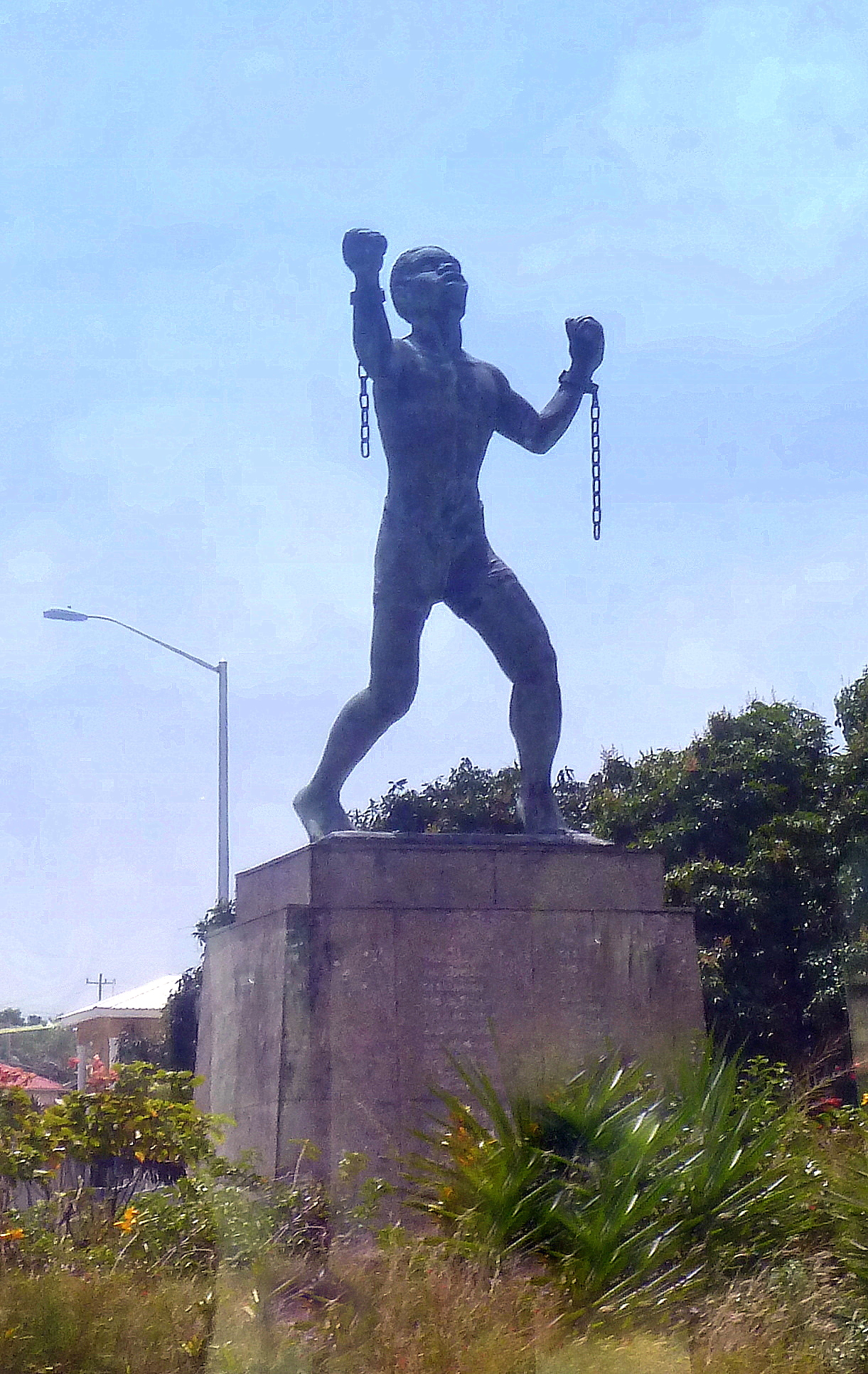
Barbados’s Emancipation Statue, created by sculptor Karl Broodhagen, gives this history a prominent public form. Its figure raises broken chains and is popularly called the Bussa statue. It symbolises emancipation; it should not be presented as an authenticated likeness made from knowledge of Bussa’s appearance. The distinction allows the artwork to be understood on its own terms. A monument can honour a historical struggle through an imagined figure while the historian remains honest about the limited visual and biographical record of the person commemorated.14
Bussa was among the ten National Heroes announced by Barbados in 1998. That recognition places an enslaved rebel within the country’s official account of itself, making resistance to plantation authority a defining part of national remembrance.15
Remembering him alongside Nanny Grigg, Jackey and other participants makes the history broader. Their organising places the agency of enslaved people within the story of emancipation, even when the surviving record reveals only fragments of individual lives.7
Sources and further reading
1. The National Archives: Bussa’s Rebellion: background and teaching resource.
2. Royal Museums Greenwich: Accounts for the Applethwaites plantation, Barbados, 1807 (MGS/40/6).
3. Enslaved.org / Legacies of British Slave-ownership data: Bayleys: plantation ownership and mortgage history.
4. Royal Museums Greenwich: Slaves in Barbadoes, circa 1818 (ZBA2550).
5. UK Parliament Heritage Collections: The transatlantic slave trade.
6. Dawn Harris / Enslaved.org: Nanny Grig.
7. National Library of Jamaica: The Emancipation Wars.
8. The National Archives: Colonel Edward Codd’s report, 25 April 1816 (CO 28/85; resource source 2).
9. The National Archives: Private letter describing the uprising, 27 April 1816 (CO 28/85; resource source 3).
10. The National Archives: Governor James Leith to Earl Bathurst, 30 April 1816 (CO 28/85; resource source 1).
11. Olivia Wyatt / Harewood House: Harewood and the Barbadian Revolt of 1816 (14 April 2024).
12. The National Archives: God always saves endavour: sketch of a flag captured after Bussa’s Rebellion (MFQ 1/112).
13. Historic England: Slavery After 1807.
14. Barbados.org: Bussa Emancipation Statue.
15. Barbados Government Information Service: Recommendations Coming In For National Heroes.
Photograph
Karl Broodhagen’s Emancipation Statue in Barbados, popularly known as the Bussa statue, photographed on 6 March 2012. It symbolises freedom from slavery rather than documenting Bussa’s appearance. Photograph: giggel, CC BY 3.0. Photo: giggel, Barbados, Karibik – Freed from the Shackles – Reminder of Emancipation – panoramio.jpg, CC BY 3.0. Original Commons image bytes; no further edits made.
