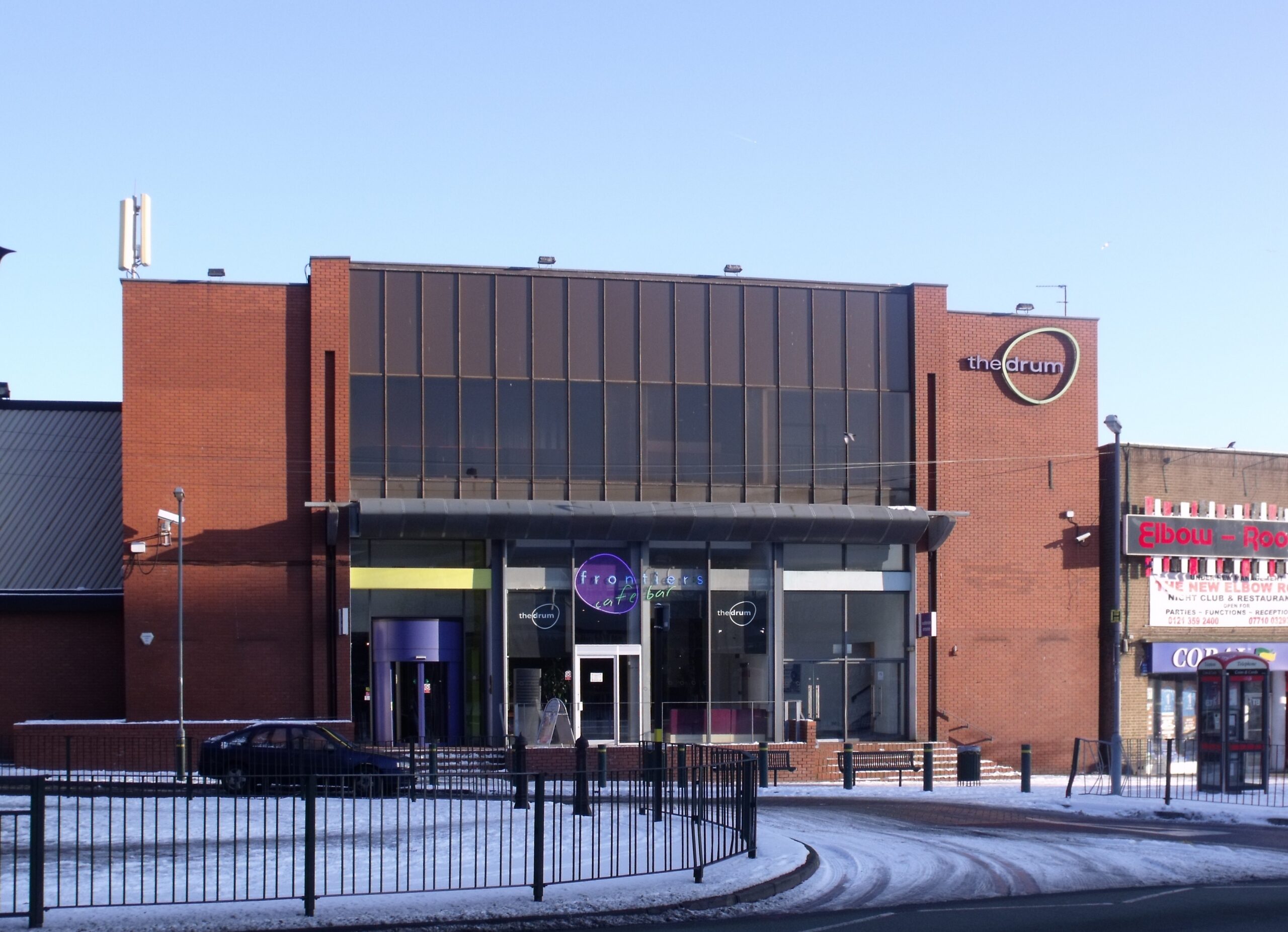
An arts centre can be measured in performances, exhibitions and tickets. The Drum in Birmingham also needs to be understood through the opportunities it created for people to take part. It brought the work of African, Caribbean and South Asian communities into a shared cultural space, with ambitions extending from local participation to national recognition. The institution that closed in 2016 left a set of questions about how Black arts are supported, remembered and renewed.1, 10
The work before the building
The Library of Birmingham’s catalogue traces the Newtown Cultural Project to 1985. It sought to support Black and Asian arts and establish a centre for Black artistic practice. Photographer Vanley Burke belonged to its steering group, alongside people including Bob Ramdhanie, Ifemu Omari and Gilroy Brown, with representatives of the city council and probation service also involved. The Drum emerged from this work in 1994, with funding from West Midlands Arts and the West Midlands Probation Service.2
These origins are significant because the project began with people identifying a need and organising around it. The same archive holds promotional and other material documenting its aims and activities between 1992 and 2004. Such records show the work involved in making an institution: persuading partners, explaining a purpose and creating a programme. The centre’s public identity grew through that process. Its history starts before the moment when visitors could arrive at a finished venue and buy a ticket.2
The centre’s Potters Lane home opened in spring 1998, following several years of development and programming.15
A place within Newtown
Davinia Gregory, who researched the Drum while it was still operating, places its development within the history of Black-led arts centres and the cultural investment associated with urban regeneration. Her study describes a project expected to provide opportunities that mainstream institutions had not adequately offered to African, Caribbean and South Asian communities. It was also expected to contribute to Newtown’s economic development. Those expectations could overlap, but they were not identical: an organisation trying to nurture artistic confidence was also being asked to help transform an area.3
The physical site carried an earlier theatrical history. BPN Architects’ account of proposed improvements locates the Drum on the site of the former Aston Hippodrome. In 2015, its plans involved raising the auditorium roof, changing the exterior and refurbishing the interior. A performance building has practical limits, including the size and flexibility of its rooms. The plans show an organisation trying to adapt its facilities to the work it wanted to present and the audiences it wanted to welcome.4
A broad artistic purpose
The PRS Foundation’s record of support for the Drum as a jazz promoter describes a commitment to contemporary art and culture from British African, Asian and Caribbean communities. The centre aimed to develop national and international recognition while remaining rooted in its neighbourhood. It also welcomed audiences across racial backgrounds. Those aims resist a narrow understanding of community arts as something separated from professional ambition. Locally grounded work could also seek artistic reach, skilled presentation and exchange with performers from elsewhere.1
The people shaping the programme brought their own histories of cultural and political organising. Former artistic director Mukhtar Dar, in the South Asian Britain oral-history project, recalls the importance of building relationships between Asian and African-Caribbean activists. He describes how reggae and the political use of the word Black helped people recognise common ground. Those recollections concern his earlier organising, rather than a claim that every Drum participant understood identity in the same way. They help explain a tradition in which music, anti-racism and practical solidarity could inform cultural work.5
Young people making work
Young Gifted Brum offered weekly creative workshops for children and young people. A June 2013 British Theatre Guide report described drama, dance and music activity at an open day and plans to develop the programme into a company creating new work. The same day’s schedule included Shivam Theatre performing Kiran Purohit’s Lottery Lottery in Gujarati, and in English and Gujarati. Within one programme, youth participation and professional theatre appeared together, making the centre a place for learning and performance across different languages and experiences.6
That relationship was also central to Benjamin Zephaniah’s support. When he and Courtney Pine became patrons in 2014, the Drum’s announcement connected their involvement with the Raising the Roof campaign. Zephaniah emphasised the value of a place where young people could explore their talents; Pine supported the ambition for a more flexible auditorium. Their public backing directed attention towards the equipment, rehearsal opportunities and suitable spaces that creative development requires. A young person’s first experience of making a performance depends on these practical conditions as much as on encouragement.7
Beyond the auditorium
The Drum’s influence extended into Handsworth Park through Simmer Down. Producer Clare Edwards described working with the centre and the Perry Barr Arts Forum to develop the event, with the Drum providing artistic direction. Her account of the 2013 festival records performances by Birmingham’s XOVA and Jamaican singer Half Pint alongside workshops, craft stalls, food and children’s activities. The festival brought several forms of participation into a public space: watching a headline artist, joining an activity or spending a day with family.8
Edwards estimated attendance at that year’s event at at least 10,000. The figure belongs to the producer’s account rather than an independently audited count, but the programme itself demonstrates the scale of the ambition. Reggae connected the event to Birmingham’s Caribbean cultural life while the accompanying activities created different points of entry. The Drum could contribute to a city’s public culture through partnerships beyond its own address, bringing its organising experience and artistic relationships into a much larger outdoor setting.8
Visibility and public recognition
In October 2013, Prime Minister David Cameron visited the Drum with Baroness Warsi. The Birmingham Press reported that chief executive Charles Small showed him the Birmingham Strong photography exhibition and introduced artists, staff and members of the African-Caribbean business and cultural community. The visit recognised the centre as a place where public discussion about the city could happen. Cultural institutions can provide a meeting point between residents, artists and political authority, even though a prominent visit alone says little about their longer-term security. Among those Cameron met were actress Tisha Whyke, a participant in Young Gifted Brum, musician Naomi Cunningham and percussionist Mohinder Singh. A roundtable brought in people from business, education, faith and cultural organisations. The centre could therefore make room for a young performer and established community representatives within the same public occasion, showing different aspects of the work taking place around it.9
The ambition to improve the building was substantial. The Raising the Roof announcement described a proposed £4.8 million programme of redesign and refurbishment, including increased auditorium capacity and improved facilities for digital arts, dance and drama. It should be read as a plan, not as a completed transformation. The campaign makes clear that the centre was seeking a future with expanded provision. Its closure two years later therefore interrupted active plans for development, as well as an existing programme.7
Closure and the question of support
The Drum closed on 30 June 2016 following the liquidation of Newtown Cultural Projects Ltd. Birmingham City Council subsequently worked with Arts Council England and local partners on cultural provision in Aston and Newtown. In 2017, the council announced a combined £500,000 programme, funded equally by the council and Arts Council England. Grants included support for ACE Dance and Music, an oral-history programme involving Black Arts Forum, and recording and media opportunities through 7E Youth Academy.10
These projects supported activity after the closure, but their existence should not be confused with the survival of the Drum itself. Gregory’s research examines the relationship between policy commitments to diversity and the pressures experienced by a Black-led organisation in practice. Her work asks how funding systems, institutional expectations and local needs interact. The closure was therefore more than a change to a listings page: it affected an organisation through which people had built working relationships and a place in the city’s artistic life.3
Saving the record
As closure approached, staff worked with the Library of Birmingham to preserve the Drum’s material. Gregory describes boxing and labelling more than 200 boxes of records and ephemera, which the library agreed to house. The rescue preserved evidence that might otherwise have been dispersed as a busy institution shut down. Posters and programmes record public events; organisational papers can reveal how those events were made possible. Both are needed to understand the labour behind the performances.11
Gregory’s project changed with the institution’s circumstances. Initially concerned with connecting audiences to its history while it operated, it became a study of closure, preservation and legacy. That shift is a reminder that archives do not appear automatically. Someone has to recognise the value of material, find somewhere for it to go and organise its transfer. The Drum’s surviving record owes much to people who undertook that work while confronting the loss of the institution they were documenting.11
Another chapter at the same address
In September 2019, the building welcomed the Legacy Centre of Excellence, a new social enterprise with a programme linking arts, business and community opportunity. Contemporary reporting identified Keith Smith, Selina Brown, Paul Knight, Augusta Ukandu and Kristina Hall among those driving the project. The reopening gave the address a renewed public role, while introducing new management and a different organisational structure. It is important to recognise that work on its own terms and to distinguish the Legacy Centre from the Drum that preceded it.12
The Newtown Cultural Strategy published by the Legacy Centre places its work within a wider neighbourhood plan. It proposes a community arts board, a programme of festivals and connections between cultural provision and redevelopment, identifying the centre and the nearby Bartons Arms among the area’s existing assets. These are stated ambitions, whose significance lies in how they position local creativity within decisions about the future of the neighbourhood. The questions that surrounded the Drum’s development continue to matter to those planning what comes next.14
The Legacy Centre’s current website describes business support alongside artistic programmes and spaces for performance and gathering. That combination continues a discussion visible throughout the site’s history: how can a building provide opportunities for people to create, learn and earn a living? Remembering the Drum adds depth to that question. Its history records sustained artistic work, local organising and the consequences of institutional loss. The building’s later life can be understood more fully when the achievements and difficulties of that earlier chapter remain part of the story.13
Sources and further reading
1. PRS Foundation: The Drum Arts Centre: Jazz Promoter.
2. Library of Birmingham: The Drum: records in the Vanley Burke Archive, MS 2192/C/E/4/2/2.
3. Davinia Louise Gregory, University of Warwick, 2019: Learning from The Drum: towards a decolonization of the arts in the UK.
4. BPN Architects: The Drum: 2015 architectural proposals.
5. South Asian Britain: Connecting Histories: Mukhtar Dar: oral history.
6. British Theatre Guide, 15 June 2013: Free workshops as Birmingham venue opens its doors.
7. The Drum press release, reproduced by The Jazz Mann, 24 April 2014: Courtney Pine and Benjamin Zephaniah appointed patrons of The Drum Arts Centre.
8. Clare Edwards, festival producer: Simmer Down 2013.
9. The Birmingham Press, 31 October 2013: David Cameron visits the Drum.
10. Birmingham City Council: £500,000 awarded for Aston and Newtown arts projects.
11. Davinia Gregory, The Iron Room, Library of Birmingham, 17 July 2017: The Drum.
12. I Am Birmingham, 10 September 2019: New Legacy Centre for Black excellence launches in Birmingham on site of The Drum.
13. Legacy Centre of Excellence: Legacy Centre of Excellence: programmes and purpose.
14. Legacy Centre of Excellence: Newtown Cultural Strategy.
15. CaribDirect, reproducing the closure account: End of an era … The Drum is now closed, 4 July 2016.
Photograph
The Drum arts centre in Newtown, Birmingham, photographed on 8 January 2010. Photo: Elliott Brown, The Drum, Potters Lane, Newtown, Birmingham, CC BY 2.0. Rotated and perspective-adjusted by Commons contributor Anvilaquarius in 2017; no further edits made.
