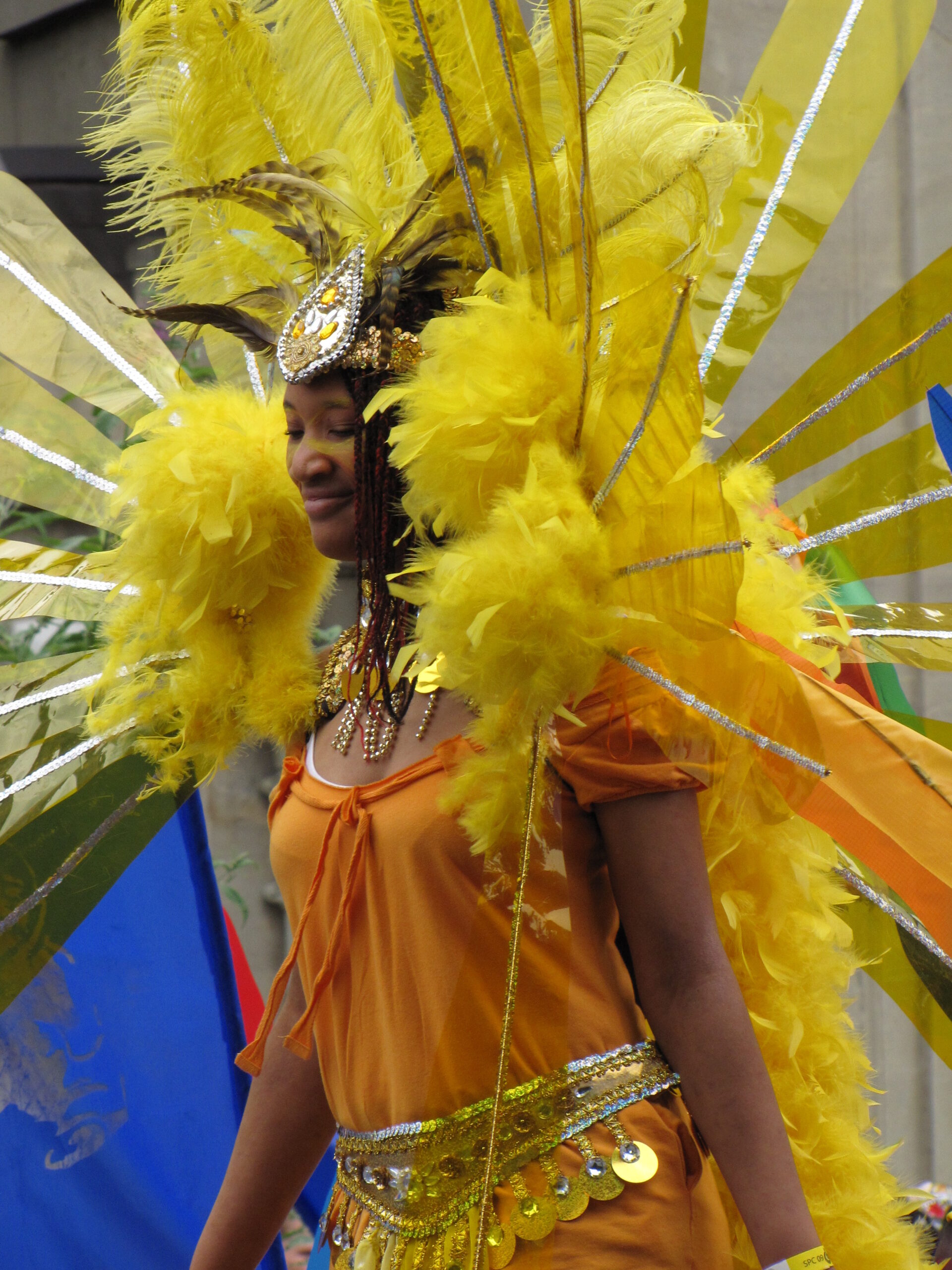
St Pauls Carnival began in 1968 with a local ambition: to bring neighbours together and share the cultures of a changing Bristol community. Its history reaches from small-scale organising to street celebrations, school workshops and international conversations. At its centre are people who made African Caribbean culture part of the city’s public life. The story belongs to those who arrange meetings, make costumes, teach children and keep community relationships alive between celebrations.1
The community behind the festival
Caribbean migrants settled in St Pauls alongside Irish and Asian communities. For residents building lives in Britain, the neighbourhood provided homes, shops and social connections. Creating a festival offered a way to invite the wider city into that world. The original name, St Pauls Festival, placed the neighbourhood itself at the centre of the occasion. Its identity as an explicitly African Caribbean carnival developed over time, through the choices of organisers, performers and participants.1
Community organisation already had a history of challenging exclusion. In 1963, the Bristol Bus Boycott confronted the Bristol Omnibus Company’s refusal to employ Black people on its bus crews. The rejection of Guy Bailey’s application helped bring the policy into public view, while youth worker Paul Stephenson became a prominent campaigner. Bristol Museums records the influence of American civil rights activism on Stephenson and the political attention the boycott attracted. The company’s employment colour bar was abandoned after months of pressure and negotiation. This struggle forms part of the background to the festival: Black Bristolians were making claims to employment, recognition and participation in the city’s life.2
How neighbours made it happen
Roy Hackett’s account makes the practical beginnings unusually clear. In an interview published by Bristol Archive Records, he recalled establishing the Commonwealth Coordinated Committee with fellow organisers in 1962. Owen Henry was central to those relationships. The committee later organised the festival, drawing on people who lived locally and worked in other occupations. Hackett remembered shopkeepers, carpenters and shoemakers contributing what they could. They collected small donations, borrowed lorries and persuaded people to give their time. Steel bands came from Bath, with the transport supported through these personal arrangements.3
Hackett described the festival as a way of thanking the community, with a role available for many different people. Preparations began months before the July celebration. His recollections bring the event down to the scale of tasks: finding a vehicle, paying a driver, arranging entertainment and directing an artist to the person who could help. They also show why voluntary associations mattered. A good idea became a public occasion because people already knew how to organise together and persuade others to contribute.3
A changing Caribbean celebration
The festival’s character was never fixed. Bristol Archives’ guide to African Caribbean collections identifies a shift towards a more Caribbean programme after Trinidadian Francis Salandy became festival organiser in 1975. By 1986, it records, the principal cultural events and stage were largely African Caribbean. By 1991 the event had become known as St Pauls Afrikan-Caribbean Carnival. These changes connected a Bristol neighbourhood celebration more explicitly with Caribbean cultural forms, while people from other backgrounds continued to participate. The chronology also helps explain why memories of the early festival can differ from accounts of the later carnival.4
The archive preserves evidence of that development in more than photographs of the day itself. Its listed material includes publicity, administrative and financial records, posters, T-shirts and children’s drawings. Such objects can tell different parts of the story. A programme records what organisers intended to present; an account records the resources available; a child’s drawing preserves a participant’s response. Together, they offer ways of studying how a celebration was made and experienced, alongside the public memories it generated.4
Music made for a shared space
Sound systems became central to the experience of Carnival. They brought the musical practices of Caribbean communities into Bristol’s streets, connecting DJs, record selections, equipment and listeners. Reporting on this heritage, Bristol24/7 described the influence of Jamaican sound systems on the city from the 1960s onwards and their continuing place at Carnival. Its account connected the event with performers including Jazzie B and Krust, as well as Jus Now, whose work linked Bristol and Trinidad. These connections show how local musical life develops through movement between places and generations. Carnival gives that exchange a public setting, where a neighbourhood can become a meeting point for different sounds and audiences.5
The people who make sound system culture possible also deserve attention. In its 2025 International Women’s Day feature, St Pauls Carnival highlighted women’s work as selectors, MCs, engineers and organisers, and shared a mix by Bristol’s Krowned Kollective. This broadens the familiar picture of a performance led by one visible figure. Selecting records and addressing a crowd are creative skills; so are the technical and organisational tasks that allow the music to be heard. Remembering those contributions gives more people a place within Carnival’s musical history.6
Family businesses and familiar faces
Food connects Carnival with family histories and working lives. In a 2021 interview, caterer Ashley Burrowes of Jerk King described a relationship stretching across three generations. His grandmother had run a stall at the first Carnival, while his father operated Jamaican restaurants on Stokes Croft and Union Street during the 1980s. Burrowes remembered looking forward to Carnival as a young person, choosing an outfit and arranging where to meet friends. He eventually built a catering business around attending carnivals. His account follows a familiar community occasion into adult working life, linking the memories of childhood with the business of preparing and selling food to the next gathering.14
Volunteer Amanda Wall described another long association in an interview that year. Her mother had worked as a social worker in St Pauls, and Wall had attended Carnival since her teens. Over time she helped run stages and bars and worked with different organisers. She particularly looked forward to delivering the Elders Brunch and praised the volunteers who made it possible. Her recollections move easily between the procession, performers and practical responsibilities. For someone involved over many years, attending, helping and organising can become connected parts of the same relationship with an event and its community.15
Remembering the people who built it
Artist Michele Curtis brought the founders into another kind of public view through The Seven Saints of St Pauls. Her portraits and accompanying biographies featured Owen Henry, Roy Hackett, Audley Evans, Clifford Drummond, Carmen Beckford, Barbara Dettering and Delores Campbell. The University of Bristol hosted the work within Artival 2018, marking Carnival’s fiftieth anniversary. Curtis also presented portraits of other community members who had contributed across those decades. This approach makes the history personal without reducing it to a single founder. The names belong together because community institutions emerge through shared effort, with different people providing leadership, practical support and continuity.7
That work of remembrance continued in Carnival’s 2023 theme, Learning from Legends. Reflecting afterwards, then executive director LaToyah McAllister-Jones described an occasion that remembered people who had died, including Hackett, honoured living contributors and considered the younger generations being raised. It was the first full Carnival since 2019, returning after the disruption of the pandemic. The theme linked the excitement of that return to the community’s history. A celebration could acknowledge loss and still make room for new participants, allowing remembrance to become part of the procession’s purpose.8
Passing on skills and stories
The education programme carries this work into classrooms. In March 2025, Carnival announced support from the Paul Hamlyn Foundation for workshops and assemblies led by artists and practitioners. Activities included costume making, drumming and dance, alongside cultural awareness and anti-racism training for teachers. The organisation reported reaching more than 7,000 pupils across twenty local schools over the preceding two years. These are useful examples of what cultural education involves in practice. Children can learn through making and performing, while teachers develop the knowledge to place those activities within a history. The relationship between Carnival and schools continues beyond preparing an appearance on one summer day.9
International exchange offers another way to learn. During the pandemic, organisers announced an online discussion bringing St Pauls together with representatives of Notting Hill Carnival and carnivals in St Lucia and Trinidad and Tobago. Its questions concerned preparation, change and opportunities for younger generations. The event’s description recognised shared practices, including costume workshops and processions, while emphasising that each carnival reflects its own host community. That distinction helps explain Bristol’s history. Caribbean connections remain essential, but St Pauls has developed through the particular relationships, streets and circumstances of the people who built it there.10
The work between street celebrations
When a full street event has not been possible, other gatherings have sustained those relationships. The Back A Yard programme in 2025 included an Elders Brunch attended by more than eighty elders, a family community event at Circomedia and performances by children involved in the schools programme. Music events took place across local venues including Lakota and Lost Horizon. The organisers’ account makes clear that these activities were a response to being unable to fund a full Carnival without debt. They maintained opportunities to meet, perform and honour older contributors, while acknowledging the disappointment of people who wanted the procession back.11
The financial question remained unresolved in 2026. On 12 May, St Pauls Carnival CIC announced that a full-scale event, including the procession, would not take place that year. The organisation cited a gap between available resources and the costs of infrastructure, staffing and public safety. It said smaller delivery models had been considered, but could not provide a viable solution. Its statement also set out continuing cultural and educational activity, including costume-making workshops and plans for training local people in event delivery. The announcement shows how closely artistic ambition is connected to practical organisation: a large public celebration depends on resources that cannot be supplied by enthusiasm alone.12
In July 2026, the CIC acknowledged the street celebrations that residents had held and described work towards a full return in 2027. That remained a plan, rather than a confirmed outcome. Its account distinguished the organisation’s responsibilities from the wider community’s ownership of Carnival, and stressed the need for cooperation among residents, artists, businesses, funders and public bodies. This continuing negotiation belongs within the history. Since 1968, St Pauls Carnival has depended on people deciding how to share culture in public and how to sustain the work required. Its future will be made through those relationships, just as its beginnings were.13
Sources and further reading
1. St Pauls Carnival: About St Pauls Carnival: Our History.
2. Bristol Museums / Bristol City Council: Boycott the buses.
3. Bristol Archive Records: An Interview with Roy Hackett – St Pauls Carnival from 1968.
4. Bristol Archives: A Guide to African-Caribbean Sources, page 30: St Paul’s Carnival Archive.
5. Bristol24/7: St Paul’s Carnival sound system heritage.
6. St Pauls Carnival: IWD 2025: Women in Sound System Culture.
7. University of Bristol: University hosts exhibition celebrating the 50-year legacy of the St Paul’s Carnival.
8. St Pauls Carnival: One Month On: Reflecting On An Incredible Carnival Day.
9. St Pauls Carnival: Carnival Receives Funding To Continue Its Carnival Education Programme.
10. St Pauls Carnival: Global carnival: a cultural evolution.
11. St Pauls Carnival: Back A Yard 2025: Thank you for your support.
12. St Pauls Carnival: A Statement from St Pauls Carnival.
13. St Pauls Carnival: Building towards Carnival 2027 and beyond.
14. St Pauls Carnival: People of St Pauls Carnival – Ashley of Jerk King.
15. St Pauls Carnival: People of St Pauls Carnival – Amanda Wall, Volunteer.
Photograph
An entrant in the mas parade at St Pauls Carnival, Bristol, on 4 July 2009. Photo: Jezhotwells, St Pauls Carnival 2009, CC BY-SA 3.0. Original Commons image version; no further edits made.
