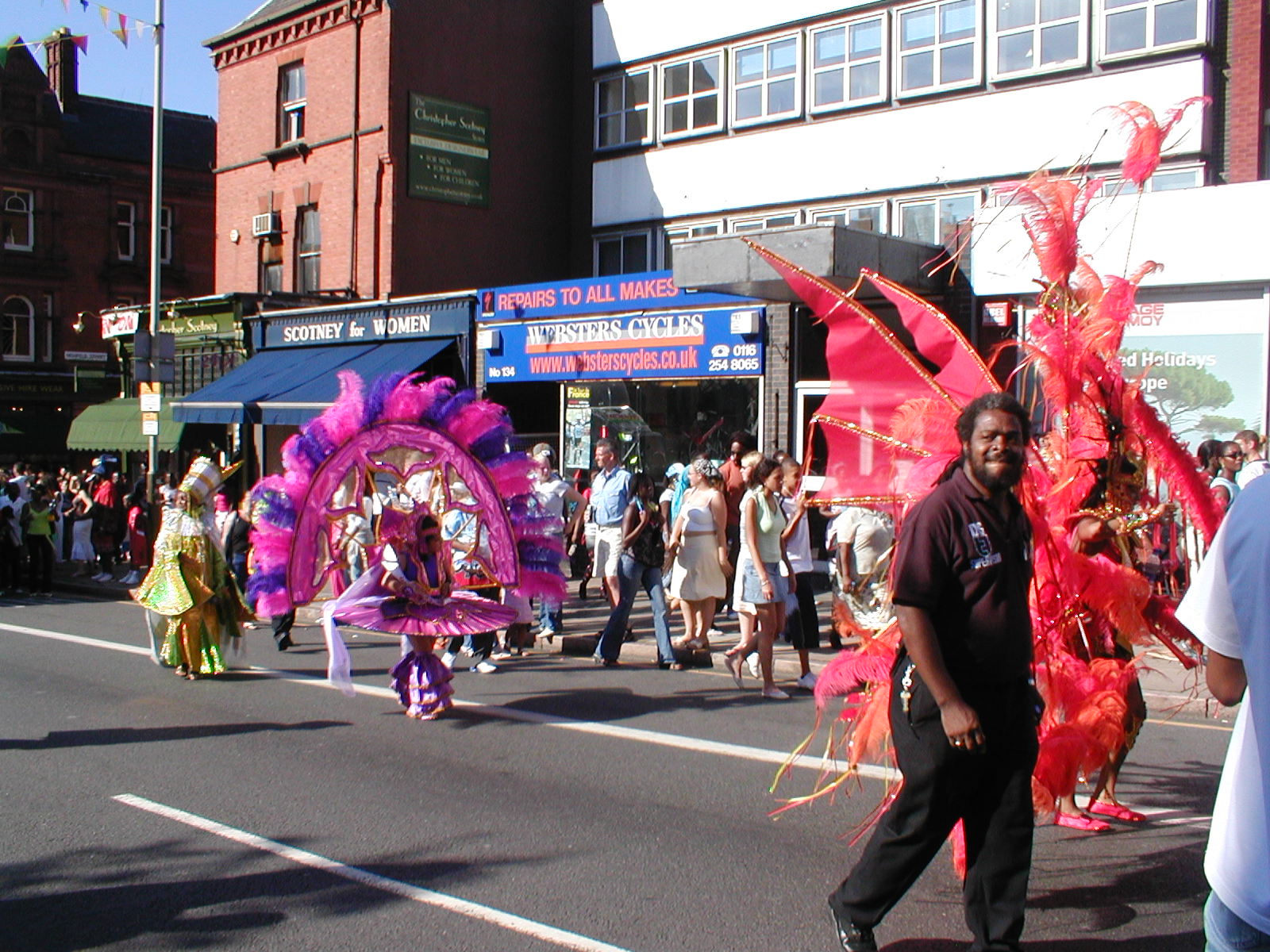
Leicester Caribbean Carnival began in August 1985 through the work of Elvy Morton and fellow Caribbean residents. They wanted to encourage togetherness, artistic expression and cultural understanding. Behind the public celebration lies the work of teaching, preparation and organisation: people making a place for their culture within the life of the city.3
From Highfields to a city celebration
The beginnings belong within the history of Leicester’s Caribbean communities. The city’s Windrush heritage project records Morton arriving in Britain from Nevis in 1958, then working with a small group of Caribbean people from Highfields to establish carnival after the racial tensions of the early 1980s. The intention was to bring people together and encourage artistic expression and cultural understanding. A community associated in public debate with conflict would help define its own public presence through a celebration open to the wider city.2
Morton’s organising drew on a broader commitment to education and representation. Leicester City Council records her move to the city in 1961, her study of catering and teaching, and her outreach work at Moat College. She also campaigned for Black children to be represented in the toys available in local shops, helping persuade Lewis’ department store to stock Black dolls. The connection with carnival is clear: both activities challenged who could expect to see their lives and identities recognised in ordinary public spaces.3
Why emancipation belongs in the story
The carnival’s August timing carries a historical purpose. Its organising committee’s account links the celebration to emancipation in the British Caribbean on 1 August 1834. For participants, the festival’s music and movement can therefore sit alongside remembrance of freedom and the people who struggled for it. Understanding that connection gives the date a meaning beyond its place in the summer calendar.1
Emancipation itself was a process. The legislation that took effect in 1834 imposed a system of compulsory apprenticeship on many formerly enslaved people, binding them to continued labour for their former enslavers. That system ended in 1838. Remembering those stages avoids treating freedom as a single uncomplicated gift. It also helps explain why carnival can accommodate historical reflection and the pleasure of gathering together without either diminishing the other.4
Learning to make a carnival
The costumes on the road emerge from research and preparation. The city’s carnival history describes groups investigating an annual theme and developing presentations around it. Themes have included The Americas and A Combination of Cultures. Workshops have helped young people explore Black cultural history and identity. Carnival offers learning in which knowledge becomes visible: an idea develops into a design, a costume and a performance before an audience.1
The work also connects Leicester with other Midlands cities. EMCCAN, the East Midlands Caribbean Carnival Arts Network, records Leicester hosting its regional Queen Competition at Highgate Community Centre in 2023. Contestants represented Leicester, Derby, Nottingham and Northampton. Such an event gives costume makers and performers a setting in which their work can be seen alongside that of neighbouring carnival communities. It also makes the regional relationship practical, bringing people and their designs into the same room.5
The brief for the 2025 regional competition at Derby Theatre shows how that art continues to develop. Designers were asked to consider the comfort and movement of the wearer, use recycled elements and reduce waste. Kings, Queens, Princes and Princesses from the four cities were included. The design challenge was therefore more than producing something impressive from a distance. A costume also had to work with a moving body, express a story and respond to questions about materials and sustainability.6
An object with a community behind it
Leicester Museums offered a particularly direct way of recognising this artistry in 2022. Its October Object of the Month was a carnival costume made, worn and donated by the Leicester group Can’t Blame Da Youth. Naming the makers and wearers placed their work within the city’s collected history. A costume that had been experienced in movement could now be examined as an object with its own design, use and history.7
Museum volunteer Nikki Lindley, who selected it, connected the object with her memories of growing up in Highfields. She recalled witnessing the disturbances of 1981 as a child and later experiencing carnival as a celebration of Black culture and her Caribbean identity. Her account includes generations following the procession, the sound of steelpans and sound systems, and food along the route. This is one person’s memory, but it shows how an annual event can become part of a lifelong relationship with a place.7
The work of keeping it going
The relationship between funding and public space was already under discussion in 2012. A council scrutiny presentation set out proposed reductions in carnival support from £100,000 in 2012–13 to £60,000 by 2014–15. It also recorded concern from Arts Council England and other stakeholders that confining carnival to Victoria Park would weaken its character. Following consultation, the proposed council support was redirected towards the city-centre procession and associated carnival arts. This was a debate about what public money should sustain: a contained festival, or a cultural event that moved through the city. The record shows how decisions about a budget could also become decisions about visibility, participation and the space available to a community’s traditions.14
Continuity has required decisions about money and the scale of the event. In 2024, organisers announced that carnival would be postponed until the following year. Their statement, reproduced by OutdoorArtsUK, identified rising event costs, financial risk and the effect of low park attendance in 2023. They also explained the difficulty of delivering a large event with a very small team. The decision reminds us that a familiar date in the city’s calendar does not make its return automatic.8
The statement thanked the council and Safety Advisory Group and appealed for support from community members and local organisations. These relationships are part of carnival’s history too. Public celebration needs planning and resources, while bad weather or disappointing attendance can affect what is possible the next year. Recognising that work gives proper weight to the people who organise the event alongside those whose performances audiences remember.8
Returning to the streets
For the fortieth-anniversary year in 2025, the council announced a returning parade beginning at Moat Community College, with speeches outside the Caribbean centre on Maidstone Road. The announced route ran through Highfields and the city centre before reaching Victoria Park. The movement between those places connected a neighbourhood strongly associated with carnival’s origins to Leicester’s wider civic space. Road closures and temporary parking arrangements were necessary to give the procession room to pass safely.9
The council’s arrangements for August 2026 again placed the main event on Victoria Park, with a procession into the city centre and back. Streets including London Road, Charles Street, Humberstone Gate and Granby Street formed part of the route. These notices are administrative documents, but they also record how carnival changes the use of the city for a day. Roads normally organised around traffic become places where costume bands and spectators can take part in a shared cultural event.10
Preserving the people behind the procession
The fortieth anniversary encouraged new work to preserve carnival’s history. Serendipity Institute for Black Arts and Heritage announced a documentary, a publication and a poem commissioned from Leicester writer Carol Leeming. Its plans centred the contributions of organisers, designers and younger generations, alongside archive material and interviews. They also recognised work that is less visible in photographs of the parade: seamstresses, choreographers, steelpan tutors, volunteers and food vendors all help make the event possible.11
A film or book can give time and space to those experiences. It allows someone to explain how a costume was made, how a troupe developed or why a particular year mattered. Preserving such accounts can help younger participants understand the labour and choices behind a tradition they have inherited. The archive grows through the people whose knowledge has often been carried in conversation, practical teaching and performance.11
History beyond carnival day
Opal22’s exhibition The Story of Carnival, created with Highcross Leicester, brought another approach to that task. It used archive photographs, historical interpretation and community storytelling to connect Caribbean carnival traditions with Leicester’s own experience. Elvy Morton’s contribution formed a central strand, alongside the organisers, performers and communities who sustained the celebration. Presenting this history in a shopping centre gave it a setting beyond the procession or a specialist heritage venue, making an encounter with carnival’s past possible during an ordinary visit to town.12
Highcross also invited people to contribute photographs, videos and written memories for a community section of its exhibition. The invitation recognised that part of the historical record remained with the public: a family photograph or an account of taking part could add something that an official programme could not. Bringing selected contributions together with costumes and archive material could make the exhibition more personal. It also gave spectators and former participants a possible role in shaping how carnival was remembered. Their experiences could appear alongside those of the recognised founders, showing the many different relationships that people had formed with the celebration over four decades.15
The accompanying summer programme also offered opportunities to try making things. A free costume workshop advertised at Highcross in July 2026 invited families and young people to create carnival-inspired crowns and masks and see costumes being made. This kind of activity makes the skills behind the spectacle easier to appreciate. Looking at a finished design is one experience; handling materials and beginning a design of your own offers another route into understanding the work.13
Music formed part of that wider programme as well. Highcross advertised sound-system evenings featuring Passion and Viking Sound, alongside Caribbean-inspired dance fitness sessions. These activities gave different routes into the same cultural season: listening, dancing, looking at historical material or making a costume. The programme connected heritage interpretation with active participation, allowing the public to encounter carnival in smaller settings before the main procession.15
A history carried forward
Morton received the City of Leicester Award in February 2026, recognising her contribution to the city. The honour brought civic attention to work that had begun through local relationships and sustained effort. The festival’s history remains a collective one: its founding vision required fellow organisers, and each new celebration depends on people choosing to participate.3
Leicester’s Windrush heritage account records Dennis “Sugar” Christopher succeeding Morton as carnival chair after her retirement. That transfer of responsibility points to a continuing task. A carnival can retain connections with the generation who established it while giving other people scope to shape what comes next. Its future depends on keeping those connections active: between organisers and audiences, between experienced makers and new participants, and between the history commemorated in August and the lives people are building in Leicester.2
Sources and further reading
1. Story of Leicester, written with Leicester Caribbean Carnival organising committee: Leicester Caribbean Carnival: origins and emancipation.
2. Story of Leicester: Leicester’s Windrush Generations.
3. Leicester City Council: City of Leicester award for local leading lights.
4. UK Parliament: The West Indian colonies and emancipation.
5. East Midlands Caribbean Carnival Arts Network: Showcase: EMCCAN past to present, 2021–2023.
6. Derby Theatre: EMCCAN Regional Costume Competition 2025.
7. Leicester Museums and Galleries / Nikki Lindley: Object of the Month: October 2022 — Caribbean Carnival Costume.
8. OutdoorArtsUK / Leicester Caribbean Carnival organisers: Leicester Caribbean Carnival: cancellation statement, 2024.
9. Leicester City Council: Rolling road closures planned for carnival parade, 29 July 2025.
10. Leicester City Council: Rolling road closures planned for carnival parade, 27 July 2026.
11. Serendipity Institute for Black Arts and Heritage / Pawlet Brookes: Leicester Caribbean Carnival at 40: Commemorating Culture, Resistance and Joy.
12. Opal22: The Story of Carnival.
13. Highcross Leicester: Costume and Creative Workshop, 19 July 2026.
14. Leicester City Council: Festivals and Events Review: outcome of the consultation, joint scrutiny meeting, 31 October 2012.
15. Highcross Leicester: Shoppers invited to be stars of Carnival Summer Exhibition at Highcross this July.
Photograph
Costumed participants at Leicester Caribbean Carnival. The photograph’s date is not recorded. Photo: Andrew Norman, Leicester Caribbean carnival, CC BY-SA 3.0. Current Commons image version; no further edits made. The 2006 upload date is not treated as the date of the photograph.
