Britain’s port communities developed through repeated journeys as well as permanent arrivals. In Liverpool, Black settlement included sailors by the eighteenth century, and later expanded through shipping routes to West Africa. Some men signed on for another voyage; others established households and raised children. The sea remained a workplace even when a British port became home. This history reaches well beyond the arrival of Caribbean passengers in the middle of the twentieth century. 6
Seafaring included different kinds of employment. The Royal Navy was an armed service. The Merchant Navy is the collective name for commercial vessels and their crews, rather than a single employer: its work has included carrying goods and passengers, operating ferries and serving aboard research ships. Merchant sailors also faced wartime danger when essential supplies had to cross contested seas. The distinction matters because military service, civilian contracts and different systems of recognition shaped what workers could expect. 1
Work, freedom and compulsion
In the eighteenth and nineteenth centuries, the Royal Navy recruited across the British Isles, Africa, the Caribbean and the Americas. Black men entered as volunteers, experienced merchant sailors, men escaping slavery and men compelled to serve. Impressment meant being taken into naval service against one’s will. Enslaved labour was also used aboard some naval vessels, particularly in North America and the Bahamas. A berth could therefore mean opportunity, coercion or a changing combination of both. 2
Jamaican-born John Simmonds illustrates one route through this world. Pressed into the navy in 1803, he served aboard HMS Conqueror at Trafalgar and later became a quartermaster. Illness eventually brought him into Greenwich Hospital. His movement between ships, naval rank and retirement shows why a sailor’s career cannot be understood simply from the place where he was born. 2
A place after service
Greenwich Hospital provided accommodation for Royal Navy personnel whose age, illness or injuries prevented continued service. Others received cash pensions while living outside its walls. Eligibility was not confined to people born in Britain: non-British seamen with qualifying service could apply from 1707. Black pensioners came from Africa, the Caribbean, the Americas and Britain, bringing backgrounds that included merchant shipping, skilled trades and enslavement. Some lived locally and formed families with white British women. The hospital made seafaring visible in an established London institution, while pensions helped sustain lives beyond the ship. Admission was an important form of material support after years spent in hazardous employment. The first pensioners arrived in 1705; by 1759, a Black seaman named Briton Hammon was among those accommodated. 3
Counting those pensioners is difficult because the records generally classified men by nationality or birthplace, rather than race. Research at the Old Royal Naval College has identified at least 45 Black men admitted between 1824 and 1841. Their places of origin ranged across the Atlantic world. Photographs and popular images add another kind of evidence. An 1854 group photograph includes a Black veteran whose name remains uncertain, despite an earlier identification. Such gaps are part of the history: a person could belong to a major public institution, receive a pension and appear in its photographs without leaving a securely identified portrait for later generations. An 1848 illustration of a cricket match between disabled pensioners also places a Black player at the crease, recording participation in the institution’s recreational life. 4
The changing labour of the ship
The transition from sail to steam altered the work available. Historian Ray Costello describes Black sailors performing skilled deck duties in the age of sail, including working high in the rigging. Steamships required fewer workers with those skills and expanded employment below decks. Racial assumptions helped direct African and other non-white workers towards cooking, stewarding and the furnace rooms. Employers treated them as better suited to heat or unsuitable for work facing passengers, shaping the jobs they were offered. 5
These were demanding conditions, especially in the stokehold and coal bunkers. Costello also identifies arrangements in which Black and white crews worked separate watches. Shipboard dependence on colleagues did not automatically remove segregation. Changes in technology, employers’ decisions and racial assumptions all affected the distribution of skill, status and physical risk. 5
Communities formed around a port
Liverpool’s links with West Africa continued after the British slave trade was abolished in 1807, through commerce in products including palm oil, timber and rubber. Kru seafarers from Liberia and Sierra Leone were among those who settled there. Later, African crews working for Elder Dempster added to the city’s existing Black population. Shipping provided repeated contact between particular places, while settlement created families whose Liverpool histories extended across generations. Maritime migration was not one uniform passage from Africa to Britain. 6
War intensified the importance of these workers. Marcus Bailey, who came from Barbados, joined the navy in 1903 and served aboard HMS Chester during the First World War. He was on the ship at the Battle of Jutland, when it sustained repeated shell hits. Afterwards, he continued working in the Merchant Navy until his death in 1927. His career crossed the boundary between naval warfare and civilian shipping. Family photographs preserved his appearance in uniform, allowing a working sailor’s history to survive alongside the records of famous ships and commanders. Wartime service was one period within a longer maritime livelihood. 7
The struggle to stay after 1918
The end of the First World War brought unemployment and a contraction in shipping. In 1919, violent attacks on Black and other minority communities in several ports damaged homes and threatened established households. Officials promoted the departure of colonial workers through repatriation schemes. Many refused because Britain was their home. For families, the choice could involve separation as well as the loss of work. 8
In January 1921, the seaman Claudius Smart wrote from Bootle seeking help to travel to Jamaica. He described prolonged unemployment and explained that his wife’s aunt would support her until he could find work and send money. Officials were demanding a guarantee he could not afford. His letter places the consequences of postwar policy within a household budget: the ability to travel, earn and support relatives had become entangled with official permission. 8
In Hull, seafarers challenged hostile treatment and argued that their wartime contribution entitled them to fair treatment as British subjects. Community organisations attempted to provide food and shelter when employment failed. The Young Men of Islam association offered relief in 1921, but its resources could not meet every need. Applicants also turned to the local Board of Guardians, which administered poor relief. 10
Solidarity had limits. Local research records Black sailors protesting in 1925 against the hiring of men described as Arab, who were subsequently identified as coming from Aden. The episode shows divisions within a workforce often grouped together by employers and officials. Competition and claims to British status could be directed against other colonial workers as well as against discriminatory treatment. 10
The power of papers
The Special Restriction (Coloured Alien Seamen) Order of 1925 made documentary identity a further barrier. Historian Laura Tabili’s research shows how discharge papers, previously accepted as identification for Black sailors, ceased to provide the same protection. Yet many seamen had not carried passports because their working documents had ordinarily been sufficient. A new demand for proof could therefore disadvantage men already accustomed to travelling on British ships. 9
Nationality, residence and employment were not interchangeable. Documents such as passports and nationality certificates acquired new importance in decisions about landing and remaining ashore. Men from different colonies and protectorates also encountered different rules and exemptions. These distinctions made the administration of empire part of everyday maritime employment: a sailor’s experience and previous voyages did not alone determine whether officials would accept his right to stay. 9
War, recognition and continuing careers
During the Second World War, merchant crews again carried supplies through dangerous waters, including the Atlantic and Arctic convoy routes. Civilian employment exposed them to enemy attack as part of the effort to sustain Britain. Recognition remained complicated by their position outside the armed services, including disputes about remembrance and the status of lost merchant ships. 1
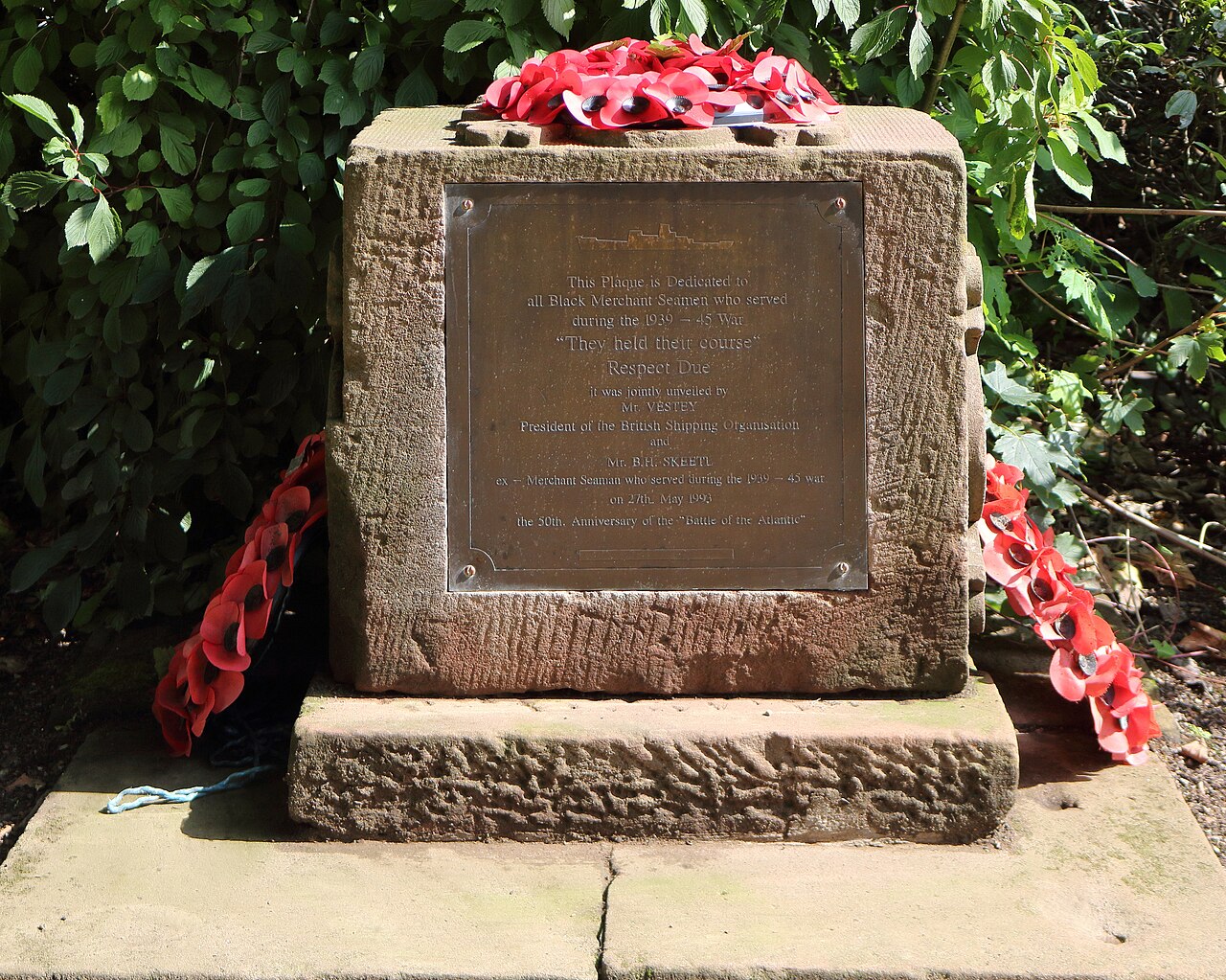
Liverpool’s memorial to Black merchant seamen makes this service explicit. Unveiled in Falkner Square in May 1993, it commemorates those who served during the Second World War. A merchant seaman from that conflict, B. H. Skeete, participated in the unveiling. The memorial was commissioned through local initiative, including Joe Farrag, whose grandfather had died when his ship was sunk in 1943. Its restoration and rededication in February 2023 extended that work of remembrance. The monument marks a relationship between wartime shipping and the neighbourhoods where seafaring families lived, keeping civilian service within the city’s account of the war. The RMT union contributed to its restoration fund in 2021, continuing a relationship between organised maritime labour and the preservation of this history. 11
Black maritime careers also developed beyond the roles most commonly associated with earlier generations. In January 2016, British captain Belinda Bennett took command of Wind Star. Windstar identified her as its first woman captain and the first Black woman captain in the commercial cruise industry. Command included responsibility for safety, maintenance, certification and the work of an international crew. In an interview published with the appointment, Bennett emphasised communication with both passengers and colleagues. Her position shows the breadth of professional maritime work: navigation and command, technical oversight and the management of people remained central to operating a passenger vessel. 12
Sources and further reading
1. What Is the Merchant Navy?. Royal Museums Greenwich.
2. Black Sailors in the British Navy. Old Royal Naval College.
3. Black Greenwich Pensioners. Old Royal Naval College.
4. Life in Greenwich Hospital. Old Royal Naval College.
5. Black Seafarers: Interview with Ray Costello. Liverpool University Press.
6. Liverpool’s Black Community Trail. National Museums Liverpool.
7. Black Poppies and the Great War. Royal Museums Greenwich.
8. 1919 Race Riots: Documents. The National Archives.
9. Racial Difference and the 1925 Seamen Order. Journal of British Studies.
10. Hull’s Sailors. African Stories in Hull and East Yorkshire.
11. Black Merchant Seamen Memorial. Imperial War Museums.
12. Captain Belinda Bennett’s Appointment. Windstar Cruises.
Featured image. The Black Merchant Seamen memorial in Falkner Square Gardens, Liverpool, photographed on 17 August 2019. By Phil Nash from Wikimedia Commons CC BY-SA 4.0; photograph dated 17 August 2019. Image record · CC BY-SA 4.0
