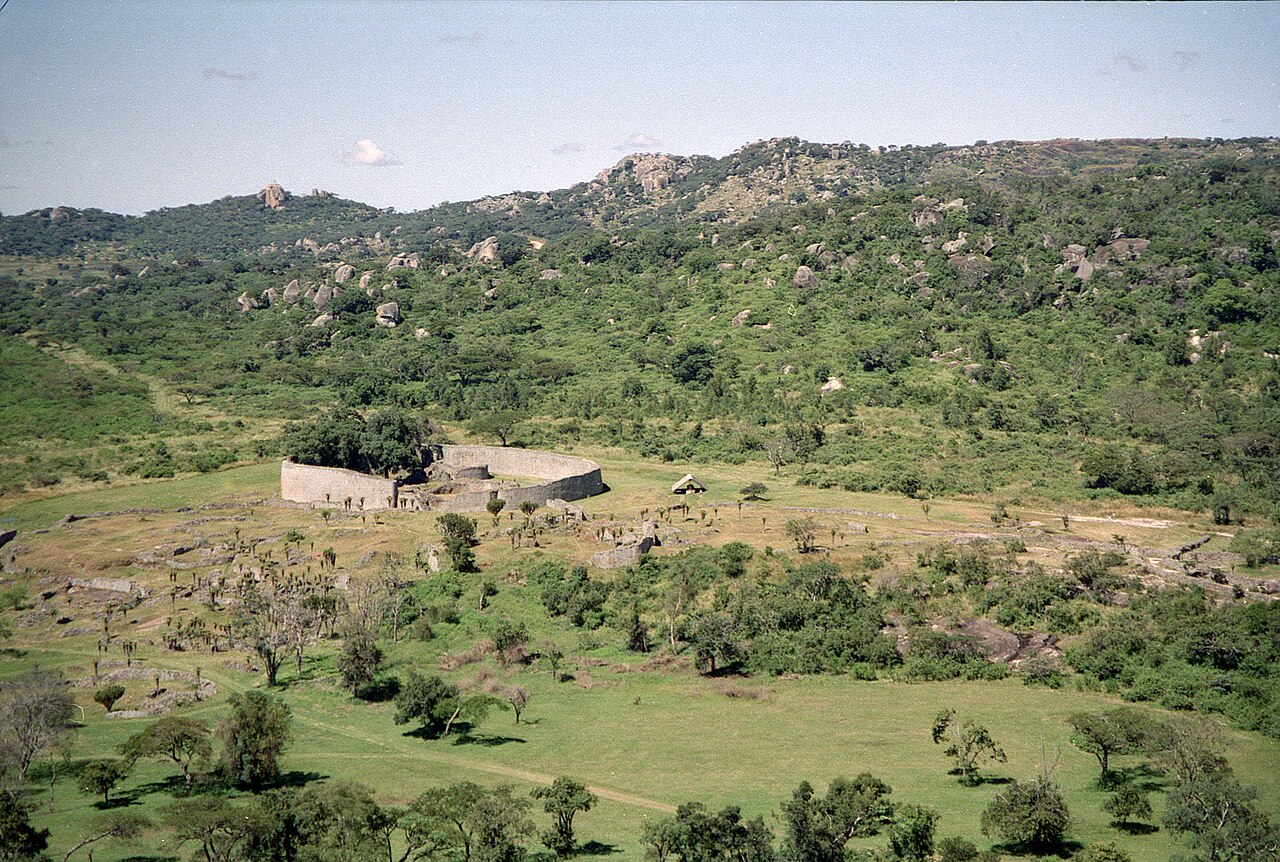
Near Masvingo in present-day Zimbabwe, monumental stone walls mark the centre of a city built by ancestors of Shona-speaking communities. Great Zimbabwe comprised a hilltop complex, the Great Enclosure and settlements across the valley. These were parts of an inhabited landscape with homes, work and religious life.1
A city that changed over centuries
The city developed early in the second millennium CE, and its major complexes took shape over several centuries. The hilltop contains the earliest remains, but its buildings, the Great Enclosure and the valley settlements did not belong to three neatly separated populations. People added walls, rebuilt earthen houses and continued using older spaces while new areas developed. Radiocarbon dates, pottery and imported objects place some activity into the sixteenth and possibly seventeenth centuries. The city’s history therefore extends beyond the mid-fifteenth-century date often used for the end of its political prominence. Archaeological layers damaged by early excavation make some sequences difficult to reconstruct precisely.4
Great Zimbabwe also belonged to a region with several developing centres of power. At Mapela Hill, in south-western Zimbabwe, excavations have uncovered stone terraces, substantial earthen floors, grain-storage structures and imported beads in deposits extending back into the eleventh century. These discoveries complicate an older account in which political complexity passed along a single line from Mapungubwe to Great Zimbabwe. Hilltop settlement, stone building and distinctions between elite and other residential spaces developed at different places. The cities shared architectural and material traditions, but their histories overlapped. Regional political change involved several communities and centres, rather than one settlement simply inheriting everything from its predecessor.5
Stone walls and the spaces within
The surviving walls were built from granite blocks laid without mortar. Their height and careful curves are striking, but stone formed only part of the architecture. Within the enclosures stood buildings made from earth, with floors, walls and other domestic features. The Great Enclosure combines an outer wall with internal divisions, courts and a narrow passage beside its conical tower. The hilltop builders also incorporated natural rock formations into their structures. Movement through these spaces could be channelled through entrances and passages. Their changing arrangements, and the loss of much earthen fabric, leave uncertainty about the precise activities associated with individual rooms and courts.2
Eight carved soapstone birds are among the city’s most distinctive objects. Six came from the eastern part of the Hill Complex, with others found elsewhere at the site. The birds stood on columns and combine avian shapes with features resembling human lips or feet. Their placement and unusual forms have encouraged interpretations involving royal authority and religious practice, although their exact meanings remain debated. They belonged to a wider tradition of working soapstone: excavators also recovered decorated bowls, pendants and other carvings. Bowls bearing animal designs show that sculptors worked with varied subjects and forms. The birds’ prominence in later national symbolism can easily overshadow this broader range of artistic production within the medieval city.3
Food, households and authority
Agriculture and animal husbandry sustained the settlement. Charred sorghum, grinding stones and storage remains belong to the practical work of producing and keeping food. Cattle, sheep and goats were part of its economy. Ceramic spindle whorls, used when spinning thread, also point towards textile production, even where the cloth itself has disappeared. Household work encompassed several activities, with farming and craft production potentially fitted around seasonal demands.6
This varied production matters for understanding political authority. Archaeologist Shadreck Chirikure argues that rulers’ claims over land, reinforced through ancestry and religious authority, could enable them to receive a share of what people produced. Such power did not require a ruler to supervise every workshop. Households retained important productive roles, while the relationships through which labour and goods reached political centres could take several forms.6
Cattle teeth reveal some of the distances involved in supplying the city. In her study of 27 teeth from archaeological contexts dated between about 1300 and 1600, Michelle House analysed chemical signatures associated with diet and place of origin. Most sampled animals had spent their early lives roughly 40–120 kilometres south of Great Zimbabwe; others had been raised closer to the settlement. Some showed evidence of movement between grazing areas. Their food was mainly grass, with smaller contributions from other vegetation. These animals therefore belonged to a supply network extending well beyond the city’s walls. The teeth preserve traces of herding decisions and movements that are otherwise difficult to see among monumental buildings, adding a regional scale to the history of everyday provisioning.7
Collecting and keeping water
Water provision depended on the surrounding landscape as well as on buildings. Depressions known as dhaka pits originated in the extraction of clay used for construction. Research combining detailed mapping with the study of sediments suggests that some were subsequently used to collect and store water. Their positions allowed them to receive runoff, while groundwater could also contribute to their supply.8
Dark, waterlogged deposits within the pits help distinguish them from simple dry hollows left by quarrying. Alongside springs and wells, they offered ways of managing a resource whose availability varied through the year. The construction dates of individual pits remain uncertain, and their use could change over time. Their importance lies partly in this adaptation: excavations for one essential material could become facilities for another.8
Making metals and exchanging goods
Metalworking left debris across different parts of Great Zimbabwe. Slag, fragments of furnaces, partially reduced ore and clay air nozzles record smelting, the extraction of metal from ore using heat. Other remains belong to smithing, when metal was reheated and shaped. Craftspeople worked iron and copper-based metals into useful and decorative objects. Surviving techniques included making wire and attaching thin metal sheets to wooden objects with small tacks.9
These processes were carried out within inhabited areas. Finds from different settlement components place production close to domestic activity, rather than locating all manufacture in one separate industrial quarter. The distribution of tools, ornaments and manufacturing waste suggests a city with several places of skilled work. Its metal economy included both the making of objects and their use within households.9
Goldworking required its own choices of materials and equipment. Scientific examination has identified gold residues in purpose-made crucibles and in ordinary pottery reused for heating metal. Craftspeople selected clays capable of tolerating high temperatures, probably obtained locally. Differences in the composition of surviving gold droplets suggest that more than one source of naturally occurring gold supplied the workshops. The evidence also places processing within the city’s own productive economy: gold arrived as material to be worked, not only as a finished luxury. Some became ornaments used locally or within the region, while some entered longer trading routes. Exports formed one part of this activity, alongside the skills, demands and social uses that gave gold value nearer its sources.10
Imported glass beads, Chinese and Persian ceramics, and coins from Kilwa place Great Zimbabwe within wider exchange networks. Such objects could pass through several intermediaries, linking an inland city with trading communities on the eastern African coast and across the Indian Ocean.2
Wood and the working landscape
Buildings, household fires and metal production also required wood. Researchers have identified species in archaeological charcoal by examining microscopic features and comparing them with modern reference samples. The results include durable timbers such as mopane and Spirostachys africana, interpreted as wood transported from beyond the immediate surroundings. Choices about strength, burning qualities and availability shaped what people collected. Charcoal preserves evidence of those choices rather than a complete inventory of an ancient forest: some woods burn or fragment differently, and different activities leave different deposits. This makes the city’s fuel and timber history more complex than a simple image of inhabitants consuming every nearby tree until the settlement became impossible to sustain.11
Changing centres of power
Great Zimbabwe’s declining political prominence formed part of a wider reorganisation of southern African states. Khami, near present-day Bulawayo, became a capital of the Torwa dynasty during the fifteenth to seventeenth centuries. Its builders used terraced stone platforms supporting earthen houses, and decorated walls with carefully arranged patterns. The resulting architecture had a character of its own, despite sharing materials and techniques with earlier centres. Imported ceramics from China and Europe demonstrate that regional exchange continued under these later political arrangements. The movement of authority towards other cities therefore did not end stone building, urban life or the long-distance relationships in which communities of the Zimbabwe plateau participated.13
Excavation and colonial claims
Under colonial rule, interpretations of Great Zimbabwe became entangled with claims to African land. Investigators supported by Cecil Rhodes sought an external origin for its builders, rejecting African authorship. Later archaeological work by David Randall-MacIver and Gertrude Caton-Thompson demonstrated its local origins through the material evidence. Yet excavation and preservation also caused losses. Early clearances treated earthen remains and occupation deposits as material to remove in order to expose impressive walls. Floors, houses and the relationships between objects and their surroundings were damaged or destroyed. This favoured the monumental stonework over evidence of ordinary life, leaving later archaeologists to reconstruct the settlement from an uneven record. The history of investigation has consequently shaped which parts of the city remain easiest to recognise today.12
Great Zimbabwe subsequently supplied the name of the country, while the carved bird became a national emblem. Inscribed on the World Heritage List in 1986, the site also retains spiritual significance for communities associated with the landscape.1
Sources and further reading
1. Great Zimbabwe World Heritage Site — National Museums and Monuments of Zimbabwe / UNOPS / UNESCO.
2. Great Zimbabwe National Monument — UNESCO World Heritage Centre.
3. Great Zimbabwe — The Metropolitan Museum of Art.
4. A Bayesian chronology for Great Zimbabwe: re-threading the sequence of a vandalised monument — Antiquity.
5. Zimbabwe Culture before Mapungubwe: New Evidence from Mapela Hill, South-Western Zimbabwe — PLOS ONE.
6. New Perspectives on the Political Economy of Great Zimbabwe — Journal of Archaeological Research.
7. Straight from the Cow’s Mouth — University of Cape Town.
8. Climate-smart harvesting and storing of water: The legacy of dhaka pits at Great Zimbabwe — Anthropocene.
9. The Production, Distribution and Consumption of Metals and Alloys at Great Zimbabwe — Archaeometry.
10. Archaeological science, globalisation, and local agency: gold in Great Zimbabwe — Archaeological and Anthropological Sciences.
11. A Study of Archaeological Charcoal from Great Zimbabwe — South African Archaeological Bulletin.
12. The Preservation of Great Zimbabwe: Your Monument Our Shrine — ICCROM.
13. Khami Ruins National Monument — UNESCO World Heritage Centre.
Featured image. The Great Enclosure at Great Zimbabwe, photographed in 1997. Photograph: Jan Derk, 1997, via Wikimedia Commons; released into the public domain by the photographer. Image record · Public domain
