Winifred Atwell could make the choice of piano part of a performance. Alongside a Steinway concert grand stood an upright she called her “other piano”. Its deliberately uneven tuning helped produce the honky-tonk sound associated with her popular recordings. The two instruments accommodated different kinds of music within one pianist’s career.1
A musician across familiar boundaries
Born in Tunapuna, Trinidad, Atwell became known in Britain for playing that moved between classical repertoire and the driving rhythms of ragtime and boogie-woogie. Music historian George McKay places that mixture at the centre of her achievement: a Black migrant woman reached a large audience through music that crossed the boundaries between concert performance, jazz-derived styles and commercial entertainment.2
In London she studied with Harold Craxton, a professor at the Royal Academy of Music. The technical demands of her work did not disappear when she played a familiar tune. A clear melody, strongly marked rhythm and assured handling of the keyboard were part of the performance that listeners came to recognise.1
A number one made from familiar tunes
In December 1954, Let’s Have Another Party reached the top of the UK singles chart. Official Charts identifies Atwell as the first Black artist to achieve a number one on that chart. The record remained there for five weeks and was the Christmas number one.3
It was a medley, bringing together parts of ten songs rather than presenting a single new composition. Familiar numbers including Bye Bye Blackbird and The Sheikh of Araby became material for a continuous piano performance. Recognition was part of its appeal: listeners could follow one tune giving way to another, carried by the same musician and rhythmic momentum.3
The work behind the rhythm
Drummer Colin Bailey remembered joining Atwell after an audition in 1952. In a later interview with McKay, he described recording with guitarist Ivor Mairants and other rhythm players, while live performances often placed him in the orchestra pit and Atwell on stage. His own touring equipment could be remarkably compact: a snare drum, with other pieces supplied at the venue.4
Bailey emphasised the strength of her left hand and the importance of keeping steady time. His recollections give the records a working context. Behind the named star were accompanists, rehearsed arrangements and musicians adapting to different theatres. The apparent ease of a party medley depended on that shared practical knowledge.4
A salon in Brixton
Atwell also recognised a market that many established businesses neglected. In 1956 she opened a hair salon in Brixton, drawing on training in chemistry and her knowledge of pharmaceutical work. As design historian Rose Sinclair explains, the business addressed Black women’s hair-care needs at a time when specialist services were scarce.5
The salon had an open-plan interior, a television and a coffee machine. Atwell developed hair treatments and products for darker skin, extending her business interests beyond performance. This connected the public image of a successful entertainer with a place where customers could obtain services designed for them. Her work in music supplied both a recognisable name and the resources for another enterprise.5
A career across screens and borders
Australia became another major setting for Atwell’s career after her first tour there in 1955. Footage preserved by the National Film and Sound Archive shows her playing Waltzing Matilda for workers at the Sydney Opera House construction site around 1964. The collection also holds material from her radio programme and a farewell television interview and performance in 1981.6
In Britain, her recording of Black and White Rag acquired a further life as the theme for the BBC snooker programme Pot Black. A performance could consequently remain familiar to people who had never attended one of her concerts.1
McKay’s research asks why such commercial visibility did not secure an equally prominent place in later jazz histories. Atwell’s repertoire crossed categories that accounts of music often keep apart. Her records preserve the sound of those crossings, alongside the technique and judgement of the pianist making them work.2
Sources and further reading
1. Winifred Atwell honoured with English Heritage blue plaque. Royal Academy of Music, 2025.
2. New chapter on Winnie Atwell. George McKay, 2014.
3. Let’s Have Another Party. Official Charts.
4. Colin Bailey interview. George McKay, 2011.
5. Winifred Atwell: Hair Entrepreneur. Rose Sinclair, Horniman Museum, 2022.
6. Winifred Atwell in Australia. Stephen Groenewegen, National Film and Sound Archive, 2018.
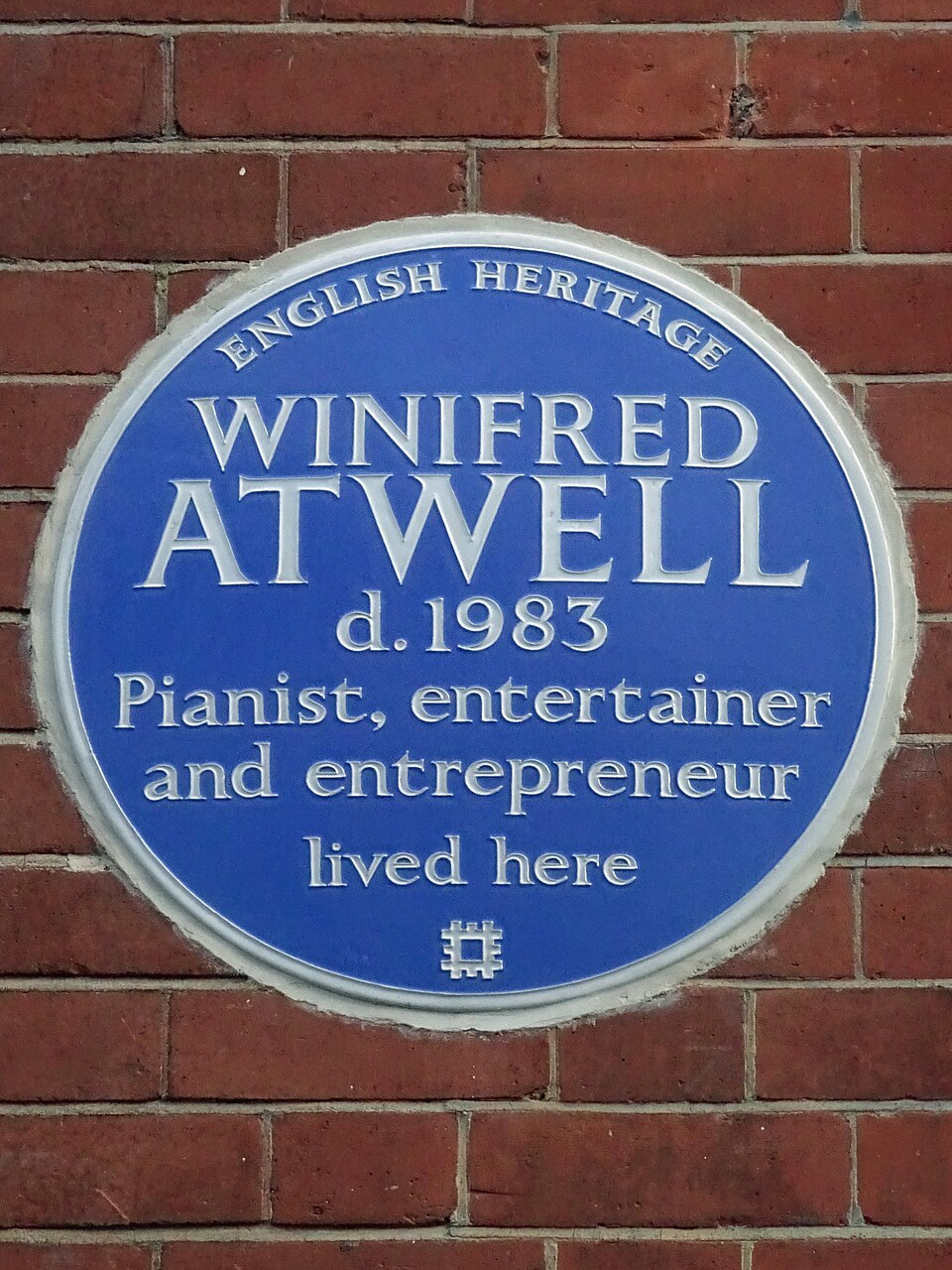
Featured image. The English Heritage plaque for Winifred Atwell at 18 Bourdon Street, Mayfair, photographed in October 2025. Photograph: Spudgun67, 11 October 2025, via Wikimedia Commons. Image record · CC0 1.0
