Tiger Bay grew through journeys that ended, paused or began again in Cardiff’s docklands. Seafarers and other workers settled in Butetown and the surrounding streets, bringing connections with Africa, the Caribbean, Asia, the Middle East and Europe. Families also came from rural Wales. Migration became part of the everyday life of the port.1
A port built around work
The docks linked the industrial valleys of south Wales with overseas markets. Iron helped drive their early growth; coal subsequently became the principal export. West Bute Dock opened in 1839, followed by further docks as trade expanded. Shipping created work aboard vessels and ashore, while the Coal Exchange in Mount Stuart Square became a meeting place for owners arranging cargoes. In 1913, Cardiff exported 10.7 million tonnes of coal. Those large movements of goods depended on repeated movements of people: crews taking ships out, returning to port and finding places to stay between voyages.2
Making a home between voyages
Butetown’s houses changed as the district developed. Wealthier residents moved towards the suburbs, Mount Stuart Square became increasingly commercial, and properties around Loudoun Square were converted into boarding houses. Seamen staying between voyages needed accommodation and services; dock workers and people employed in local shops and offices lived nearby. The distinction between a neighbourhood and a place of passage was therefore complicated. A street could contain settled families alongside lodgers whose next job would take them overseas. Local businesses depended on both, and the changing use of houses helped shape the social life around the docks.3
Community photographs give this history more precise settings. The collection presented by the Heritage and Cultural Exchange at the Senedd includes Clarence Road School in 1924–25, a cricket club in Loudoun Square Gardens in 1927 and a procession connected with pilgrimage to Mecca in 1938. These records place education, recreation and worship beside the docks’ commercial history. The neighbourhood had institutions and shared activities through which people made local lives.4
Belonging under pressure
The racist violence of June 1919 exposed the limits of security within that life. White crowds attacked Black and other minority communities in several British ports amid post-war unemployment and housing shortages. In his report of 13 June, Cardiff’s chief constable identified white people as the aggressors. He also recorded Black seamen’s argument that they were British subjects entitled to equal treatment, including men who had served the empire during the war and kept food ships moving through the submarine campaign.5
That claim to belonging was rooted in work, service and residence. The same report described hostility towards relationships between white women and Black men. Employment grievances were entangled with attempts to police family life and racial boundaries. The document records an official’s account of the crisis, including the seamen’s arguments as he understood them.5
When the streets changed
Redevelopment beginning in the late 1950s brought another kind of disruption. Housing demolition during the 1960s and 1970s broke up parts of the community and changed the streets in which relationships had developed. The National Library of Wales preserves memories of a strong sense of belonging alongside accounts of racism and hostile outside perceptions. The physical changes make those memories especially important: the places remembered by residents cannot simply be read back from the later waterfront.1
The economic setting had changed too. Cardiff’s shipping boom after the First World War proved brief, and the Depression sharply reduced coal exports. That longer industrial decline belongs alongside the later history of housing clearance and redevelopment.2
Keeping the neighbourhood in view
Local collecting has preserved much more than pictures of ships. The Tiger Bay archive includes seamen’s discharge books, ration books, school material, family albums, newsletters and recorded memories. Its collections are held at Glamorgan Archives, where volunteers have sorted, described and prepared material for online access. A discharge book traces a working life through voyages; a school record or family photograph fixes another part of that life in a particular place. Together, these different kinds of record connect the mobile world of shipping with the routines of a neighbourhood.6
The photographs selected for the Senedd displays extend into street parties and everyday leisure. Set beside images of labour and commerce, they retain the scale of individual and family life within a port often described through its wealth, its industries or its redevelopment. Tiger Bay’s history includes all of those scales, and the relationships between them.4
Sources and further reading
1. National Library of Wales: Tiger Bay migration stories.
2. Museum Wales: Cardiff – Coal and Shipping Metropolis of the World.
3. Cardiff Bay Heritage: Communities.
4. Senedd: Tiger Bay and the Docks: 1880s–1950s.
5. The National Archives: 1919 Race Riots: lesson and documents.
6. Tiger Bay and the World: Online Archive.
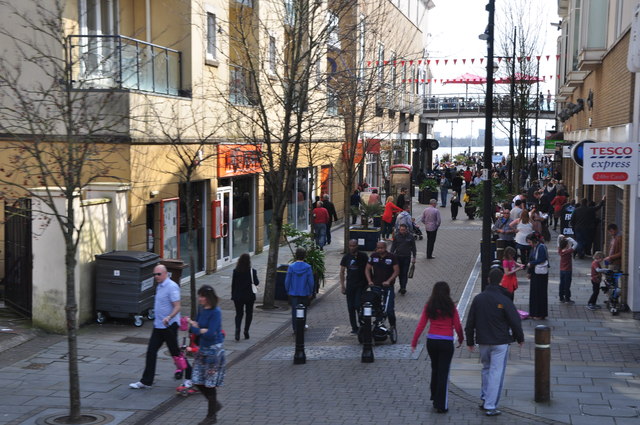
Featured image. Bute Street in Cardiff, photographed in March 2014: a modern view of the dockland area discussed in the article. Photograph: Lewis Clarke / Geograph, 30 March 2014. Image record · CC BY-SA 2.0