Caribbean history begins long before the plantation. Across the Greater Antilles and neighbouring islands, Indigenous communities cultivated food, travelled by canoe, maintained political relationships and gave material form to their understandings of the world. The peoples now commonly described as Taíno were central to that history. Their story belongs within a wider understanding of the Black Caribbean because the islands already possessed societies and knowledge before European invasion and the expansion of African enslavement. Taíno histories are Indigenous histories; the later encounters between Indigenous and African peoples make their relationship essential without making their origins identical.1
A connected and changing Caribbean
The name Taíno can suggest more unity than the evidence permits. Archaeologists use it for related cultural traditions, particularly in the centuries before 1492, rather than for a single state covering the islands. Communities in Hispaniola, Puerto Rico, Jamaica, Cuba and the Bahamas differed in settlement, material culture and political organisation. Their histories included migrations from northern South America, interaction with earlier inhabitants and adaptations within particular islands. The Caribbean also contained other Indigenous peoples. Describing this varied region as one population awaiting Columbus removes the changes that its inhabitants had already made for themselves.2
Water connected communities as well as separating them. At Salt River Bay on St Croix, the archaeological record places settlement within a wider world of farming, fishing, travel and ceremonial exchange. Dugout canoes carried people alongside cassava bread, tools, cotton cloth, beads and objects used in ritual. Pottery served practical purposes, including storing water and preparing food, while its modelled and incised designs expressed skilled choices. These journeys required accumulated knowledge of coasts, materials and provisioning. The sea was therefore part of everyday social geography, rather than an empty space between isolated islands.3
Food, work and authority
Cultivation supported these networks. Taíno farmers grew manioc, also called cassava or yuca, alongside crops including beans, peanuts and peppers. Conucos, small raised cultivation plots, were an important part of their agriculture. Fishing and gathering shellfish supplemented what grew on land, while cotton supplied fibres for cloth and exchange. Accounts of work suggest that men and women shared many agricultural tasks, although some stages of cultivation and preparation were differentiated. Producing food involved organised labour, technical knowledge and cooperation. It should not be reduced to a picture of people simply collecting an abundance supplied by nature.4
Excavations at En Bas Saline in northern Haiti bring that work into sharper focus. Researchers recovered cooking griddles, fishing weights, shell and bone tools, and stamps used to decorate cotton. Plant remains included manioc, maize, peppers, beans and fruits; fish and shellfish supplied much of the animal protein. Differences also appeared within the settlement. Its central, higher-status residents had access to larger fish and a wider variety of foods than other households. Such finds reveal nourishment, craft and inequality together, allowing ordinary material remains to complicate a history told only through celebrated ceremonial objects.5
Authority was neither uniform nor exclusively male. Spanish accounts described caciques and subordinate leaders, with distinctions between those they compared to nobles and commoners. Women could also hold leadership and accumulate wealth. On Hispaniola, larger political territories linked numerous communities, although their precise organisation remains a subject of interpretation. These societies were not egalitarian idylls: leaders organised labour and exchange, and access to resources differed. Yet translating every office into a European rank can mislead. The comparison may help explain hierarchy while concealing the particular relationships that made Indigenous authority meaningful.4
Knowledge made visible
Art belonged within those relationships. The term zemí, also written cemí, referred to sacred power associated with ancestors, deities and features of the landscape, as well as its material manifestations. Sculptures could make relationships with trees, stones and spiritual beings visible and active. Leaders, ritual specialists and artists participated in their creation and care. Pendants and other valued objects also travelled through diplomacy and exchange. Their craftsmanship expressed political and spiritual knowledge together. Treating them solely as decoration, or as evidence of a supposedly simple religion, strips away the work they performed within their communities.6
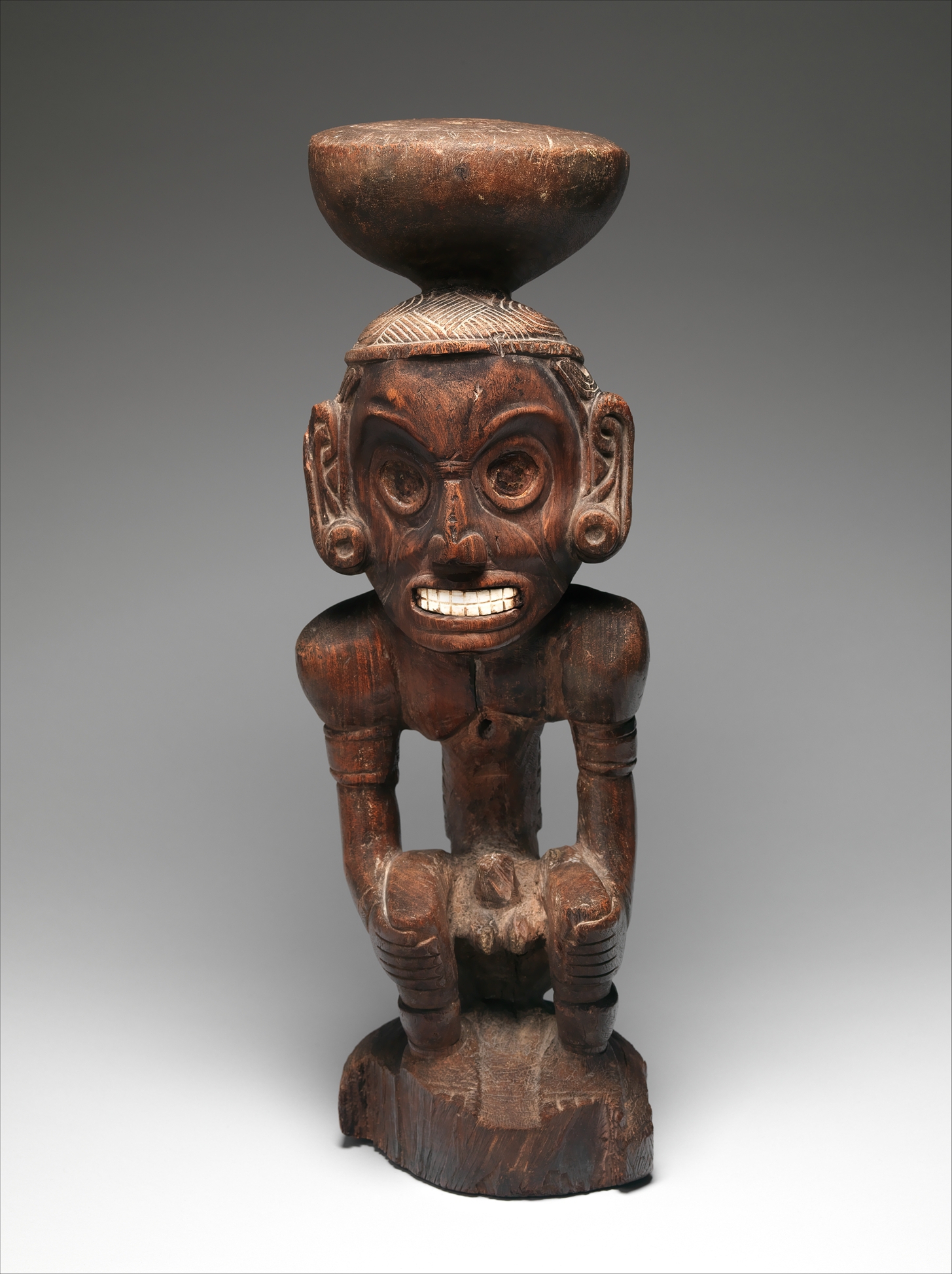
A wooden zemí cohoba stand in the Metropolitan Museum of Art provides a particularly telling example. Made from dense Guaiacum wood with shell, it depicts a crouching figure beneath a platform. Scientific dating places its creation around the year 1000. The museum interprets its thin body and streaming eyes in relation to fasting and ceremonies involving cohoba, a psychoactive plant preparation. Its survival may reflect careful protection across generations. The object is attributed, with uncertainty, to the territory of the present Dominican Republic. Preserving that question mark matters: modern museum labels cannot supply a complete original history.7
Knowledge also moved through performances that left less durable traces than stone or wood. At Salt River Bay, a stone-lined ball court points to gatherings that combined games, ceremonies, music and political life. Areytos brought movement and oral traditions into communal events. Religious specialists prepared medicines and conducted ceremonies, connecting understandings of health with the wider spiritual world. Such activities show why a history dependent only on surviving written texts is incomplete. People taught, remembered and interpreted through bodies, sound, landscapes and objects, even when their own words were not preserved in an alphabetic archive.8
Archaeology helps historians question the surviving written descriptions. A Leiden University research project at El Cabo in the eastern Dominican Republic examined settlement organisation through excavated features, alongside colonial accounts and other forms of analysis. Its starting problem was significant: established models of Taíno households depended heavily on Spanish chronicles. Bringing different kinds of evidence together can test those models. A description written during invasion may reveal something valuable, but its categories and purposes require scrutiny. The gaps in the record should remain visible, rather than being filled with confident reconstructions of domestic life.9
Invasion, coercion and survival
Spanish colonisation violently disrupted this world. In his account written in 1542 and published in 1552, Bartolomé de las Casas described warfare, killing and the exploitation of Indigenous labour across the islands. He had earlier participated in the encomienda system before turning against its abuses. His denunciation remains crucial evidence of colonial violence, but it was also an argument addressed to Spanish royal authority. Its purpose and rhetoric need consideration, especially when using its population figures. Reading the document critically does not make its central testimony to organised cruelty disappear, or reduce conquest to an unfortunate cultural misunderstanding.10
The encomienda gave colonists claims over Indigenous tribute and labour while attaching obligations of protection and religious instruction. Its operation brought coercion into farming, mining and other enterprises. Archaeologist Robyn Woodward’s study of early Spanish Jamaica follows these processes at Sevilla la Nueva, where workshops, a butchery and a sugar mill reveal Indigenous labour within the colonial economy. The mechanisms varied between islands, but their destructive effects accompanied disease, military violence and the undermining of local leadership. This was a transformation imposed upon working communities, not merely a transfer of territory between distant rulers.11
Indigenous people responded through alliances, trading, accommodation, resistance and escape. Woodward’s research stresses those choices alongside the severe limits that colonial power imposed. Cultural survival could occur within a household or workplace shaped by exploitation; cooperation in one situation did not amount to consent to conquest. Nor should changes in pottery or food be read automatically as surrendering identity. Looking for these varied responses restores human action to a period too often narrated as a sequence of European decisions. The people experiencing invasion were also interpreting it and trying to shape what followed.11
Descendants and the work of remembering
Genetic research supplies one strand of evidence against a simple disappearance story. A study published in 2018 analysed the genome of a woman who lived in the Bahamas roughly a thousand years ago. Researchers found close relationships between her ancestry and Indigenous components in the genomes of present-day Puerto Ricans, as well as affinities with northern South American peoples. This establishes elements of population continuity across colonisation. It does not mean that every Caribbean person shares the same history, or that this particular woman was a direct ancestor of everyone represented in the comparison.12
Communities had preserved knowledge of Indigenous survival before such studies existed. Smithsonian scholar José Barreiro documented traditions and oral histories in eastern Cuba, working with community figures including Panchito Ramírez and Reyna Ramírez. Their knowledge included agriculture, healing and making objects from local plant fibres. These histories concern people and relationships, rather than a catalogue of survivals detached from their keepers. Similar efforts to recover and affirm Indigenous heritage have connected island communities with Caribbean diasporas. They make family memory and living expertise part of historical enquiry, while also inviting questions about how knowledge changes as it passes between generations.13
Contemporary Taíno identity requires room for both continuity and reconstruction. Anthropologist Christina González describes histories of mixture, rupture and transformation, alongside the conscious revival of practices that colonialism damaged. Some ceremonies have been researched or adapted through relationships with other Indigenous peoples. That does not make the movement reducible to invention, any more than continuity means every tradition remained unchanged. Ancestry, community belonging, cultural practice and political identification are connected but different questions. A genetic percentage cannot answer them all, and a single modern label cannot describe every Caribbean family’s relationship with its Indigenous past.14
Food offers a visible example of inheritance crossing communities. In 2024, UNESCO recognised traditional knowledge and practices surrounding cassava bread in Cuba, the Dominican Republic, Haiti, Honduras and Venezuela. The associated practices link Indigenous and African heritage while varying in texture, flavour and preparation. The recognition concerns knowledge maintained by people, not simply an ingredient preserved from an ancient menu. Cassava bread’s continuing life demonstrates how something rooted in Indigenous experience can become shared Caribbean heritage through work, adaptation and transmission. Acknowledging that shared history should strengthen recognition of its Indigenous foundations rather than dissolve them.15
Museums and archaeological places therefore carry responsibilities beyond displaying an earlier population. Taíno communities in the Caribbean and diaspora continue to preserve and reclaim language, art, farming practices and ceremonial knowledge. Their work changes the questions asked of the past: whose account survives, who interprets an object, and whose connection to a place is recognised? Taking that work seriously allows Taíno history to extend beyond the arrival of Europeans. It also gives Caribbean history a fuller foundation, in which Indigenous peoples appear as makers of their own worlds and participants in worlds still being made.16
Sources and further reading
1. Smithsonian National Museum of the American Indian and Smithsonian Latino Center: Taíno: Native Heritage and Identity in the Caribbean — Gallery Guide.
2. Florida Museum of Natural History, University of Florida: Taíno Culture History.
3. United States National Park Service: Taino Settlement.
4. Florida Museum of Natural History, University of Florida: Taíno Society.
5. Florida Museum of Natural History, University of Florida: Material Remains — En Bas Saline.
6. The Metropolitan Museum of Art; James Doyle: Indigenous Arts of the Caribbean.
7. The Metropolitan Museum of Art: Zemí cohoba stand, Taíno artist(s), c. 1000 CE, object 1979.206.380.
8. United States National Park Service: Taino Life, Belief, and Ceremony.
9. Leiden University: Organisation of settlement space and residence rules among the Taino.
10. National Humanities Center; Franklin W. Knight and Andrew Hurley edition: Bartolomé de las Casas, A Short Account of the Destruction of the Indies (1542; published 1552), excerpts.
11. Journal of Caribbean Archaeology, volume 22 (2022); Robyn P. Woodward: Encomienda in Jamaica: Evidence for Forced Indian Labor in Jamaica 1509–1534.
12. Proceedings of the National Academy of Sciences (2018); Hannes Schroeder and colleagues; full text via PubMed Central: Origins and genetic legacies of the Caribbean Taino.
13. Smithsonian Voices, National Museum of the American Latino; José Barreiro (2018): Taíno: Valuing and Visibilizing Caribbean Indigeneity.
14. Smithsonian Voices, National Museum of the American Latino; Christina M. González (2018): The Renaissance of a Native Caribbean People: Taíno Ethnogenesis.
15. UNESCO Intangible Cultural Heritage: Traditional knowledge and practices for the making and consumption of cassava bread.
16. United States National Park Service: The Taíno Legacy Lives.
Photograph
Taíno zemí cohoba stand, c. 1000 CE, made from Guaiacum wood and shell; attributed to the present Dominican Republic (?). The Metropolitan Museum of Art, object 1979.206.380. Image: The Metropolitan Museum of Art, CC0 1.0. Photo: The Metropolitan Museum of Art; individual photographer not stated, Deity Figure (Zemí), The Metropolitan Museum of Art, DP295635, CC0 1.0 Universal. Original Commons file supplied byte for byte; no edits made. Photography date is not recorded; the 2017 upload date is not treated as the photography date.
