A community centre holds many kinds of history. Some are public: a performance, a speech or a celebration. Others belong to families and friendship groups who return to the same rooms over many years. Leeds West Indian Centre, now Leeds Caribbean and African Centre, brings these histories together in Chapeltown. Its story follows the work of people who wanted a permanent place to gather, and the changing uses they found for it.1
A place within Chapeltown
Chapeltown had already been shaped by successive communities before the centre was built. Leeds City Council’s conservation appraisal describes a nineteenth-century suburb of villas and terraces, later adapted by Jewish, African Caribbean and Asian residents. It also records a substantial Irish presence. Buildings acquired new purposes as people settled, established organisations and moved elsewhere in the city. The history of a neighbourhood is visible in these changes: an address can remain familiar while the people using it, and the activities it accommodates, change considerably.2
The search for social space had begun decades earlier. Historic England’s research traces an appeal for suitable club premises to 1951, when local newspapers described many of Leeds’ African Caribbean residents as former RAF personnel. Those seeking a club wanted to help men settle and improve understanding with other residents. This places the later building within a longer history of people who had served Britain and were making lives in the city, while organising the support that settlement required.3
The demand for a purpose-built West Indian centre grew through organised effort. A steering group brought together representatives of local organisations, as the council required. Chaired by Gertrude Paul, it appointed architects and helped shape the design. Land was eventually secured in Laycock Place, and the building emerged despite a limited budget. Historic England cautions that its exact opening year has not been established: both 1982 and 1983 appear in accounts. The early 1980s are therefore the soundest starting point for its public life.3
Gertrude Paul and the work of leadership
Paul’s involvement connected the centre with a wider history of education and community organisation. Leeds Beckett University identifies her as the city’s first Black headteacher and the centre’s founding chairperson, a position she held for seven years. She also helped establish organisations including the United Caribbean Association and Leeds International Women’s Group. These were overlapping forms of service: teaching children, representing families and creating places where communities could organise for themselves.4
Her contribution continues to enter local education. In March 2026, Leeds Beckett reported the launch of a Key Stage 2 history project created with Leeds School Library Service. Writer and illustrator Salomey Doku worked with research contributed by Paul’s daughter, Heather. The project follows Paul from St Kitts through her teaching and community work in Leeds. For children learning the city’s history, the centre provides a concrete connection between a named woman’s work and a place that still exists.4
Life inside the new building
Photographs taken in April 1983 offer a particularly valuable early record. When Historic England prepared an exhibition for the centre’s fortieth-anniversary celebrations in 2023, it highlighted images of men playing dominoes, children playfighting and a young steel band performing. Their interest lies in ordinary activity as much as in the occasion itself. Adults and children occupied the same social space, while music and conversation unfolded together. Such photographs preserve the texture of community life that a list of officers or an account of construction cannot provide.5
The anniversary programme paired the historical pictures with plans for new photographs, speeches, DJs and steel-band music. People were also invited to share memories. Returning images to the place where they were taken allowed the archive to become a starting point for conversation among those whose lives it recorded.5
Carnival finds a home
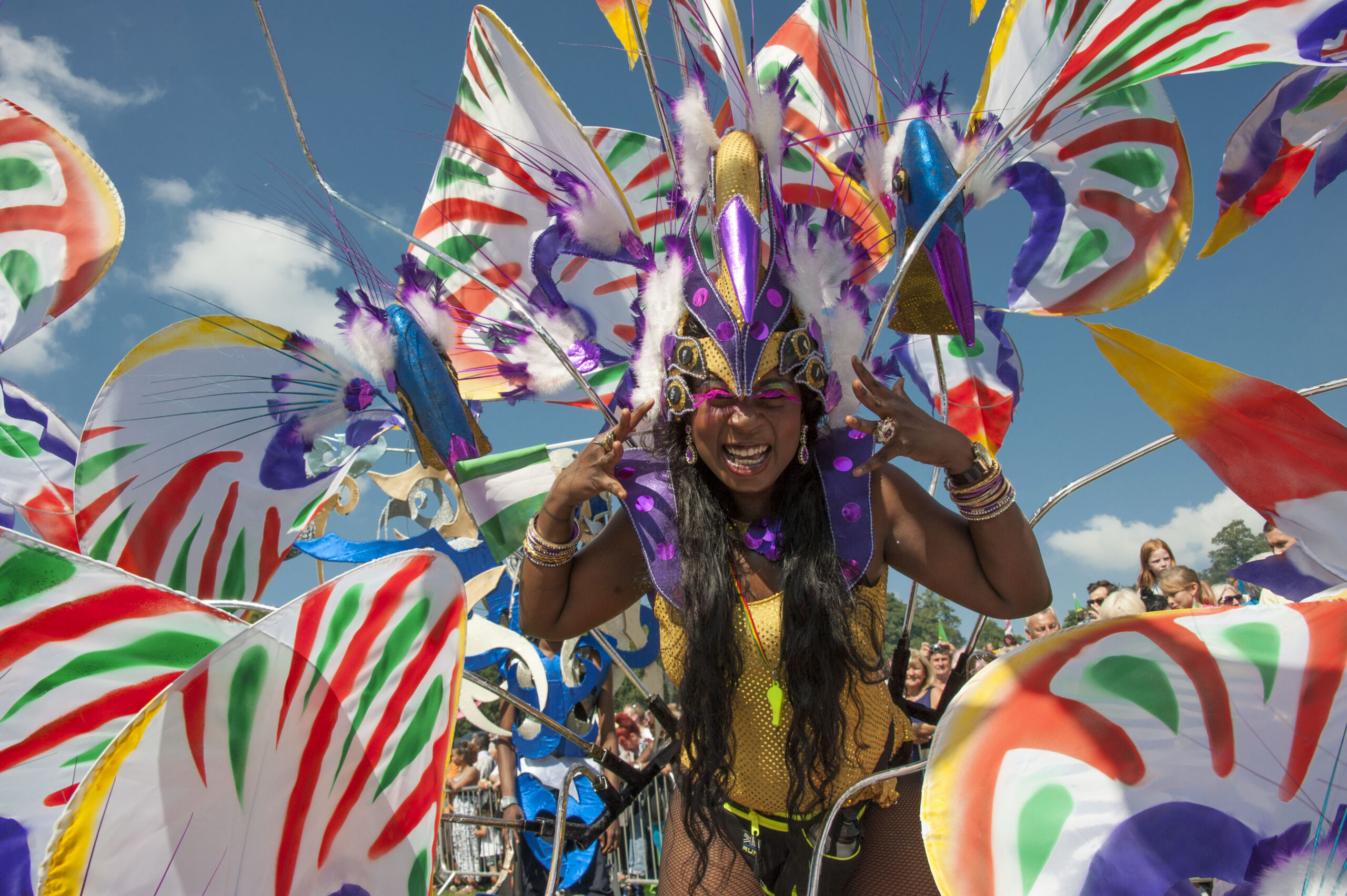
Leeds West Indian Carnival began in 1967, well before the centre opened. The two histories subsequently became closely connected. In his account of the carnival’s first fifty years, historian Max Farrar records the transfer of the Queen Show and Last Lap dance to the West Indian Centre in 1985. Tarmacking the car park made it possible to erect a marquee, extending the space available for the celebrations. The centre helped an established festival develop its programme and organise its gatherings.6
Farrar’s account of 1987 shows how much could happen around that programme. Children who had won the Prince and Princess competition appeared at the Queen Show; the New World Steel Orchestra was advertised to play later in the marquee. Dudley Nesbitt, newly arrived from Trinidad to teach steelpan and pan tuning, also performed. These details place the centre within a network of costume makers, performers, teachers and families. Carnival required rooms and rehearsal, as well as a route through the streets.6
The sound of a larger city
Sound-system culture gave the building another reach. In a 2019 interview later republished by Sound Mag, Mark Iration described how Subdub moved to the West Indian Centre after outgrowing its first venue, the Think Tank. Subdub had begun in 1998, with Iration Steppas as its resident sound system. At the centre, the larger room accommodated speaker stacks and visiting performers including Zion Train, Mad Professor and the Disciples. Its second room also created space for changing musical interests, including jungle and dubstep.7
The interviews also reveal how musical change was negotiated. Mark recalled promoter Simon Scott, whose Tribe Records shop kept him close to emerging sounds, advocating dubstep for the second room. MC Sgt Pokes remembered the excitement of bringing new music to the Iration Steppas sound system. The centre’s rooms allowed these musical interests to meet without requiring everyone to follow the same path. Familiar equipment, experienced promoters and an established audience gave newer performers a place to try something different.7
The influence travelled through listeners who became musicians themselves. Interviewed outside the centre in 2015, Gentleman’s Dub Club singer Johnny recalled first attending Subdub as a university student. He described the encounter as changing his relationship with music, before returning years later to perform there. His account illustrates a route from audience to stage. A venue sustained by a Caribbean community could become a point of discovery for people from other backgrounds, carrying its musical influence into new bands and performances.8
Care, commemoration and learning
The centre’s work also appears in records of practical support. Leeds City Council’s list of small-grant projects for 2014–15 included weekly winter soup meals and activities at the West Indian Centre for older residents in Chapeltown and Harehills. The provision included transport and staff costs, with community nurses from the Mary Seacole Nurses Association attending and making home visits. This is a useful corrective to a history told only through famous nights: food, travel and contact with other people were part of the building’s purpose.9
It also provided a setting for public remembrance. The David Oluwale Memorial Association’s annual report records a fiftieth-anniversary commemoration at the centre in 2019 involving Linton Kwesi Johnson, Emily Zobel Marshall and Akt3. The association uses the creative arts to explore racism, exclusion and social justice through Oluwale’s story. Hosting such work placed the centre within the city’s continuing discussion of whose experiences should be remembered, and how poetry and performance can help people engage with difficult history.10
Academic and community activity could meet there too. Reporting on a 2017 conference celebrating fifty years of Leeds Carnival, Emily Zobel Marshall described an evening of Caribbean food and soca at the West Indian Centre. The wider programme brought together researchers and practitioners through talks, workshops and performances. Including the centre in that programme recognised that knowledge about carnival also lives with the people who organise, perform and sustain it.11
Recording a living neighbourhood
In 2024, Historic England launched a photography residency led by Solomon Charles-Kelly, who had lived in Chapeltown all his life. Supported by the arts organisation Lens Lab Project, he was commissioned to work with the centre and other local organisations over five months. The intention was to record the neighbourhood’s African and Caribbean communities and challenge negative perceptions of the area. Selected photographs would enter the national archive.12
The choice of a local photographer gave the project a particular basis: the place being documented was also his home. This created a connection between historical preservation and present-day relationships. The project aimed to record people living their lives, rather than a portrait defined entirely by outside assumptions.12
A name for the next chapter
In an interview with East Side Story, Claude Hendrickson explained the thinking behind the 2023 change to Leeds Caribbean and African Centre. Following the pandemic, a new generation considered how the building could respond to more recently arrived African communities. He described groups from countries including Eritrea, Zimbabwe, Cameroon and Nigeria using the venue for their gatherings. The change acknowledged a practical connection across different migration histories: people needed welcoming places where they could celebrate, organise and maintain relationships.13
Hendrickson’s account also returns to family life. He recalled three of his own children being christened at the centre and described fathers and grandfathers gathering for Sunday dominoes. Such regular uses matter alongside the bigger events. They give a building a place within the week and within family memory. A new name could acknowledge changes in the neighbourhood while these familiar relationships continued to give the centre its everyday character.13
That widening purpose can also be seen in the Afrikan Market, established in November 2021 and delivered by Unity Does MAATer CIC. Its programme brings together independent traders selling food, fashion, beauty products, art and handmade goods. Visit Leeds describes a recurring market intended to support Black-owned businesses and connect generations. Holding it at the centre allows cultural activity to continue beyond carnival season, while giving small enterprises a place to meet customers directly.14
Keeping the place useful
The outdoor space has acquired new uses as well. Climate Action Leeds’s programme for May 2025 included a community-garden opening at the centre, following work by Hyde Park Source to improve the grounds. The event combined demonstrations with a wider celebration of local climate projects. A familiar community building could therefore become a meeting point for another set of concerns, linking the use of shared space with environmental action in the city.15
The centre’s own account of its future emphasises improving the building for weddings, christenings, celebrations of life, meetings and performances. Its main room has a stage, while another room can be divided for smaller activities. Maintaining those facilities is the continuing work behind the history. The achievement of the founders survives through people finding reasons to come back, bringing different needs to a place created through collective effort.16
Sources and further reading
1. Leeds Caribbean and African Centre: About Leeds Caribbean and African Centre.
2. Leeds City Council: Chapeltown Conservation Area: Historic Development.
3. Historic England: A Part of our Heritage: Memories of Chapeltown and Leeds West Indian Centre.
4. Leeds Beckett University: One woman’s lifetime, inspiring the future children of Leeds.
5. Historic England: Leeds West Indian Centre Celebrates 40th Anniversary with Historic England.
6. Max Farrar / Leeds West Indian Carnival: Celebrate! 50 Years of the Leeds West Indian Carnival.
7. Sound Mag: 21 Years of Subdub: interviews with Mark Iration and Sgt Pokes.
8. World A Reggae: Interview: Gentleman’s Dub Club.
9. Leeds City Council: Affordable Warmth Strategy, Appendix A: 2014–15 Small Grants Fund Projects.
10. David Oluwale Memorial Association: Sixth Annual Report, 2018–19.
11. Leeds Beckett University / Emily Zobel Marshall: Celebrating Caribbean Carnival Culture in Leeds.
12. Historic England: Historic England Photography Project Launches in Leeds.
13. East Side Story: Celebrating 40 years of community in Chapeltown: interview with Claude Hendrickson.
14. Visit Leeds / Unity Does MAATer CIC: Afrikan Market Leeds.
15. Climate Action Leeds: Roots of Change: A Community Climate Action Celebration.
16. Leeds Caribbean and African Centre: Home and venue information.
Photograph
A performer at Leeds West Indian Carnival, photographed on 26 August 2013. Photo: Bryan Ledgard, Leeds West Indian Carnival, CC BY 2.0. Original Commons file supplied without further editing.
