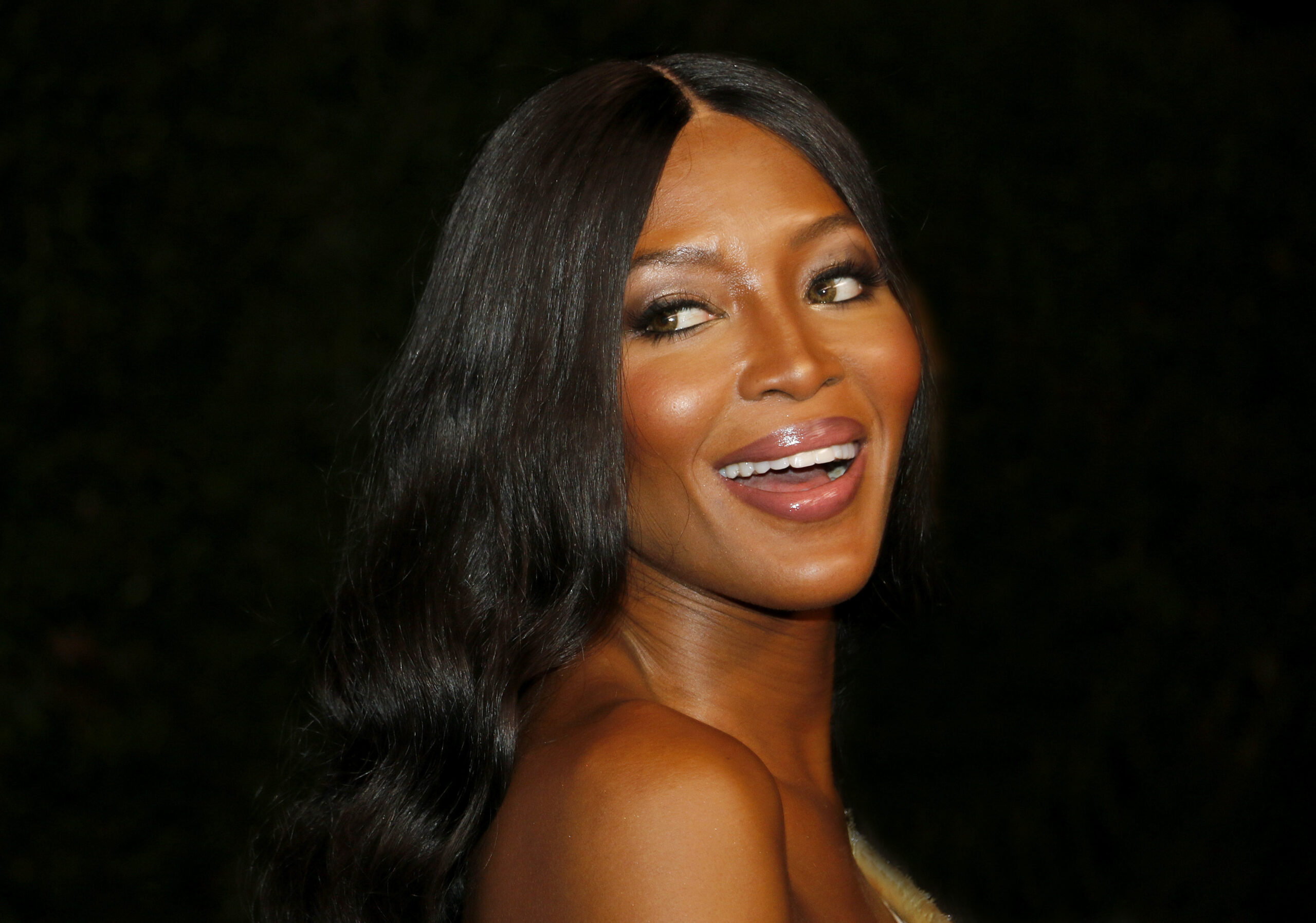
When the Victoria and Albert Museum presented NAOMI: In Fashion in 2024, clothes, photographs, runway footage and personal records brought Campbell’s career into view as a body of work. The exhibition treated modelling as a skilled contribution to fashion, tracing a life that connected early performance training with international fashion houses, major magazines and campaigns against exclusion.1
A performer before the fashion career
Born in London in 1970, Campbell studied at the performing arts school Italia Conti in the early 1980s. Her route towards modelling therefore began with an education in performance. Attention to movement, expression and an audience would remain central to her work, even when the stage became a runway and the performance lasted only a few moments.13, 14
She was fifteen when model scout Beth Boldt approached her while she was shopping for ballet slippers in Covent Garden. Boldt later recalled that Campbell accepted her invitation immediately. After joining Synchro Models, she impressed her first booker, Jonathan Phang, through her confidence at castings and early shows. His recollection moves the story beyond being discovered: Campbell had to enter unfamiliar rooms, meet clients and demonstrate what she could do, while still a schoolgirl.15
Her December 1987 cover of British Vogue, photographed by Patrick Demarchelier, marked the magazine’s first cover featuring a Black British model. Campbell was 17. The National Portrait Gallery preserves the image, in which she wears a gold Chanel tunic designed by Karl Lagerfeld. Its later place in a public collection connects a commercial commission to the history of who was permitted to represent British style and beauty.2
The women who had already changed fashion
Campbell’s achievements belonged to a history that began before her career. Donyale Luna had appeared on the cover of British Vogue in March 1966, becoming the first Black model on a Vogue cover. Beverly Johnson became the first Black woman on the cover of American Vogue in 1974. Earlier figures, including Dorothea Towles, had also worked with leading designers. Their careers developed in an industry where racist assumptions frequently restricted Black models’ opportunities or channelled them towards publications serving primarily Black readers.3
Campbell’s own Paris milestone came in August 1988, when she became the first Black model on the cover of Paris Vogue. She has credited support from Yves Saint Laurent as well as the work of predecessors. These distinctions deserve to be stated precisely: a first appearance by a Black British model, a first Black model on a particular national edition and the first Black model on any Vogue cover are different achievements. Precision gives the earlier women their place in the story.3
Her September 1989 American Vogue cover extended that visibility. In a 2016 interview, Campbell said she had only learnt later that she was the magazine’s first Black September cover model, and credited Anna Wintour’s support. By then, her career already connected British and American publishing with the Paris fashion houses.4
The supermodel as a public personality
The January 1990 cover of British Vogue brought Campbell together with Cindy Crawford, Linda Evangelista, Tatjana Patitz and Christy Turlington, photographed by Peter Lindbergh. George Michael then featured the same five models in the video for Freedom! ’90. In 1991, Gianni Versace sent Campbell, Crawford, Evangelista and Turlington down the runway together to the song. Their names and relationships were becoming part of the spectacle. Audiences were invited to recognise the women themselves, alongside the clothes they wore.5
The V&A’s selection of Campbell’s work also includes a 1989 Thierry Mugler corset whose design evoked a car, with red headlights and a metal grille. Such an outfit demands a performer who can make an unusual object convincing in motion and in a photograph. The supermodel phenomenon depended partly on this relationship between design and personality. A recognisable model could give an extravagant garment a memorable human presence, helping it travel beyond a fashion show into a much wider visual culture.5
Azzedine Alaïa and working relationships
Campbell’s relationship with Azzedine Alaïa became one of her closest professional and personal connections. She met the Tunisian-born designer during her early days in Paris and came to call him “Papa”. The V&A devoted a section of its exhibition to their work together, including a dress from his spring–summer 1990 collection. His closely fitted designs and her command of movement made their collaboration a distinctive presence in the fashion of the period.1
The foundation dates her runway debut for Alaïa to 1986, when his spring–summer collection included jersey dresses constructed from bands that closely followed the body. Arthur Elgort’s photographs record the partnership in Paris that year, in New York in 1987 and backstage in Paris in 1987. Campbell was already working internationally while her magazine career was developing. Those early collaborations also place her within Alaïa’s circle before she became part of the internationally celebrated group of supermodels.6, 16
Performance, photography and new ventures
One of Campbell’s most reproduced runway moments was a fall while wearing Vivienne Westwood’s platform shoes in 1993. The shoes survive in the V&A, where curator Elisabeth Murray has examined them as objects with a history of use. Campbell got up and continued the show. The familiar incident can be read through the physical demands of modelling: balance, difficult footwear and the need to recover in front of an audience. An image of glamour is produced by someone doing a demanding, visible job.7
TASCHEN’s Naomi, produced in collaboration with Campbell, brings together portraits and fashion photographs by Steven Meisel, Helmut Newton, Herb Ritts, Ellen von Unwerth and Nick Knight, among others. The project began as a signed collector’s edition of 1,000 copies and subsequently appeared in an updated, compact edition. Its range places her long professional career on record across editorial and advertising work. Readers encounter the photographers’ differing approaches and a performer repeatedly finding new ways to inhabit the clothes and settings chosen for her.8
Her ambitions also reached beyond modelling. She released the R&B-pop album babywoman in 1994 and appeared in the television drama Empire in 2015–16. These projects extended her work into recorded music and scripted acting, alongside her established career in fashion.13
Challenging exclusion collectively
In September 2013, Bethann Hardison launched Balance Diversity with an open letter to fashion councils in New York, London, Milan and Paris. Campbell and Iman joined the campaign, which challenged the lack of racial diversity in the industry. Addressing the councils made the issue a matter for institutions and professional practice. It was a demand for people with influence over casting and presentation to examine the choices through which exclusion kept being reproduced.9
The partnership also connected different generations of modelling experience. Hardison, Iman and Campbell could draw attention to practices that an individual newcomer might struggle to challenge. Their public standing gave the campaign visibility, while its focus remained the broader industry. The useful question was whether opportunities across shows, magazines and advertising were changing, and whether change could be sustained after attention moved elsewhere. That question extended well beyond the success of any one established model.9
For the July 2008 Black Issue of Vogue Italia, Campbell appeared alongside younger models including Liya Kebede, Sessilee Lopez and Jourdan Dunn. Steven Meisel made the photographs; the magazine’s archive credits Lori Goldstein and Edward Enninful as fashion editors. A Campbell image in the British Fashion Council’s archive also credits Enninful’s styling. The issue placed several Black women together at the centre of a major fashion title, giving visibility to established careers and newer names in the same editorial project.10, 17
In a 2020 discussion with Hardison and Iman, hosted by Alina Cho, Campbell argued for equal compensation as well as bookings. The conversation addressed the limits of tokenism and the need for lasting change. Her intervention put pay directly alongside representation: a prominent appearance could not, by itself, establish that Black models were being treated fairly. Professional inclusion also concerned the financial terms on which their work was valued.11
Public influence and accountability
Her public life has also included scrutiny of Fashion for Relief, the charity she founded. In 2024, the Charity Commission imposed a five-year trustee disqualification. On 1 October 2026, the First-tier Tribunal allowed her appeal and quashed the order. It found that the most serious financial misconduct had been committed by a co-trustee and concealed from Campbell through deception, including forged documents and a false email address. The tribunal also found that Campbell shared responsibility for failures to keep proper minutes and file accounts on time, but that the circumstances did not establish her unfitness to serve as a trustee. The appeal overturned the disqualification while leaving those governance failures on record.12
A place in the public record
Campbell received the CFDA Fashion Icon Award in 2018. Her place in cultural history is also recorded through the National Portrait Gallery’s holdings, which include work by Jamie Morgan, Patrick Demarchelier, Mario Testino and Simon Frederick. The photographs span different stages of her career, from the 1980s into the twenty-first century. Preserving them allows future viewers to study how a Black British woman was represented through changing conventions of fashion and portraiture, and how a recognisable public figure developed over time.13
The V&A exhibition closed on 6 April 2025. Its combination of clothing, photographs and film placed Campbell’s professional contribution at the centre of a history usually organised around designers.1
Sources and further reading
1. About the NAOMI: In Fashion exhibition — Victoria and Albert Museum.
2. Naomi Campbell: Patrick Demarchelier portrait, 1987 — National Portrait Gallery.
3. The groundbreaking Black models who changed fashion — Victoria and Albert Museum.
4. Naomi Campbell looks back on 30 years in the spotlight — Vogue / interview with Naomi Campbell.
5. Top 10 Naomi Campbell looks — Victoria and Albert Museum.
6. The art and photography collection: Arthur Elgort — Fondation Azzedine Alaïa.
7. Unboxing Naomi Campbell’s platform shoes — Victoria and Albert Museum.
8. Naomi: Icons edition — TASCHEN.
9. Balance Diversity — Bethann Hardison.
10. Naomi Campbell, Vogue Italia, July 2008 — British Fashion Council / Google Arts & Culture.
11. Bethann Hardison, Naomi Campbell and Iman on diversity and change — Vogue.
12. Naomi Campbell v The Charity Commission for England and Wales — First-tier Tribunal / Courts and Tribunals Judiciary.
13. Naomi Campbell: collection biography and portraits — National Portrait Gallery.
14. Naomi Campbell: performing arts alumni — Italia Conti.
15. The Naomi Factor: friends and collaborators on her early career — Vogue / interviews with Beth Boldt and Jonathan Phang.
16. Azzedine Alaïa: chronology, 1986 — Fondation Azzedine Alaïa.
17. Fab Four: the July 2008 Black Issue — Vogue Italia.