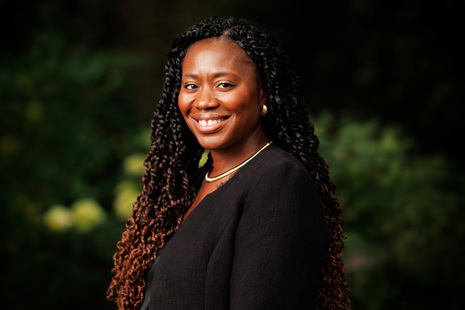
Miatta Fahnbulleh’s first two years in Parliament took her from a new constituency seat to responsibility for national energy policy. Elected as Labour and Co-operative MP for Peckham in July 2024, she became Secretary of State for Energy Security and Net Zero on 20 July 2026, after two junior ministerial roles. Her maiden speech had already set out a concern with household hardship and unequal opportunity. Government now places a demanding question at the centre of her political career: how can a programme for a fairer economy become changes people experience in everyday life?1, 10
A childhood connection to Peckham
Born in Liberia to a Liberian father and Sierra Leonean mother, Fahnbulleh came to Britain as a child when her family sought refuge. In an interview with the migration charity IMIX, she recalled visiting Peckham’s Sierra Leonean community, buying food and spending time with other families. Those connections preceded her parliamentary ambitions. She also described her parents’ determination to give their children opportunities, while recognising that many other children never received the same chances. Her account links the security her family found in Britain with her later interest in unequal life prospects.2
She studied philosophy, politics and economics at Oxford before undertaking doctoral research at the London School of Economics. Her subject was economic development in postcolonial Africa. That training gave her a historical perspective on economies: the institutions through which countries organise production, employment and investment are made over time. Her subsequent move into British policy therefore followed sustained study of development itself. The questions were larger than how to make a particular market more efficient; they concerned how an economy changes and who gains from that change.3
Learning how policy is made
Before becoming an MP, Fahnbulleh worked in the Prime Minister’s Strategy Unit, the Cabinet Office and the office of the Leader of the Opposition. She later became director of policy and research at the Institute for Public Policy Research. Her areas of work included housing, transport, energy, local growth and devolution. Moving between government and research organisations gave her experience of both proposing reforms and navigating the machinery through which proposals become policy. These were roles concerned with decisions affecting whole places, as well as individual public services.4
She was Head of Cities in the Cabinet Office policy unit from 2011 to 2013 and chief executive of the New Economics Foundation from 2017 to 2023. The sequence is useful for understanding her later political identity. She had worked within central government before leading an organisation that challenged prevailing economic choices. By the time she stood for Parliament, she was already familiar with the language of budgets, departmental responsibilities and local development. Her parliamentary arrival was a change in accountability: she would have to answer directly to voters as well as defend policy arguments.5
Growth, living standards and the climate
In a 2021 essay for the New Economics Foundation, Fahnbulleh argued that reducing carbon emissions and improving deprived places should be pursued together. She proposed linking investment in cleaner homes and energy with training, secure employment and decent wages. Public bodies, in her account, could support local firms through the goods and services they bought. The argument was about the organisation of economic change: residents should be able to take the jobs that investment created, while communities should have a stake in the projects developed around them.6
The following year she coauthored Closing the Divide with Emmet Kiberd and Andrew Pendleton. The report questioned regeneration strategies judged principally by local output or the arrival of high-value businesses. An area could appear more prosperous while existing residents remained poor or were displaced. The authors proposed examining household incomes, the strength of local economies and access to social infrastructure together. They also called for greater local decision-making power. This was a challenge to the assumption that attracting investment would, by itself, ensure that established communities shared its benefits.7
Fahnbulleh also chaired the Croydon Climate Crisis Commission. Its recommendations, considered by the council in June 2021, connected better housing, transport, green jobs and local purchasing. The council’s response exposed a practical obstacle: financial and staffing limits meant that some proposals depended on external funding. A commission could identify what needed to happen, but a council still had to secure money, organise delivery and decide which commitments it could sustain. The report provided a programme rather than evidence that its goals had already been achieved.2, 8
Representing Peckham
At the general election on 4 July 2024, Fahnbulleh won 22,813 votes in Peckham, a majority of 15,228. She received 58.8 per cent of the vote. The constituency had been created under the new parliamentary boundaries, so its results should not be treated as a direct repeat of the old Camberwell and Peckham seat. Her election moved her from developing arguments for change to representing a particular electorate, with residents whose needs would not always fit neatly within a single national policy programme.9
Her maiden speech on 22 July set out the connection she wanted to make between that local responsibility and economics. She described the different communities of Peckham and paid tribute to Harriet Harman. She also spoke about people who worked but remained poor, children whose talent did not bring opportunity, and extreme wealth existing alongside families unable to afford essentials. The speech made living standards the link between her professional background and constituency work. Its test of prosperity was what people could actually experience in their homes and neighbourhoods.10
The work of an energy minister
Her first ministerial appointment came on 9 July 2024 as a parliamentary under-secretary at the Department for Energy Security and Net Zero. She served there until September 2025 before moving to housing, communities and local government. The initial energy brief brought her into contact with a particularly direct measure of economic security: whether households could afford to keep their homes warm. It also required attention to the practical systems around bills, heating installations and consumer protection, where poor administration can undermine a policy’s stated aims.5
In January 2025, the department announced that 39 businesses had been suspended from fitting new solid-wall insulation after checks found substandard work under two government-backed schemes. Problems included inadequate ventilation and missing or exposed insulation. Fahnbulleh said installers should put defective work right at their own expense, and argued that consumer protections required reform. The episode revealed why increasing installation numbers was an insufficient measure of progress. Work intended to improve a home could create new problems if the quality of installation and the route to obtaining repairs were inadequate.11
In March 2025, the government announced £1.8 billion in allocations to councils and social housing providers, intended to support energy improvements in up to 170,000 homes in England. Insulation, solar panels and heat pumps were among the measures envisaged for low-income households and social tenants. These were funding allocations and projected reach, rather than a count of completed homes. The approach nevertheless reflected Fahnbulleh’s preference for linking national investment with local delivery: authorities and housing providers would be responsible for turning the funding into changes residents could use.12
Consumer complaints formed another part of her work. A June 2025 announcement proposed easier access to compensation, stronger enforcement of Energy Ombudsman decisions, quicker escalation of unresolved complaints and automatic referrals. The department also confirmed that an additional 2.7 million households would become eligible for a £150 Warm Home Discount. These measures addressed different problems: immediate pressure on bills and the difficulty of obtaining redress when suppliers failed customers. The compensation changes were proposals at that point; announcing a simpler system was one stage in establishing how it would operate.13
Local power and a break with the leadership
During her subsequent ministerial work on devolution and communities, Parliament passed the English Devolution and Community Empowerment Act, which received Royal Assent on 29 April 2026. Its measures included a community right to buy valued local assets and additional powers for elected mayors, alongside local scrutiny arrangements. The legislation brought questions that had occupied her research career into the operation of government. Transferring responsibilities out of Whitehall also raised questions about resources and accountability: who could exercise the powers, and how local people could challenge the decisions made with them.14
On 12 May 2026, Fahnbulleh resigned as minister for devolution, faith and communities. Her letter to Keir Starmer argued that the government had failed to act with sufficient ambition and had lost public confidence. She cited decisions on winter fuel payments and support for disabled people as reasons constituents doubted its direction, and called for a managed transition of leadership. These were her stated reasons for leaving. The resignation made clear that experience inside government had not removed her willingness to challenge its political choices.15
Responsibility for the energy system
Her appointment as Energy Secretary in July 2026 brought her back to the department with responsibility for its overall direction. In September, Great British Energy launched an initial £30 million package for community energy, presented as part of a larger planned programme. Fahnbulleh argued that communities should share ownership and retain benefits from cleaner power. The funding supported work needed to develop projects, including advice and partnerships with councils. It offered one route towards the more local economic control she had advocated; its eventual value would depend on the projects delivered and the benefits retained locally.16, 1
In a speech to Energy UK on 14 October 2026, she argued for clearer coordination between government, businesses and communities. She identified grid connections and fragmented responsibilities as barriers to investment, while acknowledging a continuing role for private enterprise. For the politician who had spent years examining economic institutions, the energy system was now a direct responsibility. The standard she set was concrete: affordable energy and an infrastructure capable of delivering it. Her record will develop through the decisions, implementation and trade-offs required to meet that standard.17
Sources and further reading
1. Parliamentary career for Miatta Fahnbulleh — UK Parliament.
2. Dr. Miatta Fahnbulleh: My confidence comes from my determination — IMIX; interview with Miatta Fahnbulleh.
3. Economic History alumna Miatta Fahnbulleh is Energy Secretary — London School of Economics and Political Science.
4. Dr Miatta Fahnbulleh: former chief executive — New Economics Foundation.
5. The Rt Hon Miatta Fahnbulleh MP: biography — Department for Energy Security and Net Zero.
6. You can’t level up without a Green New Deal — Miatta Fahnbulleh / New Economics Foundation.
7. Closing the divide: How to really level up the UK — Miatta Fahnbulleh, Emmet Kiberd and Andrew Pendleton / New Economics Foundation.
8. Recommendations from the Croydon Climate Crisis Commission: Cabinet report, 7 June 2021 — Croydon Council.
9. Last election result for Miatta Fahnbulleh — UK Parliament.
10. Economy, Welfare and Public Services: maiden speech, 22 July 2024 — Hansard / UK Parliament.
11. Action taken to protect households with poor-quality insulation — Department for Energy Security and Net Zero.
12. Up to 170,000 homes to get energy saving upgrades — Department for Energy Security and Net Zero.
13. Delivering an energy market that works for consumers — Department for Energy Security and Net Zero / Prime Minister’s Office.
14. English Devolution Bill receives Royal Assent — Ministry of Housing, Communities and Local Government.
15. Miatta Fahnbulleh: 2026 resignation letter — Miatta Fahnbulleh; transcript preserved by UKPOL.
16. People’s Power projects to give more control over local energy — Department for Energy Security and Net Zero.
17. Building an energy system that delivers for all — Miatta Fahnbulleh / Department for Energy Security and Net Zero.