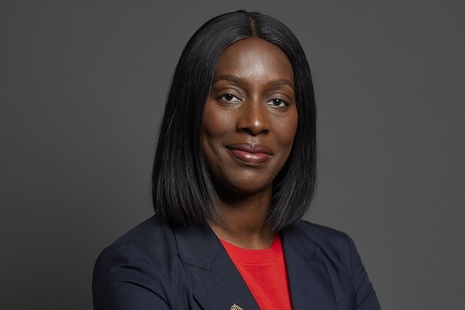
Florence Eshalomi remembers her mother receiving the keys to a home on Brixton’s Barrier Block Estate as a moment of relief. The family had been living in temporary accommodation near King’s Cross, carrying possessions between addresses. A settled home meant they could put down roots. She has repeatedly returned to that experience when explaining why she entered politics, bringing a childhood memory of insecurity to arguments over the responsibilities of councils, landlords and central government.1
Family, education and the demands of care
Illness also shaped family life. Her mother had sickle cell anaemia and later kidney failure, requiring dialysis three times a week. In her maiden Commons speech, Eshalomi recalled watching her struggle through pain while still helping her daughters prepare for school and complete their homework. Care involved responsibilities that reached beyond hospital appointments.3
Eshalomi was the eldest of three sisters. Her mother had worked as a teacher before ill health forced her to retire. Eshalomi became the first member of her family to attend university, studying political and international studies with law at Middlesex. Her route into higher education therefore developed alongside the responsibilities that illness had brought into the family home.18
She represented Brixton Hill on Lambeth Council for twelve years, standing down in 2018. Her responsibilities included culture, sport and the Olympics, and she chaired the council’s housing scrutiny committee. She also helped introduce Lambeth’s youth mayor elections in 2007. The work ranged from the Lambeth Country Show to opportunities for young people to participate in local democracy.4
Across South London and into City Hall
In 2016, she became the London Assembly member for Lambeth and Southwark. Her earlier employment had included the Runnymede Trust, public affairs work and roles with the Labour Party and Islington Council. At City Hall, her work extended across transport, policing and emergency planning. The move widened her responsibilities from a council ward to two boroughs, while keeping her rooted in the part of South London where she had already built her political career.4
As chair of the Assembly’s Transport Committee in 2019, she challenged repeated delays and rising costs on Crossrail. When further uncertainty emerged that September, she asked why promised changes to the project’s governance had failed to prevent more slippage. She wanted a reliable opening timetable and control of expenditure. Her intervention addressed the management of a major public project, pressing those responsible to explain why assurances about its delivery had repeatedly proved inadequate.5
Her transport campaigning also addressed journeys that attracted less attention than a new railway. She urged the government to prioritise Peckham Rye and Streatham stations for funding to improve access, including lifts, ramps and accessible facilities. She described the difficulties faced by disabled passengers, older people and parents with pushchairs. These were demands for investment through the Access for All programme, focused on whether people could actually use the stations serving their communities.6
Her report on girls associated with gangs examined a different failure of visibility. It highlighted young women vulnerable to criminal and sexual exploitation who were not being adequately identified or supported. Police records and information from children’s services revealed different pictures of the problem. Eshalomi called for a substantial expansion of intervention. The report challenged an approach to gang activity that could overlook girls’ experiences and the forms of coercion operating around them.7
A constituency across the river from Parliament
Elected for Vauxhall in December 2019, Eshalomi entered the Commons as a Labour and Co-operative MP. She represented the new Vauxhall and Camberwell Green constituency after the July 2024 election. Her parliamentary career therefore continued across a change in boundaries and constituency name. National roles would follow, but her electoral base remained in inner South London, close to the council and Assembly constituencies she had previously served.9
In her first Commons speech, on 16 January 2020, she described a constituency shaped by migration, naming its Portuguese, Jamaican, Ghanaian, Ecuadorian and Italian communities. She also recognised Vauxhall’s LGBTQ history and the Royal Vauxhall Tavern’s role as a place of support. The picture extended from independent businesses to major cultural institutions. Her account connected familiar national landmarks with the communities living and working around them, including families whose children attended the primary school she had once attended herself.3
Sickle cell care remained a parliamentary priority. In a December 2021 debate, she described learning about medicines and emergency treatment while caring for her mother. She challenged the dismissal of patients’ severe pain and the suspicion that requests for relief reflected addiction. She also spoke about suitable housing and time away from work for appointments. Her contribution described how treatment failures and the conditions of everyday life could combine, drawing on responsibilities she had shouldered long before becoming an MP.8
Her visibility as a Black woman in Parliament did not prevent repeated failures to recognise her individually. In March 2023, BBC Parliament incorrectly captioned her as fellow MP Abena Oppong-Asare. Speaking to the Standard, Eshalomi expressed disappointment that such mistakes continued. The broadcaster apologised to both women and said it had corrected the error for future use. The episode formed part of her public account of the assumptions Black women encountered even after winning elected office.17
Contracts, public money and political responsibility
Eshalomi served as a shadow Cabinet Office minister from July 2022 until September 2023, then moved to Labour’s shadow housing and local government team. These appointments placed her within the opposition’s detailed scrutiny of government administration. They also brought responsibilities distinct from a constituency campaign or a committee inquiry: speaking for the party on legislation and defending proposed changes to the way public institutions operated.9
During the Procurement Bill’s passage in 2023, she argued for greater openness about interests behind recommendations for public contracts. She pressed for faster payments to smaller businesses, transparency about large companies’ tax arrangements and powers to exclude suppliers that repeatedly breached workers’ rights. Her case connected public purchasing with standards of employment and the survival of smaller firms. Ministers disputed the need for some additional provisions. The record shows proposals tested against government resistance, alongside areas where she welcomed changes to the bill.10
Making housing conditions a question for government
In September 2024, MPs elected her chair of the Housing, Communities and Local Government Committee. She identified housing supply, building safety, renters’ rights and council finances as central concerns. The role required working with members of other parties and examining the record of a Labour government. She could call attention to failures, question ministers and lead recommendations, while the decisions on legislation, spending and implementation remained with government and other public bodies.11
The committee’s 2025 inquiry into children in temporary accommodation documented conditions far removed from the security families needed. Evidence described damp, mould, overcrowding and rooms with insufficient space for young children to move or play. Families could spend years in accommodation intended as an emergency measure. Placements far from their former neighbourhoods disrupted schooling and separated them from support. The report linked those conditions to the shortage of social and affordable homes and to weaknesses in the supervision of accommodation.12
Its recommendations included mandatory inspections before properties were first used and when new residents moved in. The committee called for immediate protection for families alongside the longer task of increasing housing supply. Children already living in unsuitable rooms needed safe conditions while the wider shortage was addressed.12
She criticised the government’s response in June 2025 for lacking sufficient detail. The committee had sought publication of a homelessness strategy by July; ministers would commit only to later that year. She also questioned the refusal to provide the requested update on the inter-ministerial group dealing with homelessness and rough sleeping. The exchange made clear that sharing a party with ministers did not mean accepting their timetable or their account of progress without challenge.13
Before the Spending Review that month, she wrote to the Chancellor arguing that private development alone would not deliver the government’s housing ambitions. Drawing on evidence heard by the committee, she called for a substantial increase in investment in social and affordable homes. This was a demand about the mix of housing being built as well as the total number. It placed public investment alongside planning and private construction in the argument over how to address the shortage.14
International links and a move into government
Her work also included serving as the UK’s trade envoy to Nigeria. A March 2026 government communiqué recorded her co-chairing, with Obi Asika, a working group on the creative industries launched at the British Film Institute the previous year. It also noted a business dialogue during her September 2025 visit to Nigeria. That activity connected cultural production with the practical work of building trade relationships, bringing another dimension to a career more often associated with South London and public services.15
On 21 July 2026, she became Minister for Homelessness, Democracy, Communities and Faith, serving as a minister of state in the Ministry of Housing, Communities and Local Government. Her responsibilities included rough sleeping, supported housing and elections policy. The appointment moved her from leading parliamentary scrutiny to sharing responsibility for government action. The subject she had examined through family experience and committee evidence was now part of her own ministerial brief, requiring decisions within the constraints of budgets, departments and delivery partners.2
One early announcement concerned the next round of the Common Ground Award, opened in September 2026. Up to £2.5 million was offered for community organisations to improve buildings, facilities and equipment that brought people together. The scheme had begun before her appointment; her role included taking its next stage forward. Its focus was capital investment, with awards still to be decided at the time of the announcement. It provided a concrete example of her new responsibilities, while leaving the effectiveness of spending to be demonstrated through the work funded.16
Sources and further reading
1. Florence Eshalomi MP: About Florence.
2. UK Government: Florence Eshalomi: ministerial biography and responsibilities.
3. UK Parliament, Hansard: Health and Social Care, 16 January 2020: maiden speech.
4. London Assembly: Florence Eshalomi MP: former Assembly member biography.
5. London Assembly Transport Committee: Assembly response to continued Crossrail uncertainty, 19 September 2019.
6. London Assembly, statement by Florence Eshalomi: Push for Peckham Rye and Streatham to receive step-free funding.
7. London Assembly, report announcement: Gang Associated Girls: Supporting young women at risk.
8. UK Parliament, Hansard: Sickle Cell Treatment, 8 December 2021.
9. UK Parliament: Parliamentary career: Florence Eshalomi.
10. UK Parliament, Hansard: Procurement Bill [Lords], 13 June 2023.
11. House of Commons: Florence Eshalomi elected as Chair of the Housing, Communities and Local Government Committee.
12. House of Commons Housing, Communities and Local Government Committee: England’s Homeless Children: The crisis in temporary accommodation.
13. House of Commons Housing, Communities and Local Government Committee: Children in temporary accommodation: response from Committee Chair, 16 June 2025.
14. House of Commons Housing, Communities and Local Government Committee: Chancellor must use Spending Review to boost social and affordable housing, 4 June 2025.
15. UK Government: UK–Nigeria Enhanced Trade and Investment Partnership: ministerial dialogue communiqué, 16 March 2026.
16. UK Government: Community groups invited to apply for funding to bring people together, 14 September 2026.
17. The Standard, reporting and direct interview by Barney Davis: Florence Eshalomi disappointed as BBC Parliament confuses her with another Black female MP, 15 March 2023.
18. Public Finance: Fixing the house: interview with Florence Eshalomi, December 2025.