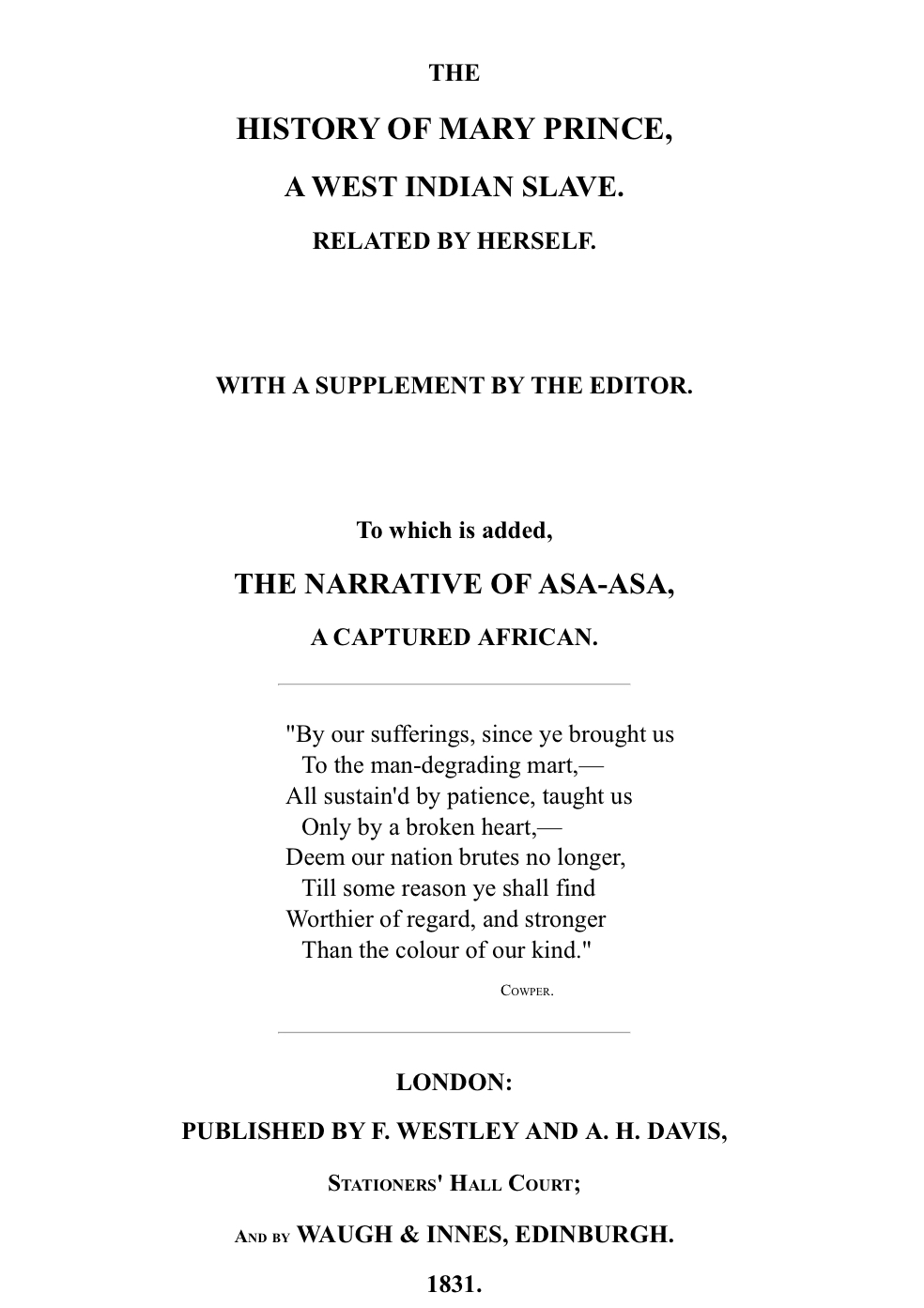
Mary Prince’s history begins with the people she loved. Before it becomes an account of violence, exhausting work and the struggle for freedom, it describes her mother, brothers, sisters and childhood companions. That beginning determines what follows. The reader sees a sale through the loss it inflicts on a family.1
Published in London in 1831, The History of Mary Prince carried those experiences into the campaign against slavery. Its account of life in Bermuda, the Turks Islands and Antigua also unsettles the idea that Britain’s involvement can be understood entirely through ships and plantations. Kitchens, laundry, childminding and salt ponds are central to her story.1
A child put up for sale
Prince was born in Bermuda around 1788. Her narrative identifies her birthplace as Brackish Pond and describes parents enslaved by different people. While still a child, she was hired out as a nursemaid. A later sale separated her from her mother and sent her and two sisters to different owners.1, 2
In recalling that sale, Prince follows her mother’s preparations, the journey to the marketplace and the inspection of her body by prospective buyers. Family affection remains present throughout. The humiliation depends upon buyers behaving as though the children’s grief and understanding do not count. The remembered details challenge the assumptions that make a human being appear in a transaction as an item of property.1
She also records affection for some people within the households that owned her. These attachments did not protect her from sale. Her account allows care, dependency and coercion to exist together, showing why an apparently kindly relationship offered no secure right to remain with family.1
The work that slavery required
The labour Prince describes is precise. On the Turks Islands, she worked in salt ponds, standing in brine and shovelling salt through long days. Water and salt damaged her legs; adequate rest and care were scarce. She estimated that she spent about ten years there. Salt production was a place of forced labour, far from the familiar image of a sugar field.1
Domestic service brought other demands. She washed heavy loads of clothing, cared for children and worked while seriously unwell. The narrative repeatedly returns to the difference between an enslaver’s accusation of idleness and a worker’s physical inability to continue. Illness did not release her from the expectation that her body should keep producing labour.1
She was also required to wash an enslaver’s naked body, an experience she describes as deeply humiliating. Her attempts to refuse and defend herself exposed her to further violence. The episode makes bodily control part of the account of slavery without allowing the reader to mistake endurance for consent.1
Bargaining for a different life
In Antigua, where John and Mrs Wood enslaved her, Prince sought opportunities to earn money. She took in washing and sold provisions, including coffee and yams. She saved towards buying freedom and approached people who might help finance it. These efforts required initiative, judgement and relationships beyond the household in which she worked.1
Money alone was insufficient. She describes being told to find another owner, doing so, and then discovering that Wood would refuse a sale. Such manoeuvres kept the decision in his hands. Her repeated negotiations expose a central feature of enslavement: even an agreed price or the means to pay could not provide a dependable route out.1
Religious fellowship offered another form of belonging. Prince attended the Moravian Church and its reading classes. In 1826 she married Daniel James, a Black carpenter and cooper who had bought his own freedom. Marriage did not remove the Woods’ control over her, but it gave her struggle a further purpose. Freedom meant the possibility of sharing a life with her husband.1
Leaving the Woods in London
Prince travelled to England with the Woods in 1828. In her account, she hoped the journey might improve her health and that she would return to Antigua. Instead, demands for work continued despite painful illness. After repeated threats to turn her out, she left the household and sought help through the Moravian mission in Hatton Garden.1, 2
Leaving required practical support. She describes help from other servants, washerwomen and people connected to the mission. Their assistance matters because freedom without money, health, shelter or contacts could be precarious. Her account follows the work of finding somewhere to go as carefully as it records the decision to leave.1
She faced a further obstacle: leaving the Woods in England did not establish freedom on returning to Antigua, where Wood still claimed ownership. Going back to Daniel could therefore put her under his authority again. Thomas Pringle’s supplement records unsuccessful negotiations and a petition presented to Parliament in 1829. The personal problem remained unresolved when the book appeared.1, 3
Whose voice reaches the page?
Prince told her history to Susanna Strickland, who wrote it down; Pringle edited it. This process is essential to understanding the book. Its first-person narrative comes through a publication shaped by white intermediaries whose access to print, money and public respectability differed sharply from Prince’s own.2
Pringle’s preface says that the idea originated with Prince. It also acknowledges cutting repetition and altering the written form. He insists that he added no important circumstance or sentiment. That is an editor’s assurance, not proof that the published sentences reproduce every word she spoke. Both her initiative and his power over the finished text deserve attention.1
The preface promises that profits will benefit Prince and distinguishes Pringle’s private publication from his position in the Anti-Slavery Society. His lengthy supplement defends her character and challenges Wood’s account. These additions show the conditions under which an enslaved Black woman’s testimony reached British readers: her own assertions were surrounded by other people’s attempts to certify them.1
A public testimony without a settled ending
The book went through three printings in 1831. In 1833 Prince appeared as a witness in litigation involving Pringle and Wood over the publication. The controversy made the credibility of her account a public battleground. It is safer to describe that conflict than to treat a libel judgment as a complete historical assessment of her life.2
What happened to Prince after 1833 is not securely known. We cannot supply a confirmed date of death or promise that she returned to Antigua and Daniel. Her published history leaves readers with demands she had already articulated: to control her labour, live beyond an enslaver’s permission and have the suffering of others understood. The uncertainties of her later life should remain visible beside the testimony she succeeded in putting into print.1, 2
Sources and further reading
1. Mary Prince, with Thomas Pringle’s preface and supplement. The History of Mary Prince, a West Indian Slave, Related by Herself (1831). The narrative, preface and supplement speak in different voices and should be read together.
2. London Museum. The life story of Mary Prince. Used for publication context, Susanna Strickland’s role and the limits of knowledge about Prince’s later life.
3. Ros Ballaster, Ten-Minute Book Club. The History of Mary Prince by Mary Prince. Discussion of voice, bodily suffering and the different meanings of freedom in England and Antigua.
Featured image. Title-page reproduction in the Project Gutenberg edition of Mary Prince’s 1831 narrative, The History of Mary Prince, A West Indian Slave, Related by Herself. Text: Mary Prince (1831). Title-page image from the Project Gutenberg edition, via Wikimedia Commons. Image record · Public domain

