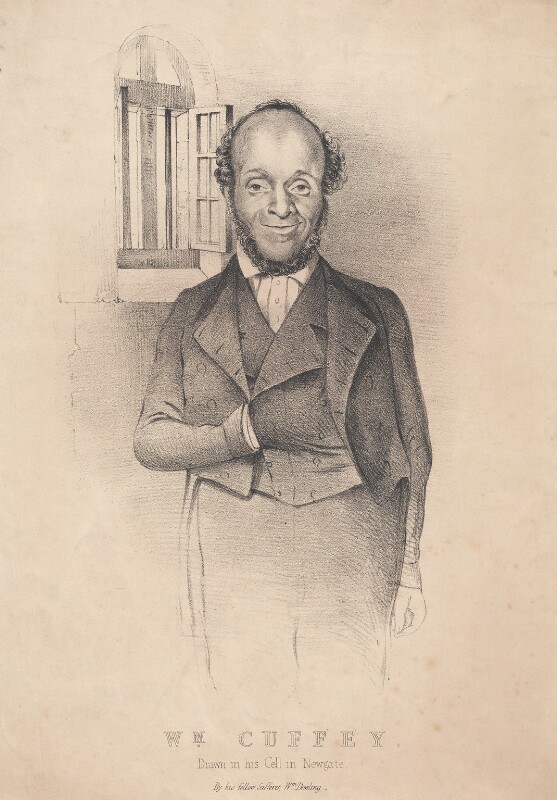
In September 1848, William Cuffay stood trial at the Old Bailey alongside other men accused of plotting an uprising. The proceedings placed a London tailor under the scrutiny of judges, lawyers, police officers and informers. They also preserved a name that belongs in a wider history: the long struggle by working people to gain a voice in the government of Britain.5
Cuffay had spent years organising before his prosecution. His life continued for more than two decades after transportation to Australia. Reading only the trial would leave out the work and relationships that made him a political figure, and the campaigning he resumed on the other side of the world.3, 6, 7
A tailor from the Medway towns
Cuffay was born in 1788 and baptised at St Mary’s in Gillingham on 6 July that year. His father, Chatham Cuffay, had been enslaved in St Kitts before coming to Britain and working at Chatham Dockyard. His mother was Juliana Fox. The family places Black history within the working life of the Medway towns well before Victorian Chartism.1
William trained as a tailor through a seven-year apprenticeship, completing it by about nineteen. That was a substantial investment in a skilled occupation. Before he became known for speeches and political meetings, his livelihood depended on making clothes. His trade remained a thread through his life, from work in Chatham and London to employment after his transportation.2, 7
When a workplace struggle became political
Cuffay joined the London tailors’ strike of 1834 and was subsequently blacklisted. By 1839 he was active in Chartism, and in 1842 he was chairing meetings and taking on leadership responsibilities. Medway’s archive exhibition traces that progression from employment conflict to organised political activity. It also records the racial hostility directed towards him by parts of the press.3
The connection between work and representation is central to understanding his politics. A skilled worker could be expected to obey laws governing employment without having a vote in the choice of those who made them. Chartism brought this exclusion into public argument. Cuffay’s significance lay in the practical work of organising as well as in the attention his speeches attracted.3, 4
What the Charter demanded
The People’s Charter of 1838 set out six demands: votes for all adult men, a secret ballot, equally sized constituencies, payment for MPs, an end to the property qualification for MPs, and annual parliamentary elections. Together, these proposals addressed who could vote, how votes were cast and who could afford to serve in Parliament. They did not amount to equal voting rights for all adults, since women were excluded from the Charter’s demand for suffrage.4, 7
Petitions were presented in 1839, 1842 and 1848 without securing the Charter. In April 1848 a mass meeting took place on Kennington Common while the authorities prepared for possible disorder. This demonstration and petition were separate from the alleged conspiracy for which Cuffay was prosecuted later that year. Keeping those events distinct prevents a complicated sequence from becoming a story of arrest simply for attending one peaceful meeting.4, 5
Inside the prosecution
The Old Bailey indictment accused Cuffay and his co-defendants of intending to levy war against the Queen to compel changes in government; another count alleged an intention to depose her. These were grave allegations. The prosecution presented meetings, conversations and preparations as evidence of a planned armed challenge to the state.5
Police evidence described a search of Cuffay’s rooms in Soho and the discovery of a pistol. Witnesses placed him within organising meetings and attributed instructions to him. A reader should retain the form in which this material survives: these are statements made for a prosecution, tested to varying degrees in court, rather than a narrator’s independent view of what happened.5
Cross-examination reveals why the distinction matters. Charles Tilden, a witness who had attended meetings, was questioned about his communications with the authorities and his own participation in conversations about weapons. Another witness, Thomas Powell, faced questions about when he made notes and how accurately he could remember what had been said. The record exposes the dependence of the prosecution on men whose position within the movement was contested.5
The trial brings allegations of armed conspiracy together with political surveillance, informer testimony and disputed recollections. Defence lawyers challenged the reliability of the evidence and the authorities’ account of events. Those exchanges form part of the record alongside the accusations themselves.5
The jury found Cuffay guilty. The printed verdict gives his age as sixty. In his response to the proceedings, he challenged the fairness of a trial by men outside his own class and condemned the treatment he had received. The National Archives’ account, drawing on criminal and transportation records, confirms that he was sentenced to transportation for life.5, 6
Politics after transportation
Cuffay was taken to Van Diemen’s Land, now Tasmania, aboard the Adelaide in 1849. He received a pardon in 1856 and remained there. Transportation had removed him from his London networks; it did not end his participation in public life.6
His 1870 obituary in Hobart’s Mercury recalls his employment as a tailor and his reputation as an effective public speaker. It gives particular attention to his part in agitation over the colony’s Masters and Servants law. The newspaper credited him alongside other campaigners with helping to secure changes. That is a contemporary assessment of collective action, rather than evidence that he alone delivered reform.7
The same notice describes his participation in elections and meetings concerning the rights of working men. One later appearance was at a meeting in the Theatre Royal opposing the colonial ministry. His political life in Tasmania therefore deserves to be read as a continuation of organising, adapted to a different place, rather than an epilogue to an English conviction.7
The life beyond the courtroom
Cuffay died in 1870, aged eighty-two, after illness and poverty had taken him into the Brickfields Invalid Depot. The obituary remembers a man who could no longer earn his living through his trade. It also reports the superintendent’s recollection of his appetite for reading. These details preserve something beyond the public figure whom newspapers and courts had presented to their audiences.7
His remains were buried in Hobart, and the obituary records that the grave was marked in case supporters later wanted to erect a memorial. Even at that point, remembrance was something people would have to arrange. The surviving records now allow his years of tailoring, political organisation and public argument to be considered together, across both the British and Australian parts of his life.7
Sources and further reading
1. Medway Archives Centre. Chatham Cuffay. Family history and William’s baptism in July 1788.
2. Medway Archives Centre. Apprentice tailor. Cuffay’s training and work in Chatham.
3. Medway Archives Centre. Unrest and protest. The 1834 strike, Chartist involvement and leadership.
4. UK Parliament, Living Heritage. The Chartist movement. The People’s Charter, its six demands and the petitions of 1839, 1842 and 1848.
5. Old Bailey Proceedings. Trial of William Lacey, Thomas Fay and William Cuffei, September 1848 (t18480918-2181). The indictment, witness evidence, cross-examination and verdict. The proceedings use variant spellings of Cuffay’s name.
6. The National Archives, based on research by Harriet Craig. William Cuffey. The sentence, removal to Van Diemen’s Land and pardon; collection references include TS 36/43, CRIM 10/28 and HO 11/16.
7. Mercury (Hobart), reproduced by Obituaries Australia. William Cuffay: obituary in the Mercury, Hobart, 4 August 1870. Read the 1870 obituary text separately from the website’s inconsistent biographical metadata.
Featured image. William Cuffay in a lithographic portrait by William Paul Dowling, around 1848. William Paul Dowling; National Portrait Gallery, via Wikimedia Commons. Image record · Public-domain artwork (PD-Art)

