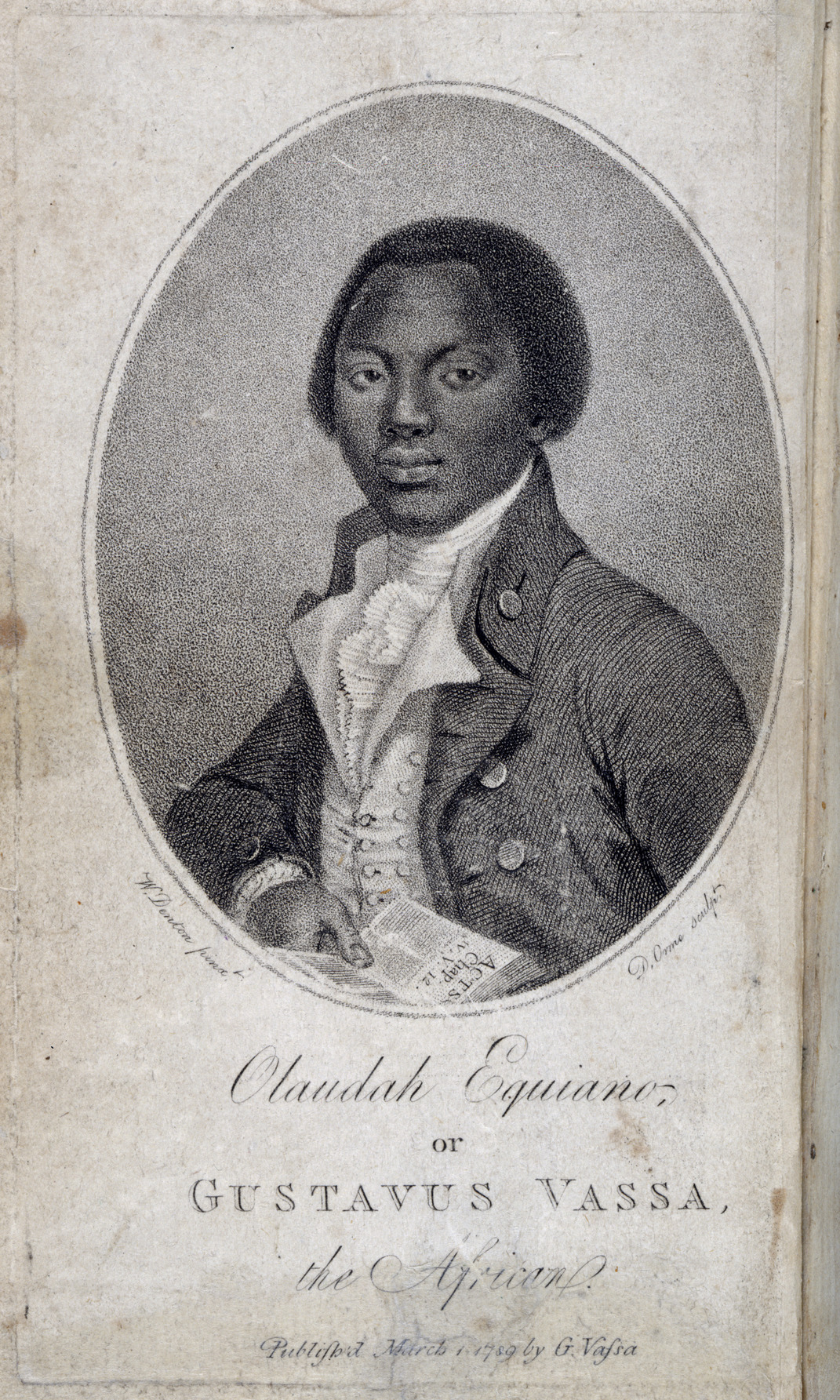
When Olaudah Equiano published his life story in 1789, he put an argument about authority on its title page. This was a book written by the man whose experiences it described. It named him both as Olaudah Equiano and as Gustavus Vassa, the name imposed during his enslavement. Readers were being asked to encounter someone who could describe the Atlantic world, judge its institutions and address Parliament in his own right.1
The book was also a practical undertaking. Its title page directed buyers to the author’s address and to booksellers. A long subscriber list stood before the narrative. Equiano was creating a readership as well as telling a life.1
A childhood account, and a historical disagreement
Equiano began with an account of birth in 1745 in Essaka, in an Igbo-speaking region of what is now Nigeria. He described family relationships, cultivation, music, religious beliefs and local government before narrating his kidnapping with his sister and his passage into Atlantic slavery. The sequence matters: the reader meets a child within a society before encountering the captive treated as merchandise.1
His birthplace remains disputed. Historian Vincent Carretta drew attention to a 1759 Westminster baptism entry giving Carolina and a 1773 naval muster giving South Carolina. These records have led some scholars to question the African childhood narrative. Brycchan Carey’s overview explains the competing interpretations. Other researchers, including Paul E. Lovejoy, defend an African origin and question how the conflicting records were produced and should be read.2, 3
The distinction should remain visible. Equiano’s account of childhood is testimony whose interpretation is contested; neither a confident African birthplace nor a confident American one adequately conveys that disagreement. It also does not follow that a dispute over his earliest years disposes of his documented life as an enslaved man, author and campaigner.2, 3, 4
Learning the Atlantic world
In the narrative, Equiano is taken through the Caribbean to Virginia, where the naval officer Michael Henry Pascal purchases him. Pascal gives him the name Gustavus Vassa. Equiano describes resisting that renaming before being compelled to accept it. The two names on the later title page therefore carry a history of coercion as well as the identities by which readers knew him.1
Ships occupy much of his account. They carry him between places while placing him under the authority of men who control his labour and movements. They are also settings in which he learns unfamiliar languages, skills and habits. His observations move between the technical demands of seafaring, encounters with different communities and the unpredictable conduct of those above him.1
That range gives the book much of its force. Equiano writes about calculation and curiosity alongside fear. He notices opportunities, weighs whom to trust and records disappointments. His life cannot be reduced to a single passage across the ocean, however central the account of the Middle Passage is to the book’s indictment of slavery.1
Forty pounds, and the power to refuse
By 1766 Equiano had accumulated enough money through trading to seek freedom from Robert King, the merchant who then enslaved him. King had promised to accept forty pounds sterling. Equiano recounts arriving with the money and finding that the promise might still be withdrawn. A captain intervened, urging King to honour the agreement. Only then could the necessary document be prepared.1
Equiano includes the manumission document in the book. Its formal language releases the claims of ownership held over him. Placed beside his description of the day, the document lets readers see the distance between an individual’s joy and a legal system that treated another person’s liberty as something an owner could grant for payment.1
The purchase depended on more than Equiano’s enterprise. He needed trading opportunities, enough money and an intermediary willing to press his case. King still held the power to obstruct the agreement. Equiano’s success exposed the insecurity of a system in which someone else could withhold freedom, even when the money for an agreed price had been saved.1
The narrative also records uncomfortable entanglements. The maritime economy in which he worked carried enslaved people as well as other cargoes. His account of earning money for freedom includes a voyage transporting captives. The book preserves a life lived inside that economy, with its compromises and dependencies, rather than presenting an uninterrupted career of abolitionist activism.1
Faith, readers and political argument
Christian belief shapes Equiano’s explanation of his experiences. He repeatedly interprets danger, deliverance and moral responsibility through religion. Readers who pass over these passages to reach the most familiar scenes of enslavement miss an essential part of the author’s understanding of himself. His religious language also becomes a way to demand consistency from Christians who accepted the enslavement of others.1
The book’s dedication addresses the Lords and Commons. Near its end, Equiano reproduces an appeal he made to the Queen in 1788. These passages show an author directing his story towards people with the ability to change policy. Personal recollection and public persuasion belong to the same project.1
Equiano also worked with other Black campaigners, including Ottobah Cugoano, in the Sons of Africa. After publication he travelled to promote the book and the abolitionist cause. Its commercial success helped his experiences circulate beyond a single meeting or petition. Buying, recommending and discussing a book offered readers different ways to enter the campaign.4
The future he argued for
The closing pages contain an economic argument as well as a moral one. Equiano proposes that trade with African societies could create demand for British manufactures without the traffic in human beings. He tries to persuade readers who measure policy through commerce that abolition need not threaten their interests. A man whose own labour had been traded now addresses the calculations used to defend the trade.1
His language about civilisation and British influence also belongs to the unequal world in which he wrote. A careful reading can recognise the force of his challenge while examining the assumptions within his proposed alternative. He was making arguments to particular audiences, using the religious, commercial and political language available to him.1
Equiano died in 1797, before Parliament abolished the British slave trade in 1807. That measure did not emancipate everyone enslaved in Britain’s colonies. His book remains valuable partly because it resists a tidy ending: freedom purchased by one man becomes the starting point for a sustained argument about the freedom of others.4
Sources and further reading
1. Olaudah Equiano. The Interesting Narrative of the Life of Olaudah Equiano, or Gustavus Vassa, the African, Written by Himself (1789). See the title page, dedication, subscriber list, chapters I–III and VII, and the closing appeal in chapter XII.
2. Brycchan Carey. Where Was Olaudah Equiano Born? (And Why Does It Matter?). An overview of the disagreement about African and South Carolinian origins.
3. Equiano’s World. Where was Vassa born?. Read alongside Carey’s overview for a different assessment of the records.
4. David Taylor, Ten-Minute Book Club. The Interesting Narrative by Olaudah Equiano. Background on Equiano’s campaigning, the book’s reception and its historical setting.
Featured image. The portrait published at the front of Olaudah Equiano’s The Interesting Narrative in 1789. British Library, 1489.g.50, frontispiece; released through the British Library’s digital collections. Image record · CC0
,_frontispiece_-_BL.jpg)