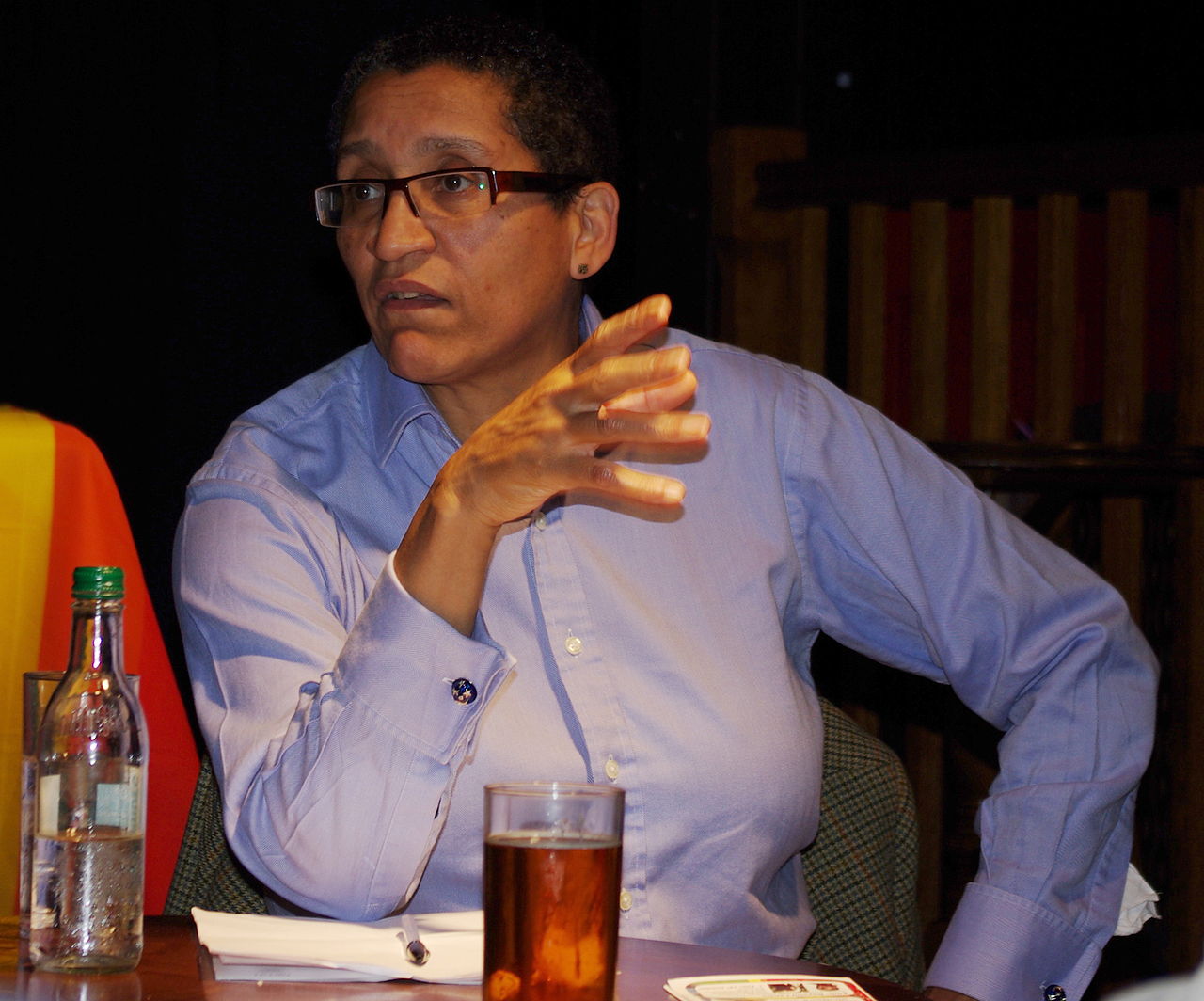
When Linda Bellos became leader of Lambeth Council in 1986, equality was already part of a difficult argument about local government. The borough faced poverty and conflict over council funding. Bellos brought experience from feminist and Black political organising into an administration making decisions about jobs, services and public money. 4
Growing up with a political awareness
In her oral history for Black Cultural Archives, Bellos remembered encountering racist language as a small child. Her parents encouraged her to value her African and Jewish family backgrounds, rather than accept the meanings others imposed on them. She also recalled reading with her brother and repeatedly borrowing books from the library near her home. These were parts of an education that extended beyond school. 1
Publishing and practical work
Bellos joined the feminist magazine Spare Rib in the early 1980s, initially bringing financial management skills before moving into editorial work. She entered a collective where political ambitions depended on the less visible business of paying wages, managing accounts and keeping the magazine in circulation. Historian Lucy Delap’s research documents the low pay and financial uncertainty behind this work. 2
Greater London Council grants enabled Spare Rib to improve staffing and pay during the early 1980s. Funding applications also required attention to the needs of Black Londoners, lesbians and disabled people. The connection between equality and organisational decisions was concrete: who could be employed, whose work was represented and how a publication could survive. 2
From organising to public office
Bellos’s professional account records her appointment in 1984 to lead equalities work in the Greater London Council’s Women’s Committee Support Unit. She also helped organise the Black lesbian conference We Are Here. Her approach rejected ranking different forms of oppression, bringing attention to the ways people’s circumstances could involve several kinds of disadvantage at once. 3
As vice-chair of Labour’s Black Sections, Bellos supported efforts to increase the selection of African, Caribbean and Asian candidates. Her own arrival in Lambeth’s leadership followed the disqualification of councillors who had resisted rate-capping, the central government’s restriction on council spending. Political representation and the resources available to elected representatives were therefore closely connected questions. 4
The choices facing Lambeth
Writing in The Independent in 1993, Bellos described an inexperienced Labour administration taking office after the 1986 elections. In her account, the council faced a demand to reduce its budget substantially while trying to maintain services. She defended her decision to implement cuts, arguing that refusing to comply risked the disqualification that had removed the previous councillors. 5
Bellos also described trying to establish clearer procedures for scrutinising contracts and giving potential contractors an equal opportunity. Disputes over spending divided Labour locally. She wrote that she and colleagues who had implemented cuts eventually lost the support of their local party organisations and stood down. Her account connects political principle with the pressures of administering a large public institution. 5
The public argument often moved away from those decisions. Press coverage targeted her sexuality and portrayed equal opportunities policies as absurd. The hostility directed at Bellos formed part of the wider confrontation around Labour councils during the 1980s, in which arguments over spending became arguments about whose concerns government should recognise. 4
History as a public responsibility
Bellos also chaired the London Strategic Policy Unit, through which she helped introduce Black History Month in Britain. That role linked local government to questions about public memory: what institutions marked, which histories they made visible and whose contribution appeared in civic life. Her political work therefore included both the distribution of resources and the recognition of communities. 6
Equality beyond the council chamber
Her subsequent practice included teaching equality impact assessment, developing online learning and advising public bodies. A professional record covering 2012–2015 lists work on a Home Office review of diversity support groups in policing, seminars for senior managers at Tate and training on the Equality Act 2010. This work focused on management and operations: examining policies and decisions, and teaching others how to assess their effects. 3
Bellos’s oral history also returned to the value of consciousness-raising groups. She described people testing ideas through discussion, asking questions and making connections between experiences. That account places collective learning alongside the more visible moments of leadership. The political skills she valued included listening and being challenged, as well as speaking publicly or holding office. 1
Sources and further reading
1. Interview with Linda Bellos. Black Cultural Archives.
2. Feminist Business Praxis and Spare Rib Magazine. University of Cambridge repository.
3. Registered Member Information: Linda Bellos. Institute of Equality and Diversity Practitioners.
4. Linda Bellos. Voices and Visibility.
5. Who Really Wrecked Lambeth?. The Independent.
6. Linda Bellos. National Portrait Gallery.
Featured image. Linda Bellos speaking at Croydon Area Gay Society during Black History Month in October 2010. Photograph: Ross Burgess, 5 October 2010, UK LGBT Archive, via Wikimedia Commons. Image record · CC BY-SA 3.0
