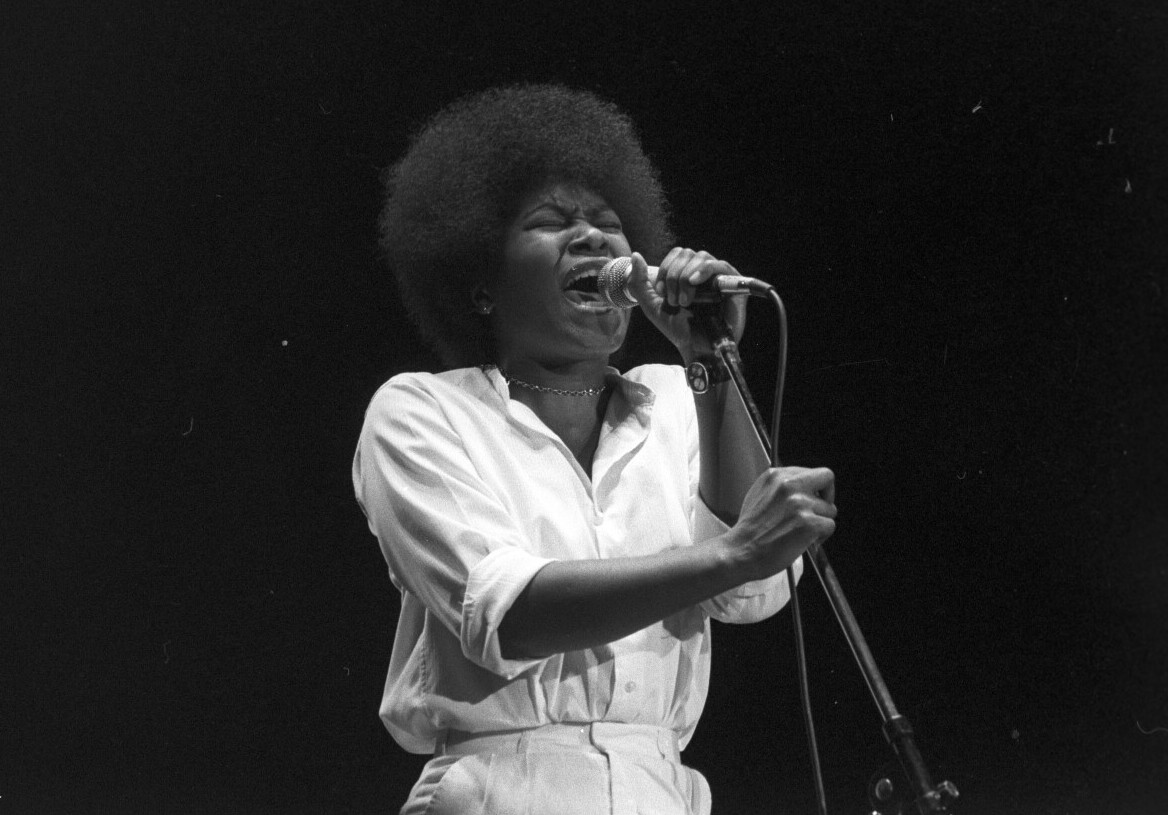
A listener might first encounter Joan Armatrading through the intimacy of Love and Affection, the energy of Drop the Pilot or the electric guitar of Into the Blues. Each offers a different entrance to the same substantial body of work. Across these changes, her attention to human feelings gives the music its continuity. In 2020, the Ivors Academy recognised that achievement by awarding her its Fellowship, the organisation’s highest honour. It was recognition of a career built through writing: finding words, melodies and arrangements capable of making complicated emotions understandable without making them simple.1
Music in Birmingham
Born on St Kitts on 9 December 1950, Armatrading moved to England at seven and grew up in Birmingham. Music developed through the instruments available to her. Her mother’s piano offered somewhere to experiment, while a guitar from a pawnshop gave her another way to arrange sounds. She taught herself and was writing songs by fourteen. Those beginnings matter because composition was present from the start of her musical education. The young player was finding out what she could make an instrument do, learning through the sounds that emerged from her own hands rather than following a formal course.2
In a 2018 interview with The American, she recalled travelling to Britain alone to join her family. She described herself as British while retaining a connection to St Kitts, holding those identities together without treating either as a qualification on the other. Her account of the first guitar was equally specific: it cost three pounds, and her mother obtained it by exchanging two old prams. The instrument survived long after she had become successful. Such details place her development within an ordinary household, where a modest purchase could provide the means for a child to discover an absorbing interest.3
Pam Nestor and the first record
A production of the musical Hair brought Armatrading together with singer and lyricist Pam Nestor. Their partnership helped turn a private store of songs into recorded work. Nestor contributed words and energy to the venture, and co-wrote much of Whatever’s for Us, released in 1972. Remembering her contribution gives a fuller account of Armatrading’s beginnings: this was a creative relationship between two women, with different strengths, working towards an opportunity in the record business. The album introduced Armatrading’s voice to listeners, but the music also carried the results of their shared effort. Their collaboration subsequently ended as Armatrading’s solo career developed.5
Producer Gus Dudgeon helped bring the debut to fruition. Looking back in an interview with Classic Rock, Armatrading described pressure to change her name and record other people’s material. She resisted both suggestions. The decision protected something practical as well as personal: she wanted the songs she had written to reach an audience. Learning how recording worked would become part of that ambition. The studio added new possibilities, but it also required her to communicate musical ideas to people whose training and habits differed from her own.4
The song that travelled
Love and Affection appeared in 1976, with Armatrading credited as its writer and vocalist and Glyn Johns as producer. The recording also features the contrasting voice of Clarke Peters. These credits offer a useful reminder of how a record is assembled: an individual composition becomes a performance shaped by the interaction of several people. Armatrading’s authorship remained central, while Johns and the musicians helped realise its recorded form. The balance between a distinctive lead voice and the surrounding arrangement became part of the recording’s identity. Even its compact title suggests the closeness and emotional attention around which her writing so often turns.6
The single reached number ten in Britain, and the self-titled album containing it reached number twelve. Show Some Emotion followed in 1977 and climbed to number six. These were substantial steps in establishing an audience willing to follow her across whole records. Her chart history also shows why reducing the career to a succession of hit singles would be misleading. Album listeners were an essential part of its foundation, making room for songs that could become important to people without appearing near the top of a weekly singles chart.7
How the songs take shape
The guitar is an active voice in Armatrading’s music. Discussing her playing with musician and writer Jeffrey Pepper Rodgers, she explained that she often hears several parts while composing: bass, keyboards, strings and percussion. Her acoustic approach developed partly from trying to suggest these sounds together. That helps explain the rhythmic force of her playing and the sense that an accompaniment can contain more than a sequence of chords. For someone approaching her work through the singing alone, listening closely to the guitar reveals another strand of the composition, carrying momentum and shaping how the voice moves through a song.8
Her writing also relies on observation. In an interview with Guitar World, she described creating characters and considering how people behave within friendships, love and marriage. Listeners may hear confession in a first-person song, but its narrator need not be the songwriter. That distinction gives her considerable imaginative freedom. She can explore conflicting feelings without offering a running account of her private life. Once a song reaches an audience, she accepts that people will understand it through their own experiences. Its meaning can deepen through a listener’s circumstances, even when those circumstances differ from whatever prompted her to write it.9
Room for rock, blues and difficult subjects
The records of the early 1980s extended her commercial reach. Me Myself I reached number five in the UK album chart in 1980; Walk Under Ladders followed at number six in 1981. The Key entered the top ten in 1983, while Drop the Pilot reached number eleven as a single. This sequence gave her music a sustained presence through a changing period in British pop. It also demonstrates the depth behind the familiar songs: several albums, each with its own collection of material, were finding substantial audiences.7
The Recording Academy’s nominations trace another aspect of that range. How Cruel was nominated for Best Rock Vocal Performance, Female at the 1981 Grammy Awards, followed by The Key in the same category in 1984. Into the Blues received a nomination for Best Contemporary Blues Album in 2008. Those categories are useful historical markers, although they cannot define the whole musician. They show her work being recognised in different musical settings across decades. Blues provided a further field for an established writer and guitarist to explore, with the same appetite for making new records that had driven her earlier career.10
How Cruel also addresses racism, making it an important part of any account of Armatrading within Black British history. Her songs about intimacy sit alongside work that confronts the judgements imposed on people. The documentary account published on her website places this writing within the racism and misogyny she encountered in the music industry. Remembering those pressures adds context to her independence. A Black woman writing and performing her own material had to negotiate expectations about both musical style and public identity while continuing to develop the work itself.16
Control in the studio and on stage
Armatrading gradually took on more of the recording process herself. She explained to The American that playing all the parts on demonstrations had long been her practice. On Lovers Speak she extended that approach to the finished recording, while bringing in a drummer; later she also programmed drums. The development brought arrangement, performance and production closer together. It allowed her to carry an idea through several stages, from the first musical thought to the sound heard on a record. Her independence involved acquiring and applying skills, as well as making artistic decisions.3
Solo touring created a different kind of concentration. Discussing her 2014–15 world tour with SongwriterUniverse, she described performing with guitar and piano without a supporting band. The format brought songs closer to their original arrangements and gave her direct control over their presentation. It also had physical costs. There was little opportunity to rest her voice or hands while someone else took over, and she recalled sore fingers and the demands of operating pedals. The account is a useful corrective to the apparent ease of a finished performance. Freedom on stage can require sustained attention, preparation and considerable stamina.11
Learning and making opportunities
Education remained important alongside music. Armatrading earned a history degree through the Open University, studying around touring commitments. She later described completing it as one of her most valued achievements. That is a different accomplishment from the honorary degrees universities have awarded her: this qualification involved her own studies. Her working life also included support for charitable causes and performances connected with Nelson Mandela. The university’s account records both her appearance at the 1988 Wembley concert marking his seventieth birthday and her later performance of The Messenger for him. Music, learning and public commitments occupied overlapping parts of her life.12
She also used touring to give developing musicians access to an audience. Her Local Talent initiative selected regional artists for opening slots, with Rag’n’Bone Man chosen for Brighton Dome in November 2012. The venue’s contemporary announcement records a fifteen-minute performance opportunity and his excitement about playing his biggest show to that point. This provides a concrete example of support within the profession. An established artist’s tour could create space for someone working locally, while the audience could discover music beyond the headliner. The opportunity combined a stage, attention and the experience of performing within a professionally organised concert.13
New forms for a continuing ambition
Armatrading’s first symphony extended her writing into a larger instrumental form. Composed in 2022, the four-movement work received its premiere from Chineke! Orchestra, conducted by Andrew Grams, at London’s Queen Elizabeth Hall on 24 November 2023. She explained that the melodic second movement came first and initially felt like writing a song. The rest followed over roughly five months. Her account makes the project understandable as a development of an existing practice: finding musical ideas, following them and shaping their relationships. The orchestral setting enlarged the available colours and scale while leaving the responsibility for composition in the same hands.14
The 2024 album How Did This Happen and What Does It Now Mean continued her work in recorded song. BMG credited her with writing, producing, programming and engineering its twelve tracks. It followed Consequences, which had reached the UK top ten in 2021. These later records give the career an open ending. Familiar songs remain available to the people who have carried them through their lives, while new compositions ask for a fresh hearing. Armatrading’s history is consequently still best approached through the work: the decisions inside a song, the different sounds she chooses and the continuing pleasure she takes in making music.15
Sources and further reading
1. The Ivors Academy: Joan Armatrading – Academy Fellowship.
2. Joan Armatrading official website: About Joan.
3. The American: Joan Armatrading interview, by Michael Burland.
4. Classic Rock / Louder: Joan Armatrading on Whatever’s for Us.
5. Articulate with Jim Cotter: Her/Herself/She: Joan Armatrading interview and transcript.
6. Universal Music Group / Joan Armatrading on YouTube: Love and Affection: official recording credits.
7. Official Charts Company: Joan Armatrading: Official Chart history.
8. Jeffrey Pepper Rodgers: Joan Armatrading interview and guitar lesson.
9. Guitar World: Joan Armatrading on Consequences and her craft.
10. Recording Academy: Joan Armatrading: Grammy Awards and nominations.
11. SongwriterUniverse: Joan Armatrading talks about her songwriting and new projects.
12. The Open University: Joan Armatrading CBE: how the OU helped this music icon achieve a lifelong dream.
13. Brighton Dome: Local talent to support award-winning artist at Brighton Dome.
14. Boosey & Hawkes: Joan Armatrading’s Symphony No.1 premiered in London by Chineke!.
15. BMG: Joan Armatrading releases How Did This Happen and What Does It Now Mean.
16. Joan Armatrading official website: Joan Armatrading: BBC Four documentary description.
Photograph
Joan Armatrading performing at the Kongresshaus in Zurich, 16 May 1980. Photo: Petra Gall / Schwules Museum, Joan Armatrading photograph, CC0 1.0. This version was cropped by a Wikimedia Commons contributor; no further edits made for this pack.
