The shop Len Dyke and Dudley Dryden opened in West Green Road in 1965 sold both records and products for Black skin and hair. Its beginnings were modest, but its customers represented a market that much of British retail had failed to serve. Within a decade, hair and beauty had become the company’s central business. 1
From records to a new partnership
The original enterprise combined record distribution with travel services. Tony Wade joined as company secretary and director in 1968, forming the three-person partnership associated with Dyke and Dryden’s expansion. His arrival did not mark the beginning of the business; it helped change its direction. 2
Wade’s account, reported by the Jamaica Gleaner in 2010, described a stock review that found too many records and too few cosmetics, wigs and hair products. He pressed for a change. Advisers were doubtful, but the partners agreed to concentrate on the stronger demand. This was a decision about what customers wanted and how much money was tied up in stock. 3
Knowledge on the shop floor
Wade regarded customer contact as a source of commercial information. As the company grew, professional hairdresser Elsa Robinson took responsibility for the shops’ day-to-day management. Her technical understanding and ability to talk with customers were important to their operation. The business depended on expertise beyond its three directors: knowing a product’s purpose and explaining it were part of making a sale. 3
Hair care also had a social history that a balance sheet could not describe. Curator Michael McMillan’s 2013 Cambridge exhibition explored connections between home grooming, barbershops and women’s salons. These settings could be places for conversation, advice and exchanging news, as well as styling hair. His work situated commercial hair care within debates about appearance, identity and the pressure to conform to European beauty ideals. That wider history gave the hair-care trade a cultural significance extending beyond the purchase of a product. 4
Financing growth and finding markets
According to Haringey Council’s historical account, the founders used their own money after failing to secure support from high-street banks. By 1973, the company had concentrated on beauty, hair and cosmetics. The same account records numerous branches and annual turnover of £5 million by 1986. Turnover measures sales, rather than the founders’ personal wealth or the company’s profit; even so, the figure indicates how far the enterprise had grown from its first shop. 1
Its changing markets feature in the BBC’s Witness History account with former marketing manager Rudi Page. The programme describes competition from major record labels as reggae gained a wider British audience, and the company’s expansion into hair care. It also identifies Ghana and Nigeria among the markets supplied. The commercial connections ran between Britain, the Caribbean and Africa, with a Tottenham enterprise participating in trade on a much larger scale. 5
Employment and a public showcase
Speaking to the PA news agency in 2020, Page remembered the opportunities the company had created for young people, including himself. He also pointed to employment at its Bradford factory. Its reach therefore involved manufacturing jobs as well as London shop counters. Page’s recollection broadens the story beyond the wealth of its owners to the people whose working lives developed within the business. 6
In 1983, Dyke and Dryden launched the annual Afro Hair and Beauty exhibition. The event gave the industry a public setting of its own. Products and the businesses selling them became visible together, extending the company’s presence beyond its individual branches. Commercial expansion included creating occasions at which Black hair and beauty occupied the centre of attention. 2
Remembered in West Green Road
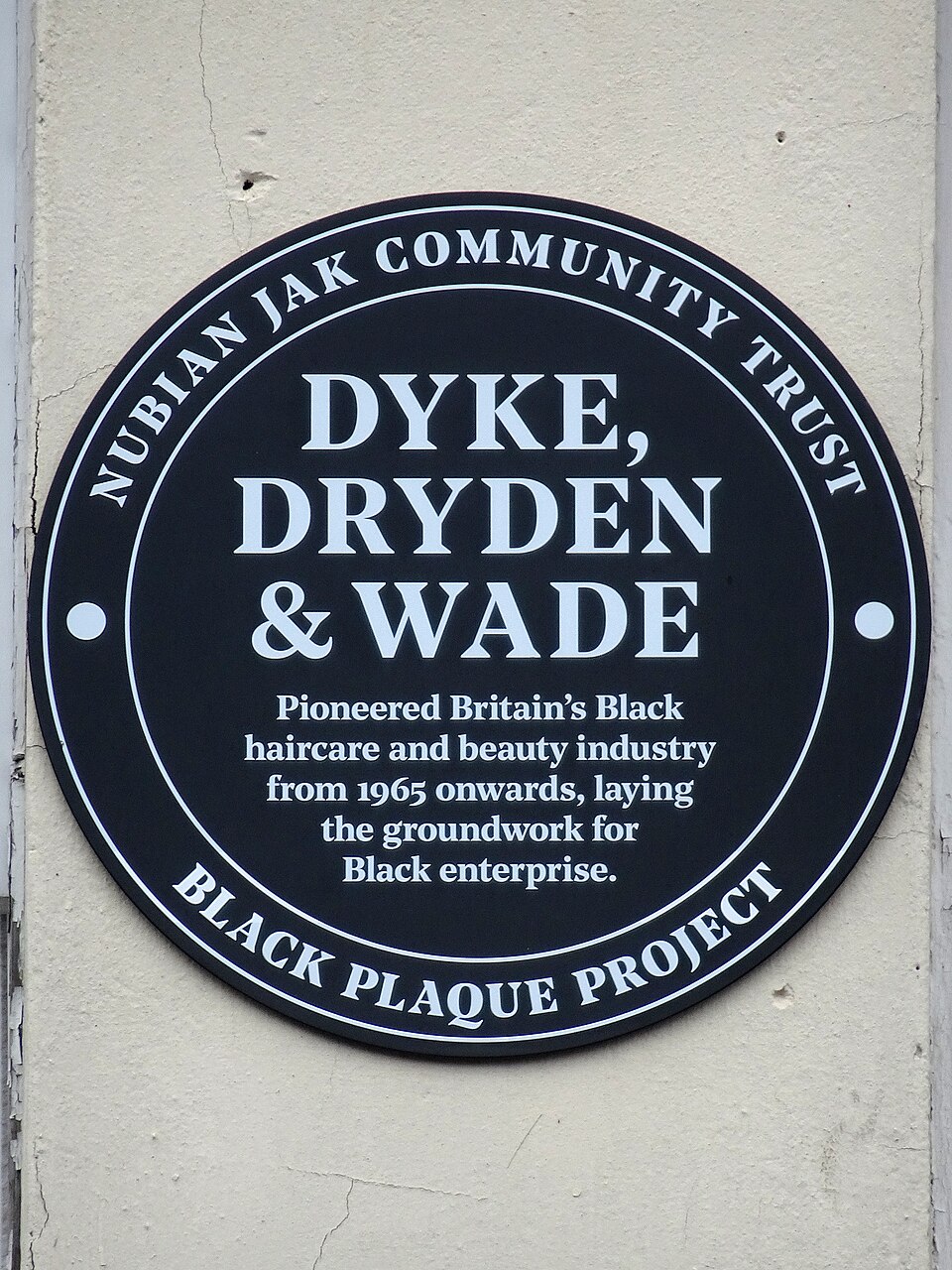
A plaque unveiled in Tottenham in November 2020 commemorated Dyke, Dryden and Wade at premises associated with the business. Page used the occasion to draw attention to their economic contribution. The location gives that history a tangible address, while his testimony recalls the opportunities that spread beyond it: a shop could become a route into employment, management and a growing industry. 6
Sources and further reading
1. Windrush timeline, 1965–1975. Haringey Council.
2. Dyke, Dryden and Wade. Black Plaque Project.
3. The Dyke, Dryden and Wade Story, Part 2. Jamaica Gleaner. 2010-02-08.
4. My Hair: Black Hair Culture, Style and Politics. Michael McMillan.
5. Dyke and Dryden: Cosmetic Kings. BBC World Service, via Apple Podcasts. 2024-10-17.
6. Three Haircare Businessmen Honoured with Black Plaque in Tottenham. PA, published by Express & Star. 2020-11-13.
Featured image. The commemorative plaque for Dyke, Dryden and Wade at 126 West Green Road, Tottenham, photographed in May 2023. Photograph: Spudgun67, 21 May 2023, via Wikimedia Commons. Image record · CC BY-SA 4.0
