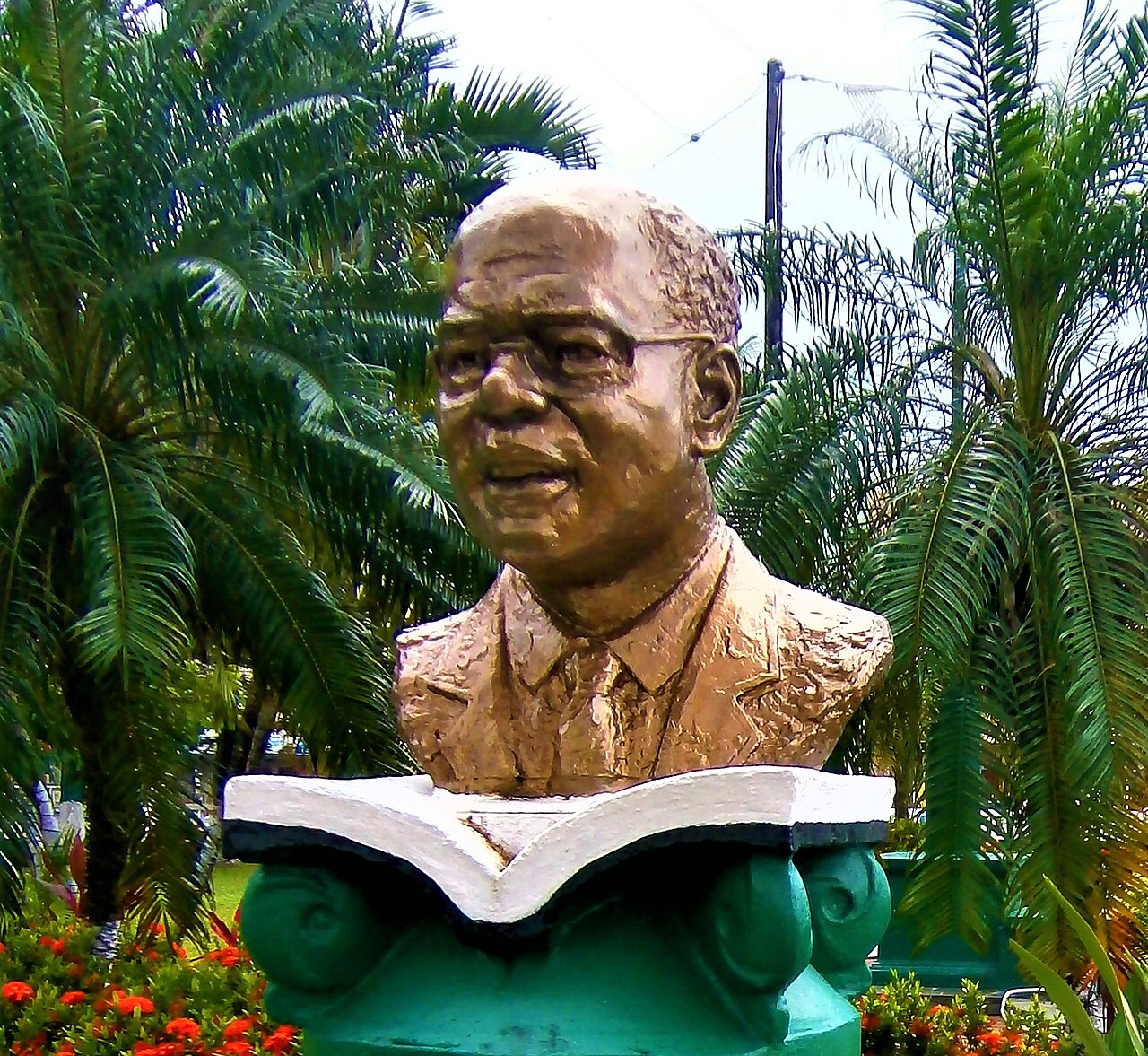
When the South Hulme Evening Centre opened in September 1953, Arthur Lewis had helped prepare its programme and arrange the launch music. The Manchester professor was working on a practical problem: how Black residents could gain access to better jobs. 1
A scholarship and a restricted choice
Lewis was born in St Lucia in 1915 to parents who had moved from Antigua and worked as teachers. He completed school at fourteen, became a civil-service clerk and won a scholarship to study in Britain in 1932. His ambition was engineering, but he later explained that the racial barriers imposed by government and white businesses made that career appear closed. He chose commerce instead. At the London School of Economics, where he began studying in 1933, accounting, law and business administration accompanied economics. He graduated with first-class honours in 1937. Economic theory had entered his life through a course chosen partly because of discrimination. 2
An appointment with restrictions
LSE appointed Lewis to teach in 1938, before he completed his doctorate in 1940. He became the institution’s first Black academic. Its appointment records, examined by archivist Sue Donnelly, show the limits of that acceptance: the director anticipated objections to employing a Black lecturer and proposed that Lewis teach groups rather than meet students individually. During the war, he carried a substantial teaching load while LSE was evacuated to Cambridge. His subjects ranged from transport and business economics to money, banking and colonial economics. Recognition and discriminatory treatment existed within the same institution. 3
In 1948, Lewis became Stanley Jevons Professor of Political Economy at Manchester. The move gave him the setting for work that would reshape development economics: the study of how poorer economies might increase production and improve living standards. 4
Why profits and wages could diverge
His 1954 article, Economic Development with Unlimited Supplies of Labour, examined an economy containing a large pool of people whose work produced little additional output. Expanding businesses could recruit from this pool without immediately having to raise wages. If profits were invested in equipment and further production, employment could grow again. Once the available surplus of workers had been absorbed, employers would face stronger pressure to pay more. This was an explanation of how profits and production could rise while wages initially lagged. Lewis’s model depended on particular conditions. He expressly said the abundant-labour assumption did not describe every country, and his examples extended beyond farming to casual urban employment and domestic service. 5
Growth involved more than factories
Historian Gerardo Serra’s study of Lewis’s Manchester years places this work within the politics of colonialism and independence. Lewis sought ways for economies dependent on raw-material exports to change their position. Agricultural producers mattered as well as industrial firms: improving food production could support wider economic change. His 1955 book, The Theory of Economic Growth, considered knowledge, institutions and social conditions alongside saving and investment. This breadth is easily lost when his contribution is reduced to a diagram showing workers moving between two sectors. Questions about who could acquire skills, own productive resources or influence institutions remained part of his thinking about development. 6
The limits of evening classes
In Manchester, those questions reached into the classroom. Research by Paul Mosley and Barbara Ingham documents the South Hulme centre’s courses in engineering, metalwork and car repairs, intended to help Black residents enter skilled employment. Yet technical enrolments were small; music, English and craft classes attracted more students. Many left, and shift work disrupted attendance. Education offered possibilities, but a class timetable could not remove the obstacles facing working adults. 1
Putting institutions to work
Lewis left Manchester in 1957 to advise Ghana’s new government, later moving to Princeton. In 1979 he shared the Nobel Memorial Prize in Economic Sciences with Theodore Schultz. The award recognised research developed over a career that repeatedly crossed between academic work and public responsibilities. 4
As founding president of the Caribbean Development Bank from 1970 to 1973, he helped establish its structure, procedures and priorities. The bank’s account of his tenure stresses education and skills alongside cooperation between Caribbean countries. These were matters of building institutions, allocating resources and making learning possible. Lewis had approached related questions in Manchester on the scale of a neighbourhood evening centre. The distances between the two settings were considerable; in both, economic opportunity required practical arrangements through which people could participate. 7
Sources and further reading
1. Fighting discrimination: W. Arthur Lewis and the dual economy of Manchester in the 1950s. University of Sheffield. 2013.
2. Autobiography. Nobel Lectures, Economics 1969–1980; UWI reprint. 1979; collected 1992.
3. Arthur Lewis at LSE: one of our best teachers. LSE. 2015-01-23.
4. Arthur Lewis. University of Manchester.
5. Economic Development with Unlimited Supplies of Labour. The Manchester School; University of Texas copy. 1954.
6. W. Arthur Lewis and economic development: a Manchester story. Manchester University Press. 2024.
7. CDB Pays Tribute to Sir Arthur Lewis on the Anniversary of his Birth. Caribbean Development Bank. 2024-01-23.
Featured image. Detail of a monument to the economist Arthur Lewis in Saint Lucia, photographed in December 2016. Photograph: Ulises Icardi, 20 December 2016; source crop by Olea, via Wikimedia Commons. Image record · CC BY-SA 4.0
