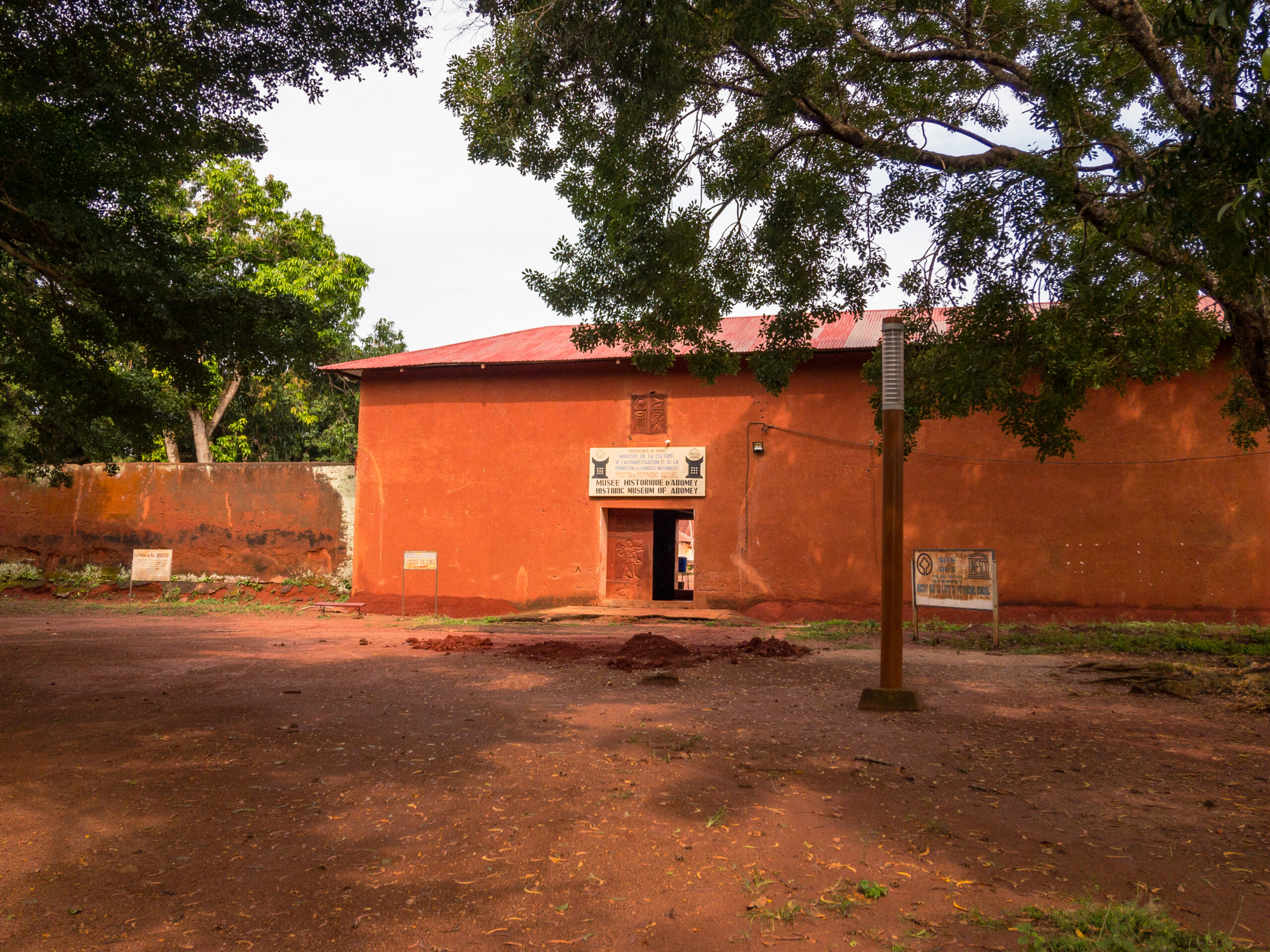
Abomey was the royal capital of Dahomey, a kingdom in the territory of today’s Republic of Benin. Its history belongs to a different state from the Edo Kingdom of Benin, centred in present-day Nigeria. The distinction matters when reading about palaces, royal art and objects taken during colonial wars. A carved stool from Abomey, for example, followed a journey through Paris to Finland, carrying evidence of a particular kingdom and a particular act of conquest.1
A capital built through successive reigns
Dahomey developed from the middle of the seventeenth century, with Houegbadja, also rendered Wegbaja, remembered as a founding ruler. The royal palace site covers roughly 47 hectares. Successive rulers added residences within an established landscape of authority; the complex contains ten palaces, with King Akaba’s enclosure separated from the others. Each palace followed a familiar arrangement of outer, inner and private courtyards. Walls and gateways controlled movement between spaces, making access part of the architecture of power.2
Builders worked with earth, wood, water and straw, while coloured reliefs gave surfaces visual and historical meaning. These were places for governing, storing royal possessions and developing specialist crafts. Sacred spaces associated with deceased rulers also connected the reigning court to its predecessors. The arrangement made dynastic continuity something people encountered through buildings and ceremony, while each ruler left a distinct material presence.2
The palace reliefs recorded victories, royal emblems and accounts of the dynasty’s origins. The Getty Conservation Institute’s study, Palace Sculptures of Abomey, explains how these images celebrated particular rulers and communicated the kingdom’s history. Their value extends beyond their subjects. Modelling figures in earth and applying colour required skilled makers working within an established artistic practice. As royal commissions, the reliefs also presented a selective account: they expressed what the court wished to commemorate. A scene celebrating a conquest cannot supply the whole experience of those who fought, fled or were captured during it.3
Artists gave royal authority a visible form
A nineteenth-century elephant figure attributed to Hountondji guild artists shows the sophistication of palace metalworking. A wooden core was covered with hammered silver, producing an object associated with royal prestige. The elephant served as an emblem of both Ghezo, who reigned from 1818 to 1858, and his successor Glélé, who ruled until 1889. Animal imagery carried meanings interpreted through proverbs, poems and songs. During annual huetanu festivities, sculptures and textiles were displayed in processions celebrating the kingdom’s wealth and military power. Court art therefore belonged to public performance as well as to the possession of an individual ruler.4
Cloth provided another surface for history. Family guilds made appliqué hangings for patrons of high rank, assembling designs that referred to royal emblems, events and proverbs. A Smithsonian example includes animals and sailing ships within this visual vocabulary. Related imagery appeared in the palace reliefs. Across different materials, artists made signs that audiences could recognise and interpret. The textile’s ability to be carried or displayed elsewhere gave these royal associations a reach beyond a permanent wall.5
Women within the structures of government
Women’s authority at Abomey took forms that the familiar image of the woman soldier can obscure. Historian Edna Bay examined the office of kpojito, the king’s female counterpart or reign-mate. In the eighteenth century, Hwanjile and King Tegbesu ruled in a partnership that helped establish the legitimacy of the monarchy. Powerful women could support a prince’s claim at a disputed succession, becoming kpojito when their ally secured the throne. This was an office with its own political history, rather than simply an honorary title for a ruler’s mother.6
Its influence changed. During the nineteenth century, princes found other sources of support, while members of the royal family increasingly occupied senior positions. Bay argues that these developments restricted the power of non-royal women within the palace and weakened the kpojito. Women’s participation in government did not mean that opportunity was equal or remained constant.6
The kingdom also maintained organised female military units. Their precise origins remain debated, but elite formations developed during the eighteenth century and were enlarged under Ghezo. They trained for military service and fought in campaigns including attacks on Abeokuta and Ketu, as well as the wars against France. Their record demonstrates the substantial responsibilities women could carry within an African state. It also locates their service within Dahomey’s territorial ambitions. Military achievement should be studied together with the purposes for which an army was deployed. These soldiers served a monarchy engaged in conquest and slave trading; their presence cannot be treated as evidence that the kingdom sought freedom for every woman or for neighbouring peoples.7
Commerce, captives and the limits of royal control
Slave trading was integral to Dahomey’s political economy. Robin Law’s research traces changes in how captives reached the Atlantic market. Royal armies initially supplied prisoners through raiding. From the middle of the eighteenth century, purchases from the interior became increasingly important, with Dahomey acting as an intermediary as well as a raiding state. Licensed officials and later private merchants participated in the business. This history assigns responsibility to rulers and traders who organised capture and sale, within an Atlantic system whose overseas demand rewarded the traffic in human beings.8
The growth of palm-oil exports in the nineteenth century did not automatically end coercion. Merchants who expanded production could obtain enslaved labour from the monarchy. A change in the commodity shipped abroad therefore did not necessarily bring freedom to the people doing the work. The transition altered relations between court and merchants while allowing exploitation to continue within the region.8
Royal involvement did not amount to an unchanging monopoly over every transaction. In an earlier study, Law distinguished the king’s commercial privileges and control over war captives from the activities of private traders. Attempts to impose more exclusive control met a trading world in which merchants already mattered. This distinction helps explain why commerce generated negotiation and conflict within the kingdom. The palace could command considerable resources without determining every commercial decision, and merchants could strengthen their position as opportunities in palm oil expanded.9
Lives beyond the official royal account
Archaeology at Cana, another important Dahomean settlement, has investigated that wider world. Work led by J. Cameron Monroe brought together researchers and students, including participants from Benin. Finds reported from the project include pottery, beads, tobacco pipes, glass bottles, European porcelain and iron objects. Such material helps reconstruct patterns of consumption and exchange. Settlement evidence also allows researchers to ask how warfare and slave raiding displaced people and changed where they lived. Palace histories become more substantial when the people supplying, trading with and seeking protection from the state enter the account.10
An unusual recorded recollection gives another perspective from inside the royal household. In January 1951, a Yoruba woman living at Meko described her earlier service in a Dahomean palace to anthropologists William Bascom and Paul Mercier. Peter Morton-Williams later published the account. She recalled royal wives, their ranks and groupings, and her service during the reigns of Glélé and Béhanzin. Her memories extended to war and exile. Recorded decades after the events, this testimony requires careful interpretation, but it preserves observations from someone whose position differed sharply from that of a king or visiting European official.11
Conquest and the dispersal of royal possessions
French forces occupied Abomey on 17 November 1892 after fighting the army of King Béhanzin. The king continued resistance before surrendering in January 1894; he was subsequently exiled to Martinique. France’s military archives preserve accounts and images of the campaign, including representations intended to justify conquest. Those materials need to be read with their political purpose in view. They document the machinery of colonial expansion while also showing how an invading power presented its actions to audiences at home.12
Royal objects became trophies and museum collections. The Musée du quai Branly’s account of the eventual restitution of 26 works acknowledged that they had been removed by force during the colonial war. Their presence in Paris was thus tied to military seizure. A French law adopted in 2020 enabled their transfer to the Republic of Benin. An exhibition before their departure in 2021 marked a change in the museum’s relationship to objects that had long been held as part of a national collection.13
One object took a longer route home. The katakle, a low royal stool carved from a single piece of wood, was taken from Abomey in 1892. In 1939 it passed from a Paris museum to Finland in an exchange of collections. The transaction included Finnish and Sámi material moving in the other direction. Following the stool’s provenance reveals how a seizure at a palace could be followed by further institutional transfers, separating an object from the people and historical setting that had given it meaning.1
The National Museum of Finland returned the katakle in a ceremony in Cotonou on 13 May 2025. Its return followed France’s restitution of the 26 royal works in November 2021. These were specific, documented transfers involving particular objects and institutions. They reopened possibilities for their interpretation within Benin and made the history of their removal part of the public record. The stool’s journey also shows why researching an object’s later movements can be as necessary as identifying the person or workshop that first made it.14
Conservation and continuing investigation
The palaces themselves require sustained care. Between 1992 and 1997, a Getty Conservation Institute project worked on 50 coloured earthen relief panels removed from the Salle des Bijoux. The programme included training staff from Benin in conservation, photographic documentation and long-term care. Keeping these works legible involves recording their condition and understanding the behaviour of their materials. The survival of a royal image depends upon contemporary expertise as well as the skill of its original maker. Conservation also preserves evidence that future researchers may be able to interpret differently.15
Research continues beneath and within the buildings. The AROMA project, directed by Philippe Charlier and Didier N’Dah, has investigated palace archaeology and ritual sites, including occupation extending back before the kingdom’s familiar dynastic history. Its methods include analysing residues in vessels and wall coatings, alongside training archaeologists from Benin. Such work can add evidence about activities that official histories scarcely recorded. Abomey’s palaces remain an archive of government, belief and craftsmanship, with further histories still held in their materials and in the knowledge of the communities around them.16
Sources and further reading
1. National Museum of Finland; Pilvi Vainonen: Kataklè stool’s journey from Dahomey via Paris to Helsinki.
2. UNESCO World Heritage Centre: Royal Palaces of Abomey.
3. Getty Conservation Institute; Francesca Piqué and Leslie Rainer: Palace Sculptures of Abomey: History Told on Walls.
4. The Metropolitan Museum of Art: Elephant figure — Hountondji guild artists.
5. Smithsonian National Museum of African Art: Wall hanging, accession79-13-24.
6. Edna G. Bay; The Journal of African History: Belief, Legitimacy and the Kpojito: An Institutional History of the Queen Mother in Precolonial Dahomey.
7. UNESCO: Women Soldiers of Dahomey.
8. Robin Law; The Journal of African History: Slave-Raiders and Middlemen, Monopolists and Free-Traders: the Supply of Slaves for the Atlantic Trade in Dahomey, c.1715–1850.
9. Robin Law; The Journal of African History: Royal Monopoly and Private Enterprise in the Atlantic Trade: the Case of Dahomey.
10. University of California, Santa Cruz: Archaeology course unlocks silent history of the slave trade in West Africa.
11. Peter Morton-Williams; Africa: A Yoruba woman remembers servitude in a palace of Dahomey, in the reigns of Kings Glele and Behanzin.
12. Service historique de la Défense, France: The conquest of Dahomey (1890–1894).
13. Musée du quai Branly – Jacques Chirac: Benin: the restitution of26 works from the royal treasures of Abomey.
14. National Museum of Finland: Katakle repatriation ceremony.
15. Getty Conservation Institute: Royal Bas-Reliefs of Abomey.
16. Ministère de la Culture, France; AROMA research project: Les palais royaux d’Abomey.
Photograph
Entrance to King Ghezo’s palace at Abomey, used by the Historical Museum of Abomey, photographed on 19 September 2020. Photograph: Fawaz.tairou, CC BY-SA 4.0. Photo: Fawaz.tairou, Palais du roi Guezo abritant le musée historique d’Abomey – Site des Palais royaux d’Abomey 04.jpg, CC BY-SA 4.0. Original Commons image; no further edits made.
