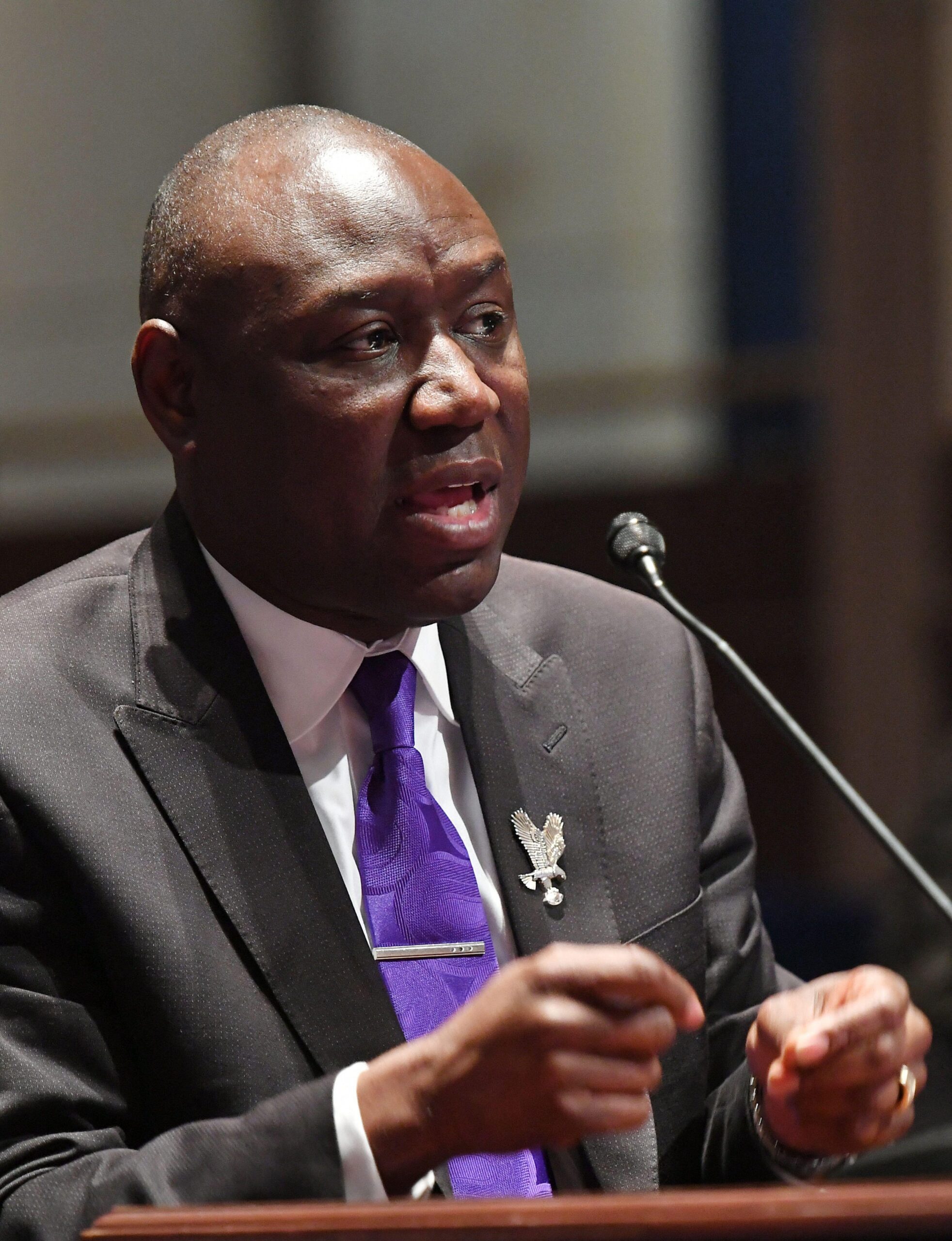
In March 2021, Ben Crump stood alongside George Floyd’s relatives as Minneapolis announced a $27 million civil settlement over Floyd’s death. Before the cameras, the legal outcome and the family’s bereavement remained inseparable. Floyd’s brother Philonise said he would surrender the money if it could bring George back. Crump described the agreement as one step in a longer pursuit of justice. The occasion captured the role for which he had become familiar: a lawyer helping a family seek accountability while the loss at the centre of its case remained painfully personal.1
An ambition formed in childhood
Crump grew up in Lumberton, North Carolina, where he became aware of the gulf between the resources available to Black and white communities. In his account of his childhood, travelling to an integrated school brought those differences into sharp focus. His mother, who worked two jobs, told him about Thurgood Marshall and the lawyer’s role in opening educational opportunities. Crump came to associate the law with a practical possibility: changing the conditions in which a community lived. He has traced his ambition to become a lawyer to those school years, when Marshall offered an example of someone who could challenge circumstances that a child otherwise had little power to alter.3
As an adolescent, he moved to Florida and later won a scholarship to Florida State University. He studied criminal justice and served two terms as president of the university’s Black Student Union. Student leadership also brought him into contact with Daryl Parks, who held student government office at nearby Florida A&M University. Their friendship developed before either entered legal practice. Both went on to Florida State’s law school, carrying into professional education a relationship shaped by campus organising and their experiences of growing up with limited financial resources.4
After graduating from law school in 1995, Crump and Parks established a practice in Tallahassee. Their work included medical negligence, road accidents, defective products and neglect in nursing homes, as well as civil rights litigation. These were cases involving injured people and families negotiating with institutions that often possessed greater resources. The practical foundations of Crump’s career therefore extended beyond the events that later brought national attention. Building a firm meant developing the ability to pursue compensation, prepare evidence and represent clients whose injuries or bereavements had disrupted ordinary lives.5, 6
A practice rooted in the community
Community involvement accompanied that early professional work. In 2003, Crump and Parks met 29 young people taking part in an educational journey organised by American football player Derrick Brooks. The visit took place at Florida State, where the students had stayed during the tour. Crump spoke about identifying their abilities, working towards goals and making use of educational experiences. He also introduced members of a university fraternity step team, who performed and answered questions about college life. The encounter connected professional achievement with a setting the young visitors could experience for themselves.7
One of the cases that brought Crump wider attention concerned Martin Lee Anderson, a 14-year-old who died following his treatment at a Florida juvenile boot camp in January 2006. Crump represented his family as video evidence exposed what had happened. Florida’s legislative investigation examined the force used against Anderson and the administration of ammonia while his mouth was held closed. The resulting civil settlements included a $5 million state contribution. This was a formative example of the work that would define Crump’s public career: supporting grieving parents while pressing institutions to answer for a young person’s death.4, 8
Trayvon Martin and a national audience
The killing of Trayvon Martin in Sanford, Florida, in February 2012 placed that work before a much larger audience. Martin’s family questioned why George Zimmerman, the neighbourhood watch volunteer who shot him, had not initially faced charges. Crump became a public representative of their demand for an investigation and accountability. The family and its supporters argued that racial profiling had shaped the encounter and challenged the authorities’ response. In April, when Zimmerman was arrested and charged with second-degree murder, Crump also urged people not to take matters into their own hands. He was representing the family, while the prosecution belonged to the state.9
Zimmerman’s trial ended in acquittal in July 2013. A separate federal investigation continued, but the US Department of Justice announced in February 2015 that it had insufficient evidence to bring federal criminal civil rights charges. The department explained that its decision reflected the demanding legal standard for such a prosecution. Those outcomes remain essential to understanding this part of Crump’s career. The attention he helped bring to Martin’s death did not produce a criminal conviction. His role was to represent the family’s interests and press its concerns within a process whose charging decisions and verdicts he did not control.10
Other cases required a less visible struggle over whether a civil claim could proceed. Crump represented Robbie Tolan, who was unarmed when a police officer shot him outside his parents’ home in Texas in 2008. In 2014, the US Supreme Court set aside a ruling against Tolan because the lower court had mishandled disputed evidence at the summary judgment stage. The justices required that evidence favourable to Tolan receive proper consideration. They did not themselves decide that the officer was liable. For a lawyer representing injured clients, securing that opportunity for a claim to be examined could be a significant part of the work.2, 11
A wider platform for civil rights
In 2015, Crump became the National Bar Association’s 73rd president. He and Parks had attended their first annual convention in 1995, with support from lawyer Willie Gary, and Crump credited the association’s members with teaching them practical lessons about legal work. His presidential agenda included police body cameras and voting rights. A symposium revisited the Voting Rights Act half a century after its passage. The organisation offered a route from representing individual clients to working with other lawyers on questions about professional responsibility, political participation and the institutions administering justice.5
George Floyd’s death in Minneapolis in May 2020 brought Crump into another case that generated protests across the United States. He represented the family as it pursued civil redress against the city. When councillors approved the settlement the following March, the agreement included $500,000 for the community around the intersection where Floyd died. At the announcement, Crump appealed for peaceful protest. His work involved negotiating a financial resolution while remaining alongside relatives whose concerns extended beyond the terms of an agreement. The family’s loss had become the focus of demands reaching far beyond Minneapolis.1
The civil agreement was separate from the criminal proceedings against the officers. In April 2021, a Minnesota jury convicted Derek Chauvin on all counts in his state trial. Chauvin later pleaded guilty to federal civil rights offences involving Floyd and a separate victim, and received a federal prison sentence in July 2022. Those prosecutions were conducted by government lawyers. Crump’s place in the wider story was as counsel and advocate for Floyd’s family. Keeping those responsibilities distinct gives a clearer account of what the family’s legal team achieved and how different forms of accountability were pursued.12, 13
Crump had taken his arguments to Congress before those outcomes were known. In written testimony for a House Judiciary Committee hearing on 10 June 2020, he called for national policing standards, compulsory body cameras, limits on force and changes to qualified immunity. His statement connected Floyd’s death with those of other Black Americans and argued that individual cases revealed broader problems. It also showed how his public work moved between different audiences. A family’s civil claim sought a remedy for particular harm; congressional testimony asked legislators to change the conditions under which future encounters might unfold. He urged police to act as community partners and peacekeepers, matching their powers with public accountability for the harm they caused.14
Beyond the best-known cases
The growth of Crump’s public profile was accompanied by changes in his practice and work in broadcasting. Florida State’s alumni records announced the launch of Ben Crump Law in 2017, following his partnership with Parks. The next year, he hosted TV One’s Evidence of Innocence, which examined the experiences of people imprisoned for crimes they had not committed and later released. The programme brought questions about wrongful conviction to a television audience. It was another means of placing individual experiences before the public, alongside the press conferences and legal proceedings with which his name was increasingly associated.15
His work with Henrietta Lacks’s family brought a different history into that public discussion. Cells taken from Lacks without her knowledge in 1951 became the HeLa cell line, widely used in medical research. Her family’s lawsuit against Thermo Fisher Scientific argued that the company had continued to profit from the cells after their origins were well known. Crump represented the family as the dispute reached a confidential settlement in 2023. Both sides announced that the matter had been resolved, without disclosing the terms. The case concerned commercial benefit and an earlier generation’s treatment, expanding the subject matter beyond police encounters while retaining the question of whose contribution and suffering receive recognition.16
Education, mentoring and continuing ties
Educational access remained part of Crump’s work throughout these developments. Florida State’s 2007–08 annual report recorded that he and Parks had increased their commitment to an endowed diversity scholarship from $25,000 to $100,000. The fund supported students from groups historically underrepresented in the legal profession. The donors expressed a preference for recipients who lived in Florida or would remain to practise there for at least three years. Their contribution linked access to professional training with the future provision of legal services in the state where they had built their own careers.6
In February 2023, St Thomas University in Miami Gardens named its law school after Crump. At the ceremony, he emphasised education, diplomacy and strategic thinking as resources for students who wanted to challenge injustice. The university subsequently resumed using the name St Thomas University College of Law; its current faculty information identifies a Benjamin L. Crump Environmental and Societal Law Institute. The institutional relationship places his name within legal education as well as litigation. It also returns to a recurring concern in his career: how students gain the training and confidence to enter a profession that can shape other people’s opportunities.17, 18
Tallahassee remains central to the way Crump describes his working life. In an interview with the city’s visitor organisation, he recalled choosing to stay after graduation and credited local mentors with lessons he had not learnt in the classroom. He also spoke about the city’s Black history museums and the value of raising a family there. Those continuing ties provide a setting for a career often seen through national news coverage. National cases have carried him from city to city, but when he explains how he became a lawyer, he returns to the community that helped him begin.19
Sources and further reading
1. MPR News: Minneapolis council approves $27M Floyd family settlement.
2. Ben Crump Law: Ben Crump — attorney biography.
3. Ben & Jerry’s: An Interview with Attorney Benjamin Crump.
4. Super Lawyers: ‘Benjamin Crump. Justice.’.
5. Florida State University College of Law: Alum Benjamin Crump: Seeking Justice Through the Profession and His Practice.
6. Florida State University College of Law: Florida State Law, Fall 2008 — 2007–08 Annual Report, page 5.
7. Tampa Bay Buccaneers: Brooks’ Bunch Returns Home.
8. Florida Legislature: Relief of the Estate of Martin Lee Anderson — Special Master’s Final Report.
9. NPR / KUNC: Zimmerman Is Reportedly Arrested; Prosecutor Has ‘New Information’.
10. US Department of Justice: Federal Officials Close Investigation Into Death of Trayvon Martin.
11. US Supreme Court / Cornell Legal Information Institute: Tolan v. Cotton, 572 U.S. 650 (2014).
12. US Department of Justice: Statement of Attorney General Merrick B. Garland on the Verdict in the Chauvin Trial.
13. US Department of Justice: Former Minneapolis Police Officer Derek Chauvin Sentenced to More Than 20 Years in Prison.
14. US House of Representatives, Committee on the Judiciary: Ben Crump’s written testimony: Oversight Hearing on Policing Practices and Law Enforcement Accountability, 10 June 2020.
15. Florida State University College of Law: Class of 1995 — alumni notes for 2017 and 2018.
16. ITV News: Henrietta Lacks’ family settles lawsuit with biotech company that used her cells without consent.
17. St Thomas University: STU College of Law Naming Ceremony.
18. St Thomas University: Shani M. King — faculty profile and Crump institute directorship.
19. Visit Tallahassee: Warrior for Justice: The Footprint of Attorney Benjamin Crump.