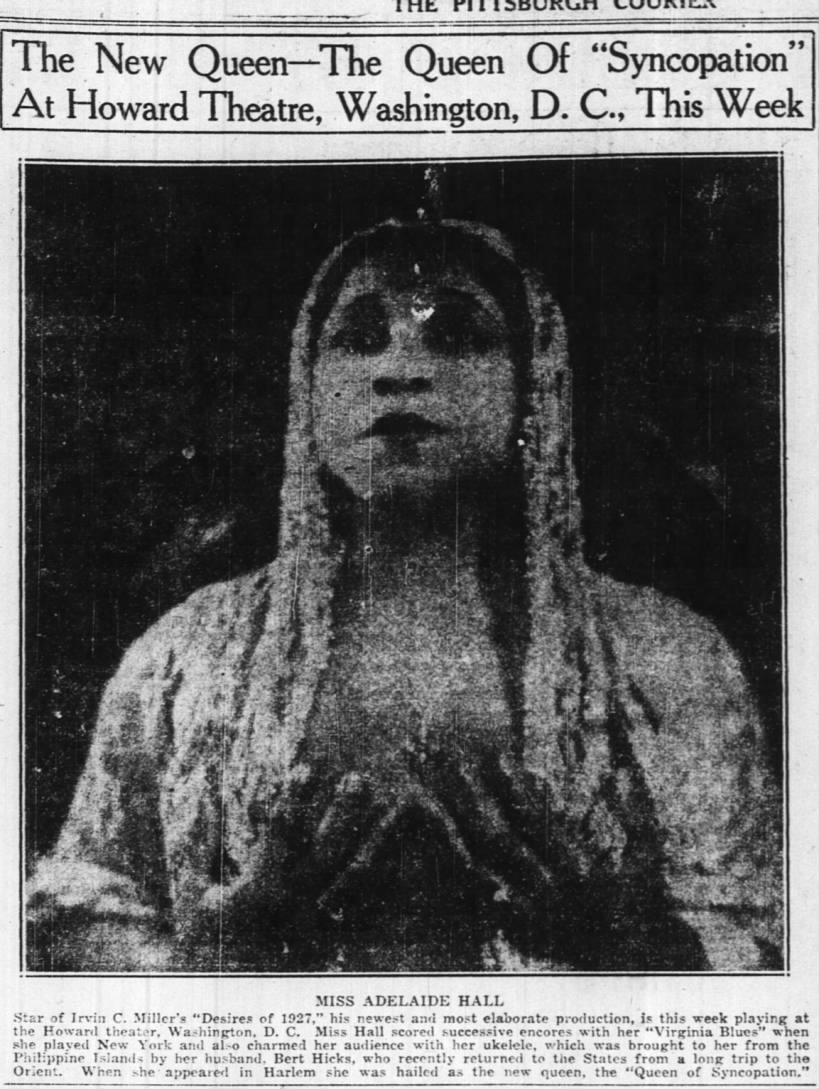
On Duke Ellington’s 1927 recording of Creole Love Call, Adelaide Hall sings without words. Her voice takes its place within the music as a distinct sound, carrying a melodic line without a lyric to explain it. Her career spanned jazz, musical theatre and cabaret, and her voice became familiar to British audiences over many decades.1, 2
The recording can be dated precisely. Victor’s session information, preserved by the University of California, Santa Barbara, places it in Camden, New Jersey, on 26 October 1927. Hall is credited as the soprano vocalist; Ellington, Bubber Miley and Rudy Jackson receive the composer credits. Those details keep the collaboration in focus. Hall’s contribution was the sung performance, recorded with an orchestra whose musicians brought their own parts to the finished sound.1
Learning the work on Broadway
Hall was born in Brooklyn in 1901. By 1921 she was appearing in Shuffle Along, the Broadway musical with music by Eubie Blake and lyrics by Noble Sissle. The production’s cast record lists her as a Jazz Jasmine, one of its ensemble performers. Before the recordings and headline appearances came the collective work of a musical: singers, dancers and instrumentalists contributing to the same evening’s entertainment.3, 12
Photographs at the New York Public Library place her in Blackbirds of 1928, with music by Jimmy McHugh and lyrics by Dorothy Fields. The show gave Hall a prominent place in the photographic record of Broadway revue. Its surviving production photographs also preserve the visual work of a revue: costume, pose and presentation were part of how a singer met an audience. A revue number was a song and a stage appearance, sustained by the production around it.4
A group photograph from the Paris production in 1929 records a Christmas gathering of cast, crew and guests. The Smithsonian identifies Hall among those pictured, alongside performers including Elisabeth Welch and Aida Ward. It documents the international company of people around this entertainment. By then the work had carried Hall across the Atlantic, linking a Broadway production to the artistic and social life of Paris.5
Across the Atlantic, towards London
Hall appeared at the London Palladium in 1931. With her husband and manager, Bertram Hicks, she later established a club in Paris, La Grosse Pomme. In 1938 she moved to London for The Sun Never Sets and made the city her home. The couple’s Old Florida Club in Mayfair added running a venue to her performing career. It was destroyed in an air raid in 1940.2
Racism also shaped the choices available to her. In September 1932, the Black newspaper The Advocate printed William Pickens’s response to opposition to Hall leasing a house in Larchmont, New York. He challenged a white resident’s argument that she should live somewhere else. The report makes clear that professional success offered no guarantee of freedom to choose a home. It also preserves a contemporary public defence of her right to live there, rather than leaving the story entirely to later reminiscence.6
In Britain, the club and broadcasting worlds overlapped. A 1939 Radio Times television listing advertised Harlem in Mayfair from the Old Florida Club, with Hall among the performers. It also named Fela Sowande, printed as Felix, with his choir and orchestra. A nightclub programme could thus become television entertainment. The listing places Hall within a working network of Black musicians in London before the Second World War.7
A voice on the wartime airwaves
Wartime programme listings show another setting for her singing. On 21 August 1942, the BBC Forces Programme scheduled Hall with the tenor Heddle Nash, a chorus and the augmented BBC Revue Orchestra. These credits bring together different musical backgrounds under one broadcast. They also show the scale of the collaboration surrounding a featured singer, whose voice reached listeners through the work of conductors, players, arrangers and producers.8
Her wartime work also included performances for troops through ENSA, the organisation that provided entertainment for the armed forces. Broadcasting belonged to a wider pattern of live work in the difficult conditions of the war.2
Her own series, Wrapped in Velvet, followed in 1943. English Heritage identifies it as part of her early regular broadcasting for the BBC. A continuing programme gave Hall a different relationship with an audience from a single theatrical engagement: listeners could hear her again as a familiar presence in their homes. Her place in British entertainment was being made through repeated appearances and recognisable sound as well as the prestige of a particular venue.9
The singer at work on film
Surviving footage from A World Is Turning, an unfinished film of 1948, shows Hall at London’s Nightingale Club. The BFI holds six reels of rushes, including rehearsal and performance material. Some scenes were filmed in multiple takes and were arranged for the camera. That distinction matters when watching them: they preserve a performer at work, but they are not an untouched record of a private rehearsal or a complete night in the club.10
Hall sings The Gospel Train and rehearses Swing Low, Sweet Chariot with a pianist. The material extends the picture offered by her Ellington recording, showing how spirituals also belonged to her repertoire. Voice, accompaniment and presentation meet in the same frame. The BFI’s account of her British career also records appearances in Kiss Me Kate and Love from Judy, placing her in the postwar West End as well as its cabaret rooms.11
Songs carried into a long career
In 1957 Hall returned to Broadway in Jamaica, playing Grandma Obeah. British television audiences could still encounter her much later: the 300th edition of Parkinson, scheduled in February 1981, listed her among its special guests. These appearances belong to different stages of a career that crossed formats as well as countries. The show credits keep her visible as a working performer through changes in theatrical and television fashion.12, 13
The album Live at the Riverside Studios with Benny Waters offers another route into that range. Its programme includes Creole Love Call, Diga Diga Do, Streets of London and The Way We Were. The selection brings music associated with different periods into one performer’s repertoire. Hall could return to familiar material while making room for songs from later decades; the track list gives a practical starting point for exploring that breadth.14
Hall died in London in November 1993. The recordings, stage credits and surviving films leave several ways to meet her work: as an ensemble performer, a featured voice with an orchestra, an actor in a musical and a singer addressing a cabaret audience. Listening across them reveals the variety of the career she built.12
Sources and further reading
1. Victor matrix BVE-39370: Creole Love Call / Duke Ellington Orchestra — University of California, Santa Barbara Library — Discography of American Historical Recordings.
2. Adelaide Hall — English Heritage.
3. Shuffle Along — Original Broadway Production — The Broadway League — Internet Broadway Database.
4. Adelaide Hall in the stage production Blackbirds of 1928 — New York Public Library, Billy Rose Theatre Division.
5. Group portrait of the Christmas cast party for Lew Leslie’s Blackbirds of 1928 — Smithsonian National Museum of African American History and Culture.
6. Adelaide Hall and the Larchmonters, 24 September 1932, page 1 — William Pickens, The Advocate; Historic Oregon Newspapers, University of Oregon Libraries.
7. Radio Times television listings, 1939 — Harlem in Mayfair — BBC History of the BBC.
8. Forces Programme schedule, 21 August 1942 — BBC Programme Index.
9. Women to be celebrated with English Heritage blue plaques in 2024 — Adelaide Hall — English Heritage.
10. A World Is Turning — British Film Institute — BFI Replay.
11. Transatlantic stardom: African American trailblazers in British film — British Film Institute; Suyin Haynes.
12. Adelaide Hall — Broadway Cast and Staff — The Broadway League — Internet Broadway Database.
13. BBC One London schedule, 28 February 1981 — Parkinson: 300 — BBC Programme Index.
14. Adelaide Hall Live at the Riverside Studios with Benny Waters — JAY Records.
Featured image. Adelaide Hall pictured in The Pittsburgh Courier on 13 November 1926, promoting her appearance at the Howard Theatre in Washington, DC. The Pittsburgh Courier, 13 November 1926; photographer uncredited. Newspaper clipping via Wikimedia Commons. Image record · Public domain
