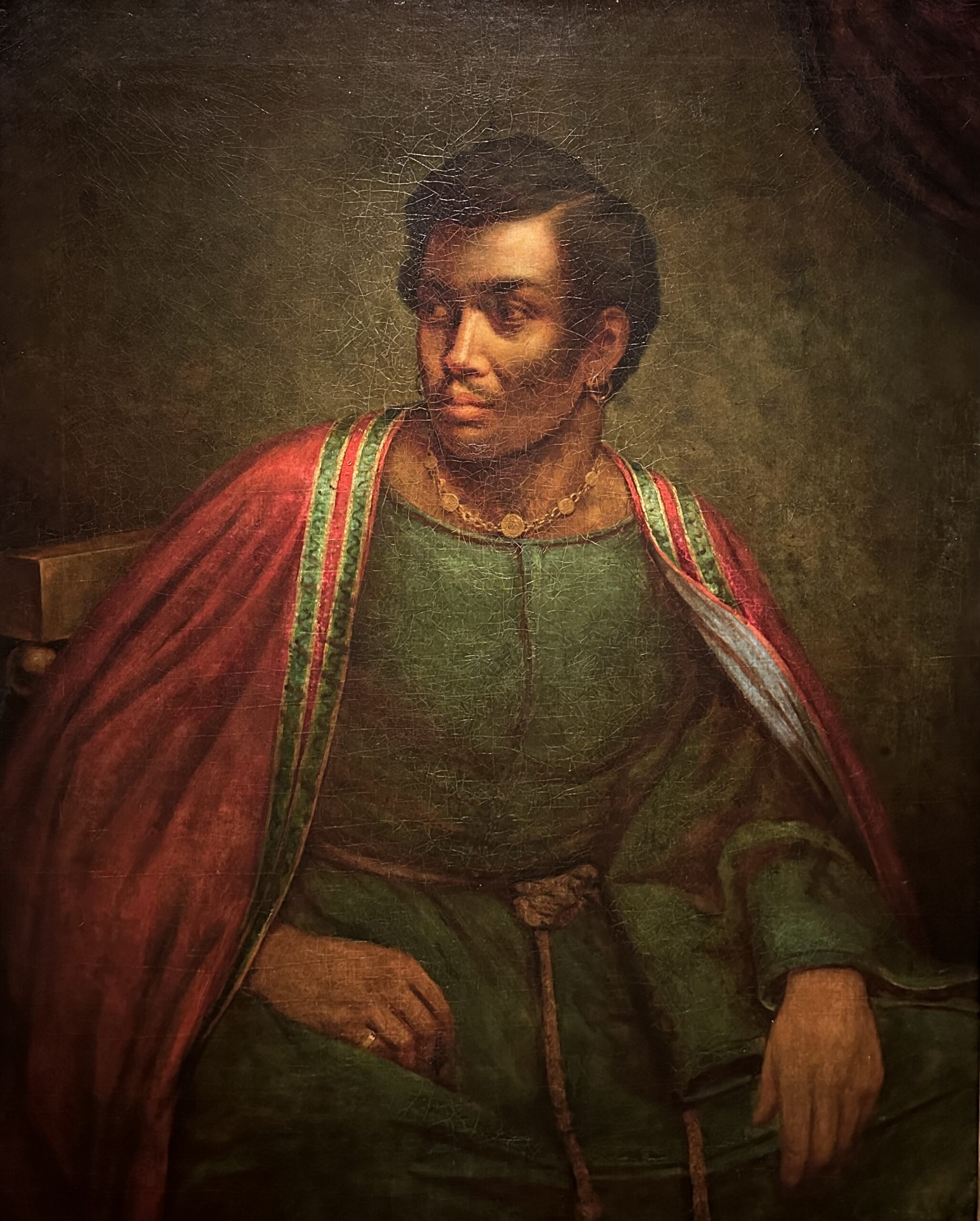
In 1851, Ira Aldridge signed the visitors’ book at Shakespeare’s Birthplace and added a line from The Merchant of Venice: “Mislike me not for my complexion”. Beside his name he also placed “Senegal, Africa”. The entry brought Shakespeare’s language, a challenge to racial prejudice and the actor’s carefully fashioned public identity onto a single page. Aldridge had actually been born in New York.1, 2
From New York to the London stage
Born in 1807, Aldridge attended New York’s African Free School. Its examination days gave pupils opportunities to demonstrate their learning through public performance. That schooling places his beginnings within a Black community’s intellectual and cultural life. He was already associating with professional Black actors as a teenager. The education behind his later Shakespearean reputation matters: his abilities developed through learning, practice and contact with other performers.2
The African Grove Theatre in New York provided one of those early opportunities. Black actors performed there despite harassment from white opponents; the theatre eventually closed after repeated violence and police intervention. The Folger Shakespeare Library places Aldridge’s teenage acting within this company. His career began in an existing Black theatrical world, whose ambitions were restricted by the conditions in which it had to operate.3
In 1825 Aldridge appeared as Othello at the Royalty Theatre in London’s East End, using the name Mr Keene. He was still a teenager. Performances at the Royal Coburg followed later in 1825. These early London engagements preceded the better-known Covent Garden appearance by eight years. Keeping the venues separate makes his progress clearer: he acquired experience and a reputation before being invited onto that prestigious stage.4
The business of making a career
Touring offered further opportunities. In Coventry in 1828, Aldridge took over the management of the theatre for a short season. He changed the company and made improvements to the building, assuming responsibility for the work around a performance as well as the acting itself. The results were mixed, and his management ended that spring. It was a brief venture in running a theatre, with the practical difficulties that the role brought.5
In 1833 he played Othello at Covent Garden, replacing Edmund Kean. Audience enthusiasm did not secure an equivalent response from critics, whose judgements were entangled with hostility to a Black actor occupying the role. Aldridge continued working around Britain. The geography of his career is important: London’s most prestigious theatres were only part of a much larger network in which an actor could establish a following and make a living.6
An August 1834 letter preserved by the Folger catches that working life in motion. Writing from Hull to the manager of Southampton’s Theatre Royal, Aldridge proposed another engagement and discussed its arrangements and payment. He signed with his professional title, the African Roscius. Here is the actor organising the next job while already away from home. Such correspondence gives substance to the word “touring”: each performance depended on negotiation, travel and the cooperation of another theatre company.3
A wider Shakespearean repertory
Othello remained central to Aldridge’s reputation, but his parts also included Lear, Shylock, Macbeth and Richard III. Moving among these roles required a range of ages, temperaments and dramatic situations. The repertory shows how widely he worked within Shakespeare, even when racial expectations shaped the opportunities available to him. A career described solely through Othello leaves much of his acting out of view.6
He also helped change a play. Working with Charles A. Somerset on an adaptation of Titus Andronicus, Aldridge transformed Aaron from a villain into a heroic figure. Much of the violence was removed and new material altered the character’s position in the story. No script of this version is known to survive, so its shape must be approached through contemporary reviews. Those accounts establish a substantial intervention in the drama, while leaving details that cannot now be reconstructed confidently. Aldridge’s relationship with Shakespeare included decisions about what an audience would see and whom it would be asked to sympathise with.5
Publicity, identity and a visit to Stratford
The title African Roscius linked Aldridge to a celebrated actor of ancient Rome. His publicity also circulated a story of princely Senegalese ancestry. These claims belonged to the public persona through which he sold his performances; they should not be repeated as family history. Playbills could praise his talent while presenting him as an exceptional curiosity. Reading them requires attention to both the work being advertised and the assumptions about race built into the advertisement.4
The Stratford visit of 1851 brought this publicity into Shakespeare’s hometown. Aldridge performed seven plays during an eight-day stay and visited the Birthplace twice. His Othello opened on 28 April at the Royal Shakespearean Theatre on Chapel Lane, a building that has since disappeared. The surviving playbills and visitor-book entries document the visit from different directions: one sells a theatrical attraction, while the other preserves the name and words he chose to leave behind.1
Performing across Europe
Continental tours from 1852 widened his audiences considerably. Aldridge found acclaim in places where many spectators knew Shakespeare through translation and could not follow all his English. Surviving reviews paid attention to his face, voice and physical expression. They offer evidence of a performance style capable of carrying feeling across a language gap. That reception also challenges the idea that the London press could deliver a final verdict on his abilities. Audiences elsewhere encountered and judged the same actor on their own terms.7
Britain remained part of his life. In 1863 he applied for British citizenship, and the papers held by The National Archives include support from admirers, friends and associates. Such documents preserve relationships that a hostile review cannot represent. Alongside the public career, they reveal a man whose work and presence had acquired value for people prepared to put their support in writing.8
Aldridge died while touring in Łódź in 1867 and was buried there. His journeys had carried a New York education and a career developed on British stages across much of Europe. The honours he received record one kind of achievement; the theatrical record supplies another, in the roles he repeatedly returned to and the audiences he continued to seek. His career remained an active, travelling enterprise until its end.7
The Stratford signature gives this history a particularly direct form. Aldridge selected a passage from the plays that sustained his working life and made it part of his own entry. The surviving page allows readers to encounter that deliberate act of self-presentation more than a century and a half later.1
Sources and further reading
1. 1851: Ira Aldridge Comes to Stratford — Shakespeare Birthplace Trust; Victoria Joynes.
2. Ira Aldridge — Examination Days: The New York African Free School Collection — New-York Historical Society.
3. A Man of Firsts: Black Shakespearean Actor Ira Aldridge — Folger Shakespeare Library; Heather Wolfe and Johnna Champion.
4. The African Roscius — Shakespeare Birthplace Trust; Victoria Joynes.
5. Mislike me not for my complexion… — Shakespeare Birthplace Trust; Victoria Joynes.
6. Ira Aldridge — National Portrait Gallery.
7. Chevalier Ira Aldridge — Shakespeare Birthplace Trust; Victoria Joynes.
8. Love Letters exhibition — Ira Aldridge’s 1863 citizenship application — The National Archives.
Featured image. Henry Perronet Briggs’s portrait of Ira Aldridge as Othello, painted around 1830, in the National Portrait Gallery, Smithsonian Institution. Painting by Henry Perronet Briggs (1793–1844). Photograph by APK, 8 July 2026, via Wikimedia Commons. Image record · CC BY 4.0 (photograph)
