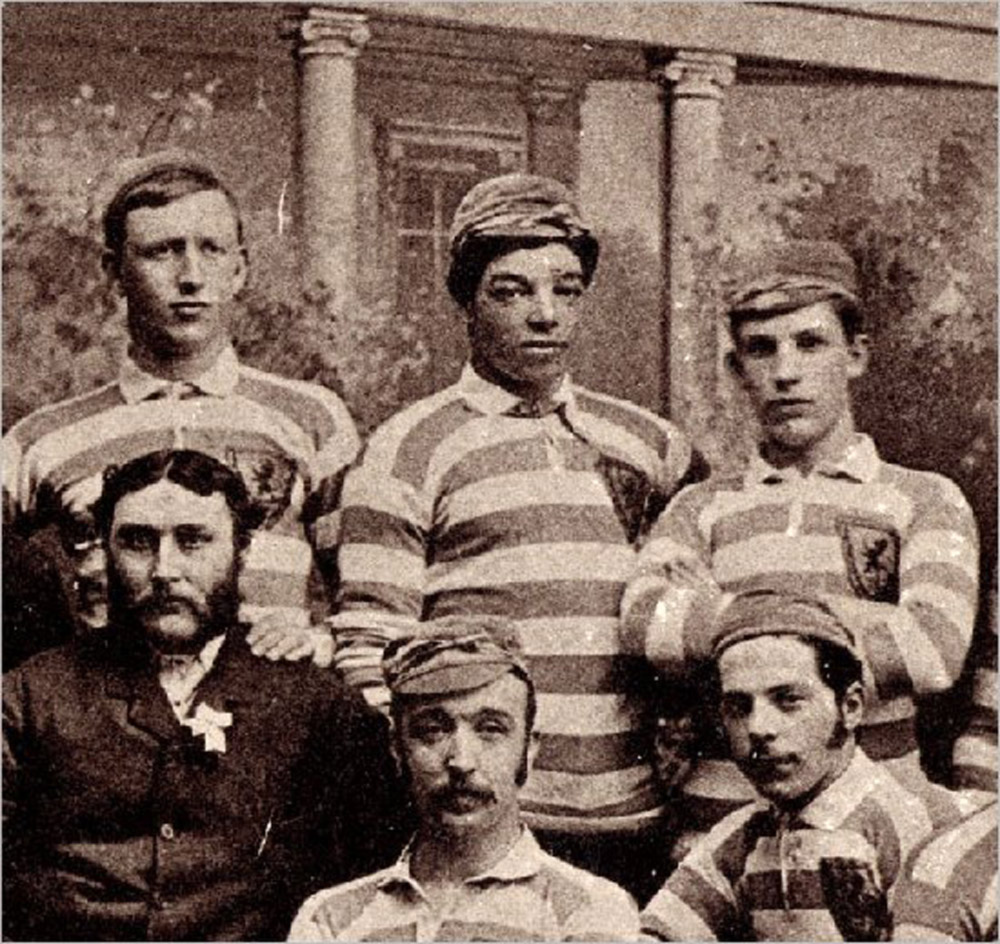
At the Oval in March 1881, Scotland beat England 6–1. The visiting captain was Andrew Watson, a defender whose first international appearance ended in an emphatic victory. Days later he captained Scotland again, this time in a 5–1 win over Wales. His position in the team was already one of responsibility. 1
The Scottish Football Association recognises Watson as the first Black man to play international association football. That distinction belongs to a career involving several clubs, administrative work and a changing approach to how the game was played. His story also leads back to the wealth and violence of the British Caribbean. 2
A family history connected to slavery
Watson was born in Demerara, in what was then British Guiana, on 24 May 1856. Today that territory is Guyana. His father, Peter Miller Watson, was Scottish; his mother was Hannah Rose, a woman from Guyana. 3
His father’s wealth cannot be separated from the plantation economy. UCL’s Legacies of British Slavery database identifies Peter Miller Watson as a recipient of several compensation awards following the abolition of slavery. The payments went to enslavers for the loss of what the law had treated as their property. 4
Peter died in 1869. His estate provided for Andrew and his sister Annetta, both children of Hannah Rose. The probate record placed his effects below £35,000, a substantial estate. These records reveal the material advantages available to Andrew alongside the racial inequalities surrounding his family. 4
Inheritance does not explain his footballing ability. It does help us understand the opportunities through which that ability developed: education, movement between places and participation in a game organised around amateur clubs. Remembering a Black sporting pioneer also means recognising the enslaved people whose labour contributed to the family’s prosperity. 4
Education and the work of building a club
Watson attended Heath Grammar School in Halifax and later King’s College School in London. Sport was part of his education before he became a familiar name in Scottish football. His route into the game crossed national borders well before his international debut. 5
The University of Glasgow preserves his matriculation entry. It records his enrolment in November 1875, aged 19, for studies in philosophy, mathematics and engineering. He left his studies the following year. The record is a useful reminder that his life in Glasgow included education and professional ambitions as well as matches. 6
It also places him among the people moving between Scotland and the Caribbean through the networks of empire. A university register can look like a small administrative trace, but here it fixes a young man’s presence in a city where he would make a considerable sporting reputation. 6
Watson played for Maxwell and Parkgrove before joining Queen’s Park in 1880. At Parkgrove he took on organisational responsibilities and invested his own money in the club. The Scottish FA records more than a hundred appearances for the side and his service as its vice-president. 7
This work matters because football clubs had to be made and maintained. Players needed opponents, arrangements and funds as well as a pitch. Watson helped sustain that collective activity while developing as a player. He was part of the organisation of the game, as well as its public performance. 7
Queen’s Park and the Scotland team
At Queen’s Park, Watson entered one of the leading clubs of the period. He became its secretary in November 1881, combining his place in the side with an influential role off the field. The appointment followed his emergence as a Scotland international. 3
Across his time with Queen’s Park he won three Scottish Cups. Those successes give his reputation a firm competitive basis. He was a member of teams that won major matches, with repeated selection reflecting his value to the club. 7
Watson’s third Scotland appearance came in 1882, in another 5–1 victory over England, this time in Glasgow. Three internationals produced three wins. The surviving team photographs place him among his colleagues in a successful national side. 1
His international record ended there. The Scottish Football Museum explains that his move to London for business coincided with Scotland selecting players based at home. The small number of caps should therefore be read in the circumstances of the early game, rather than as a measure of a short-lived talent. 1
Taking the passing game south
In England, Watson played for Corinthian FC. The club’s records list eleven appearances between 1883 and 1885, including an 8–1 victory over the FA Cup holders, Blackburn Rovers, in December 1884. Corinthian-Casuals, the later successor club, associates him with the development of its passing style. 5
The emphasis was on combining with team-mates: moving the ball between players to create an attack. Watson carried experience of Scottish football into a club eager to learn from it. He was valued as someone who could help a team play, not simply as an unusual name on its list of players. 5
A profile in the Scottish Athletic Journal in 1885 presented Watson as an established sporting figure. The museum’s account of the article also records its acknowledgement that he had been subjected to insults on the field. Recognition and racial hostility could exist within the same career. Selection for a leading club did not make prejudice disappear. 3
The player behind the milestone
Watson later played for Bootle and pursued work as a marine engineer. He died in Kew in March 1921 and was buried in Richmond Cemetery. His life extended beyond the photographs in football kit through which he is most often encountered. 5
In 2012 he was inducted into the Scottish Football Hall of Fame. Public recognition brought attention back to a career that had long belonged in the history of the national game. The honour also creates an opportunity to look past the language of exceptional individuals and ask how football’s early institutions worked. 8
Watson’s significance is precise: a Black man played and captained international association football in the nineteenth century. His wider importance emerges from the details. He helped organise clubs, won trophies and took part in the exchange of footballing ideas between Scotland and England. Family records add a difficult history of inherited wealth to that sporting achievement. Both belong in the account. 2
Sources and further reading
1. Andrew Watson. Scottish Football Museum, via Google Arts & Culture; Scottish Football Museum.
2. Andrew Watson. Scottish Football Association: 150 Years of Scottish Football.
3. Andrew Watson: Pioneering the Beautiful Game for Scotland. Scottish Football Museum; Robyn McCready and Megan Stamper.
4. Peter Miller Watson. UCL, Centre for the Study of the Legacies of British Slavery.
5. Corinthian Greats: Andrew Watson. Corinthian-Casuals Football Club.
6. Guyana: University Student Records. University of Glasgow Archives & Special Collections.
7. Remembering Andrew Watson. Scottish Football Association.
8. Andrew Watson. Scottish Football Museum, Hall of Fame.
Featured image. Andrew Watson, standing at the centre of the back row, with the Scotland team that faced England at Hampden Park on 11 March 1882. Photographer unknown. Scottish Football Museum, reproduced by TheGlasgowStory; public-domain status documented on Wikimedia Commons. Image record · Public domain

