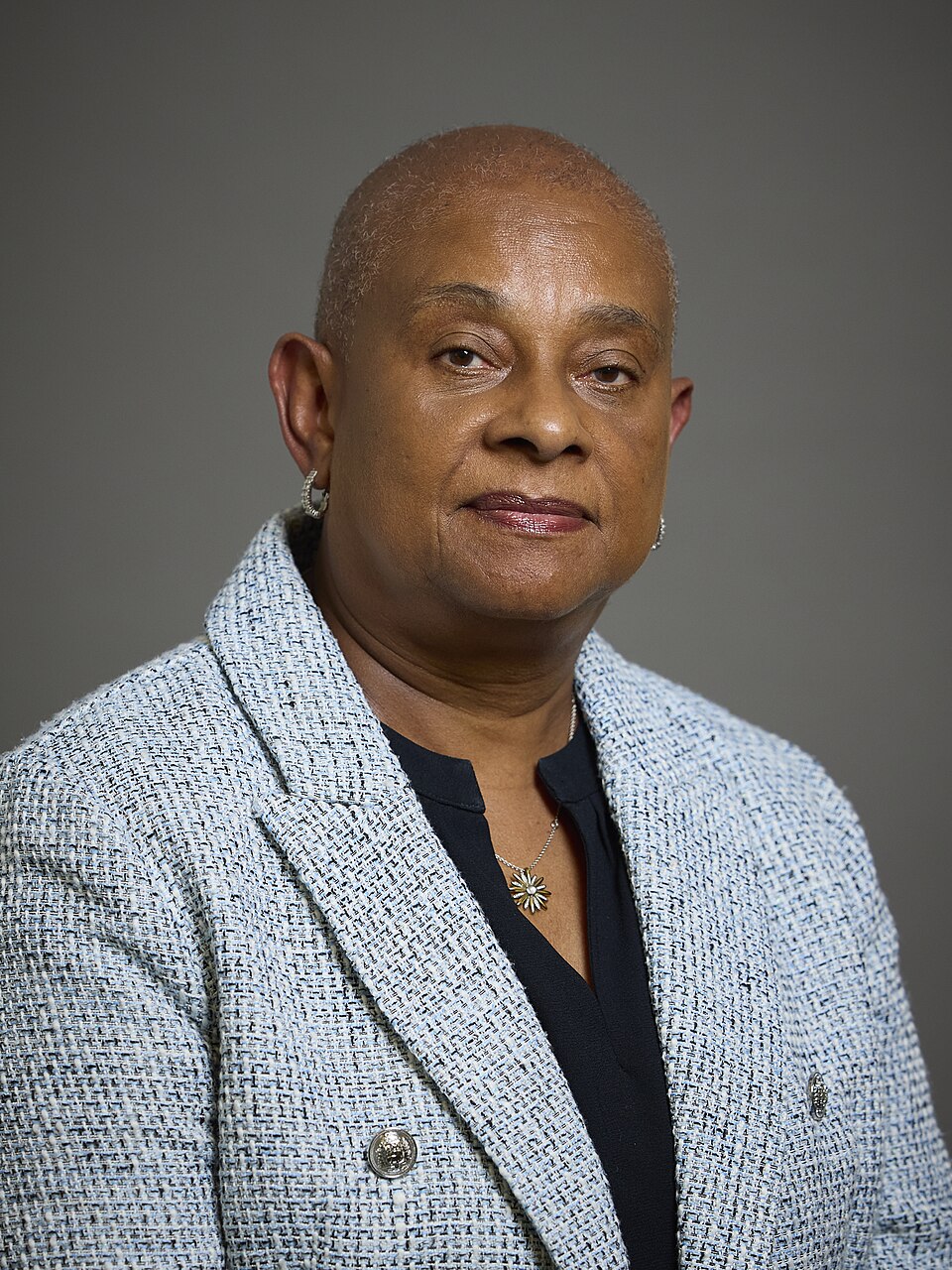
Doreen Lawrence entered national public life through the campaign following the racist murder of her son Stephen in 1993. The family pressed for answers about the police investigation and for changes in the treatment of other families. Over time, Lawrence’s work extended into charities, public policy and Parliament, while education remained a central concern. 1
Family, migration and study
Lawrence spent her early childhood with her grandmother in Clarendon parish, Jamaica. At nine, she travelled to England to join her mother in Brockley, south London. Later, as a parent herself, she returned to education. Her career as a campaigner developed alongside the demands of family life and study. 1
An access course led to a Humanities degree at the University of Greenwich. Stephen was murdered during her first year, but she continued her studies and graduated in 1995. She subsequently completed a postgraduate certificate in therapeutic counselling in 1999. These qualifications form part of a longer engagement with education that is sometimes obscured by the public history of the campaign. 6
Securing a public inquiry
In February 1999, Home Secretary Jack Straw told Parliament that meetings with Doreen and Neville Lawrence had helped persuade him that the case required an independent examination. He had appointed Sir William Macpherson to lead a judicial inquiry in July 1997. Its task covered both the investigation of Stephen’s murder and the wider lessons for policing. 2
The inquiry identified failures of leadership, professional incompetence and institutional racism in the investigation. Its account of institutional racism concerned the ways an organisation’s processes, attitudes and behaviour could produce discriminatory treatment. The seventy recommendations addressed matters including the handling of racist crime, relations with victims’ families, police training and accountability. The family’s sustained campaign had brought the operation of public institutions under national scrutiny. 2
Change and unfinished work
A House of Commons Home Affairs Committee review in 2021 found important improvements in the policing of racist crime and in commitments to diversity. It also identified continuing racial disparities in areas including stop and search, recruitment and misconduct procedures. The committee concluded that progress had stalled and that the ambition of fair treatment across racial groups remained unmet. More than two decades after Macpherson, it called for renewed leadership and specific action, showing why implementation had become a continuing part of the public argument. 3
Community organisations and opportunity
In her first speech in the House of Lords, on 21 November 2013, Lawrence discussed the voluntary and community sector. She described support that the family had received from people with religious faith and from those without it. Local organisations mattered because they provided services, relationships and routes to opportunity. Her speech asked government to recognise their contribution, particularly where people otherwise struggled to obtain support. 4
She also discussed the Stephen Lawrence Charitable Trust’s work helping disadvantaged young people enter architecture and the built environment, fields connected to Stephen’s own ambition. The practical emphasis was on access to education and employment. Campaigning for institutional change and helping young people prepare for professional life formed connected parts of her public work. 4
Work in the House of Lords
Lawrence became a Labour life peer in September 2013. Her parliamentary service has included membership of the Joint Committee on Human Rights and the committee examining the Children and Families Act 2014 in 2022. These roles involved scrutiny of rights and the operation of legislation. In June 2026, she joined the Built Environment Committee, extending her committee work into questions about the places where people live and work. 5
The work of the foundation
Through the Stephen Lawrence Day Foundation, Lawrence has continued to connect commemoration with opportunities for young people. The organisation describes its work through classrooms, communities and careers, with mentoring, coaching, work experience and bursaries among its methods. Lawrence serves as chair of trustees. Education and preparation for employment are therefore part of the foundation’s activity alongside the annual day of remembrance. 7
In 2018, the government announced that 22 April would become Stephen Lawrence Day. For Lawrence, whose own return to education had continued through the campaign’s earliest years, the development of educational opportunities brought a further dimension to that public recognition. Her work across study, campaigning and national institutions has repeatedly returned to how young people obtain the support needed to pursue their ambitions. 6
Sources and further reading
1. Doreen Lawrence. Black Cultural Archives.
2. Stephen Lawrence Inquiry, 24 February 1999. House of Commons Hansard.
3. The Macpherson Report: Twenty-two Years On. House of Commons Home Affairs Committee.
4. Voluntary and Community Sector, 21 November 2013. House of Lords Hansard.
5. Baroness Lawrence of Clarendon: Parliamentary Career. UK Parliament.
6. Baroness Doreen Lawrence OBE. University of Greenwich.
7. About Us. Stephen Lawrence Day Foundation.
Featured image. Doreen Lawrence, Baroness Lawrence of Clarendon, in her official parliamentary portrait from May 2025. © House of Lords / photography by Roger Harris, 7 May 2025, via Wikimedia Commons; source-provided crop. Image record · CC BY 3.0
