David Pitt entered the House of Lords as a Labour life peer in 1975. By then he had already practised medicine and participated in politics on both sides of the Atlantic. His parliamentary interests included health, social services, welfare and education. These were fields in which decisions made by public bodies affected conditions that a general practitioner encountered through individual patients and families.6
Medicine and politics in Edinburgh
Born in Grenada, Pitt studied medicine at the University of Edinburgh and graduated in 1938. During his student years he joined the Labour Party, participated in the university’s Socialist Society and held office in the Students’ Representative Council. The deprivation he encountered in Scotland helped shape his understanding of the relationship between poverty and ill health. His political interests also remained Caribbean. He supported federation, believing that the islands’ shared colonial history and their economic circumstances made political cooperation necessary. Medical education and arguments about government developed together during this stage of his life.1
A campaign for responsible government
Pitt later described his Caribbean political work in a Lords debate. He had served on San Fernando Borough Council in Trinidad and was deputy mayor when he left. In 1947 he came to Britain seeking support for responsible government in Trinidad and Tobago. He met ministers and addressed Labour meetings, while his colleague Patrick Solomon continued campaigning in the Caribbean. The constitutional settlement adopted by the British government fell short of what he sought. Pitt remained in Britain and established himself in medical practice. The journey connected his Caribbean campaigning with his later British career.2
A surgery connected to its neighbourhood
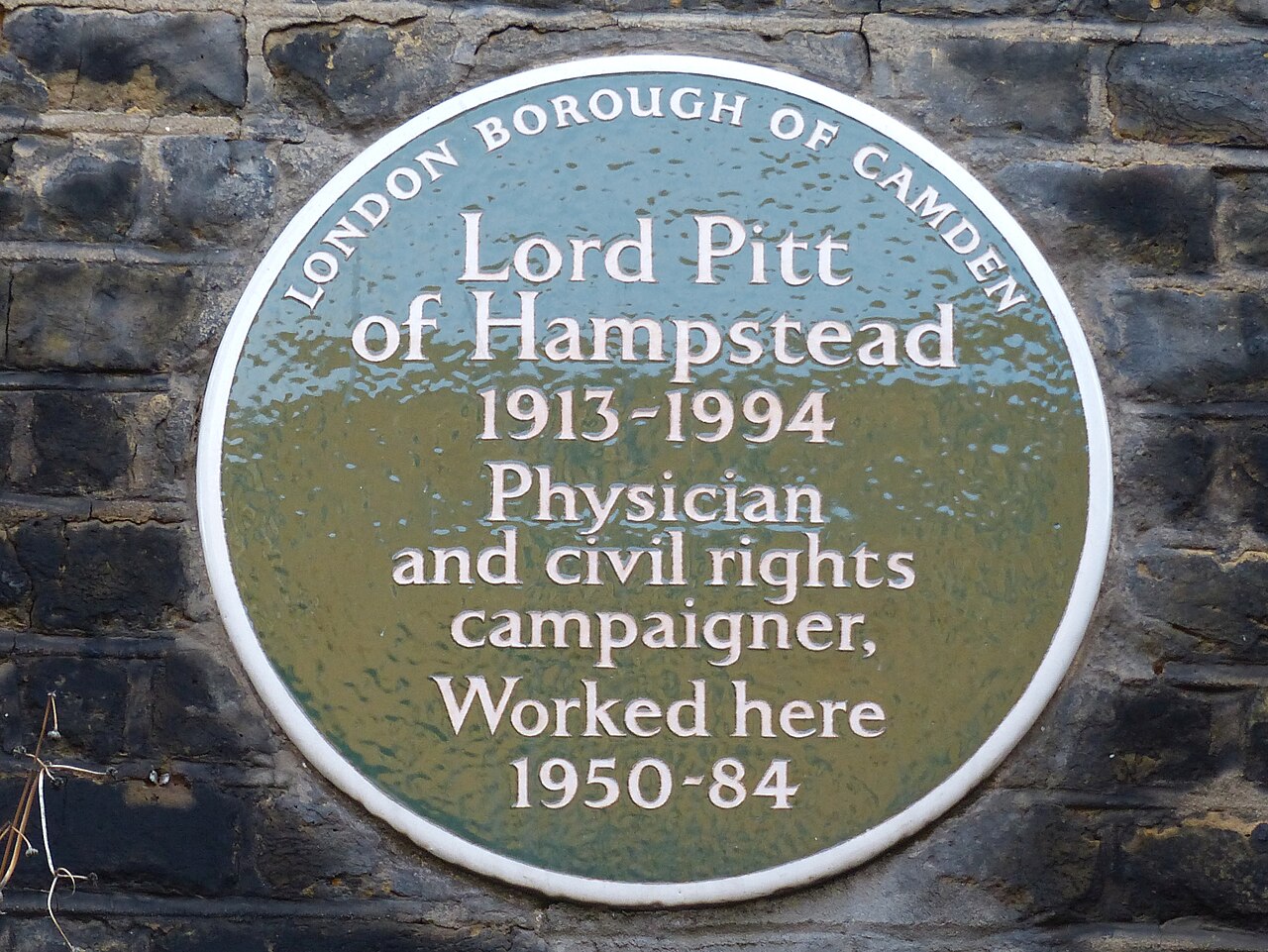
At North Gower Street in London, Pitt worked with his wife Dorothy to run a general practice. Alongside medical care, patients sought help with housing and employment. The surgery also became a meeting place for anti-apartheid campaigners. This combination brought him into contact with problems that extended beyond the consulting room. His public responsibilities grew further in local government: after service on London’s councils, he became chair of the Greater London Council in 1974.3
Election to Westminster remained difficult. Pitt’s own parliamentary account recalled his defeat as Labour’s Hampstead candidate in 1959, followed by election to the London County Council in 1961 and the Greater London Council in 1964. These different outcomes gave him experience of both unsuccessful parliamentary campaigning and sustained service in elected London government.2
Organising pressure on legislation
As chair of the Campaign Against Racial Discrimination, usually known as CARD, Pitt helped lead an organisation seeking stronger protection against unequal treatment. The Race Relations Act 1965 had left employment and housing outside its central prohibitions. When new legislation was considered in 1968, CARD circulated proposals for amendments and urged supporters to contact their MPs. This was detailed parliamentary lobbying: the organisation tried to change provisions in a bill and make those changes matter in everyday life. Its activity joined pressure outside Parliament with the procedures through which MPs examined legislation. Winning a public commitment against racism was only one stage; the reach and operation of the law also needed scrutiny.4
Challenging the terms of debate
Speaking in the Lords on 24 June 1976, Pitt rejected the claim that reducing immigration would, by itself, improve race relations. He recalled exclusion from accommodation and social venues when Britain’s Black population was much smaller. In his argument, prejudice could not be explained simply by numbers. He also warned that complaints about immigration often displaced anger about poor housing and other deprivation. He supported immigration control conducted fairly and compassionately, while opposing rules directed against particular racial groups. The position combined a defence of family life and equal treatment with recognition that governments administered entry. It challenged fellow peers to address both racism and the material conditions surrounding the debate.5
The doctor remains in public life
Pitt became president of the British Medical Association in 1985. In his address to its annual representative meeting, he defended equal access to healthcare and rejected economic arguments for withholding treatment available to others. The presidency gave him a professional platform for concerns already present in his political work. He linked government’s responsibilities with the care of patients.3
Sources and further reading
1. David Pitt — University of Edinburgh; UncoverED.
2. Trinidad and Tobago Republic Bill, 21 July 1976 — House of Lords Hansard.
3. A champion of equality — British Medical Association; Tim Tonkin.
4. CARD: Campaign Against Racial Discrimination — UK Parliament.
5. Immigration policy debate, 24 June 1976 — House of Lords Hansard.
6. David Pitt, 1913–1994 — UK Parliament.
Featured image. A plaque commemorating David Pitt, Lord Pitt of Hampstead, photographed in October 2020. Photograph: Megalit, 23 October 2020, via Wikimedia Commons. Image record · CC BY-SA 4.0
