When Allan Glaisyer Minns became Mayor of Thetford in 1904, he was already an established doctor in the Norfolk town. He is the first known Black mayor of an English town. His route into office developed through professional work and local relationships, within a family whose history connected Britain and the Bahamas. 5
A family across the Atlantic
Minns’s grandfather had emigrated from Britain to the Caribbean, where he became a planter and enslaver. His grandmother had been enslaved. That family history brought together the movement of British settlers, Caribbean slavery and the later movement of their descendants to Britain. Minns would follow his older brother into medical training in London. 5
Born in Inagua in the Bahamas in 1858, Minns attended Nassau Grammar School before studying at Guy’s Hospital. His qualifications included membership of the Royal College of Surgeons and a licentiate of the Royal College of Physicians. In 1885, he came to Thetford, where his elder brother Pembroke was already practising medicine. 4
Medical work and town life
Minns purchased a medical practice in 1888 and became medical officer at the Thetford Workhouse and honorary medical officer of the town’s Cottage Hospital. He lived in White Hart Street. His work also reached readers of the Thetford and Watton Times, to which he contributed articles on health in the early 1900s. Fresh air and practical health advice were among his subjects. Medicine connected him to households, public institutions and the local press. 1
The workhouse appointed him unanimously as its medical officer in July 1888 and increased his salary the following year. 2
The route into local politics
His activities extended beyond his consulting room. Minns donated medical textbooks to the Mechanics’ Institute and gave public lectures on medical subjects. He became involved in organisations including the Oddfellows and the Musical Society, and founded the Thetford Horticultural Society in 1905. These associations placed professional knowledge, recreation and voluntary activity within the same busy civic life. 2
Minns had attended political events from the late 1880s and supported the Working Men’s Conservative Association. Elected to the council in 1903, he became mayor the following year. During his two terms, the council’s work included a new recreation-ground pavilion, expansion of the fire brigade, the creation of a surveyor’s committee and improvements in sanitation. His mayoralty involved both ceremonial appearances and the town’s public services. 2
Services, sanitation and cost
Thetford’s corporation had been reformed in 1835, with a mayor, four aldermen and twelve councillors responsible for the town’s government. 3
The expansion of fire protection had a particularly visible result. Thetford’s brigade had begun in 1880 with twenty volunteers and a manually operated engine. In 1905, during Minns’s mayoralty, the town purchased a steam engine. Its arrival was marked by a demonstration and concert on Castle Meadow. Investment in equipment became a public occasion, bringing the work of the council before the wider town. 3
Public health presented more persistent difficulties. A piped water supply had been introduced in 1877, but the 1890s saw renewed outbreaks of smallpox, typhoid and diphtheria. In 1909, after Minns’s mayoralty, the council rejected a proposed sewage system because of its expense. The town’s eventual sewage system came much later, in 1949. The contrast between individual improvements and continuing infrastructure problems shows the scale of the responsibilities facing local government. 3
After the mayoralty
Minns had been chosen as mayor by his fellow councillors and served the municipal years 1904–05 and 1905–06. He then spent two years as deputy mayor and continued on the council afterwards. His public service therefore extended beyond the two years for which he is most often remembered. 1
Remembering Minns in Thetford
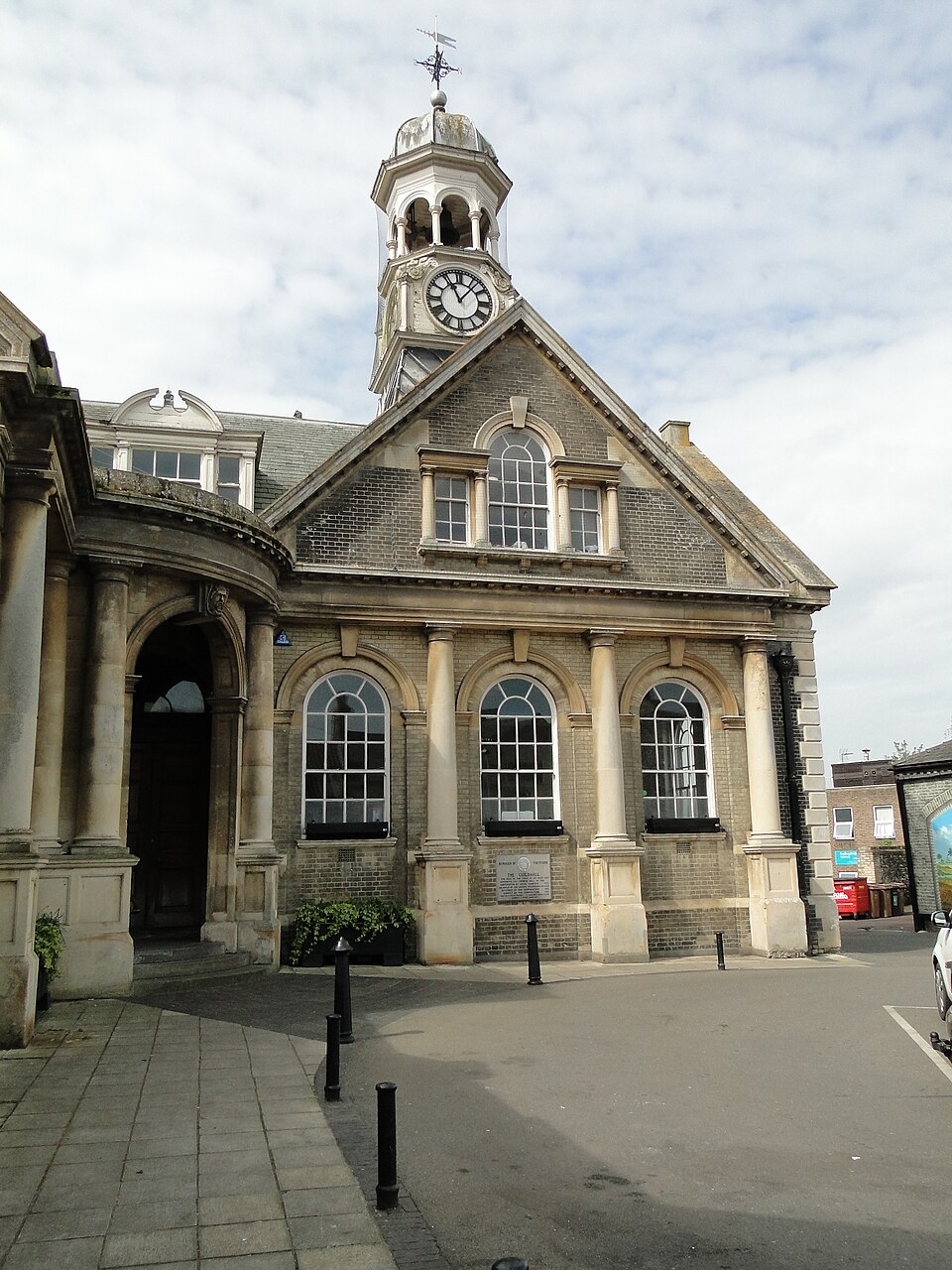
Minns died on 16 September 1930. His mayoral portrait remains part of Thetford’s civic collection, displayed in the Guildhall. In December 2025, the town council announced that it had set aside £5,000 towards a sculpture ahead of the centenary of his death in 2030. The proposed commemoration linked his contribution to medicine with his environmental interests and work in local government, bringing several parts of his Thetford career into the same civic project. 4
Sources and further reading
1. Allan Glaisyer Minns: The First Black Mayor of a British Town. Norfolk Record Office.
2. The Black Middle Class in Nineteenth- and Early Twentieth-Century Norfolk. Norfolk Archaeology.
3. The Age of Municipal Democracy. Thetford Town Council.
4. UK’s First Black Mayor to Be Celebrated by Council. Thetford Town Council.
5. Minns, Allan Glaisyer (1858–1930). University of East Anglia.
Featured image. Thetford Guildhall, photographed in April 2019. A modern view of the town’s civic building. Photograph: Adrian S Pye / Thetford Guildhall, 24 April 2019, Geograph, via Wikimedia Commons. Image record · CC BY-SA 2.0
