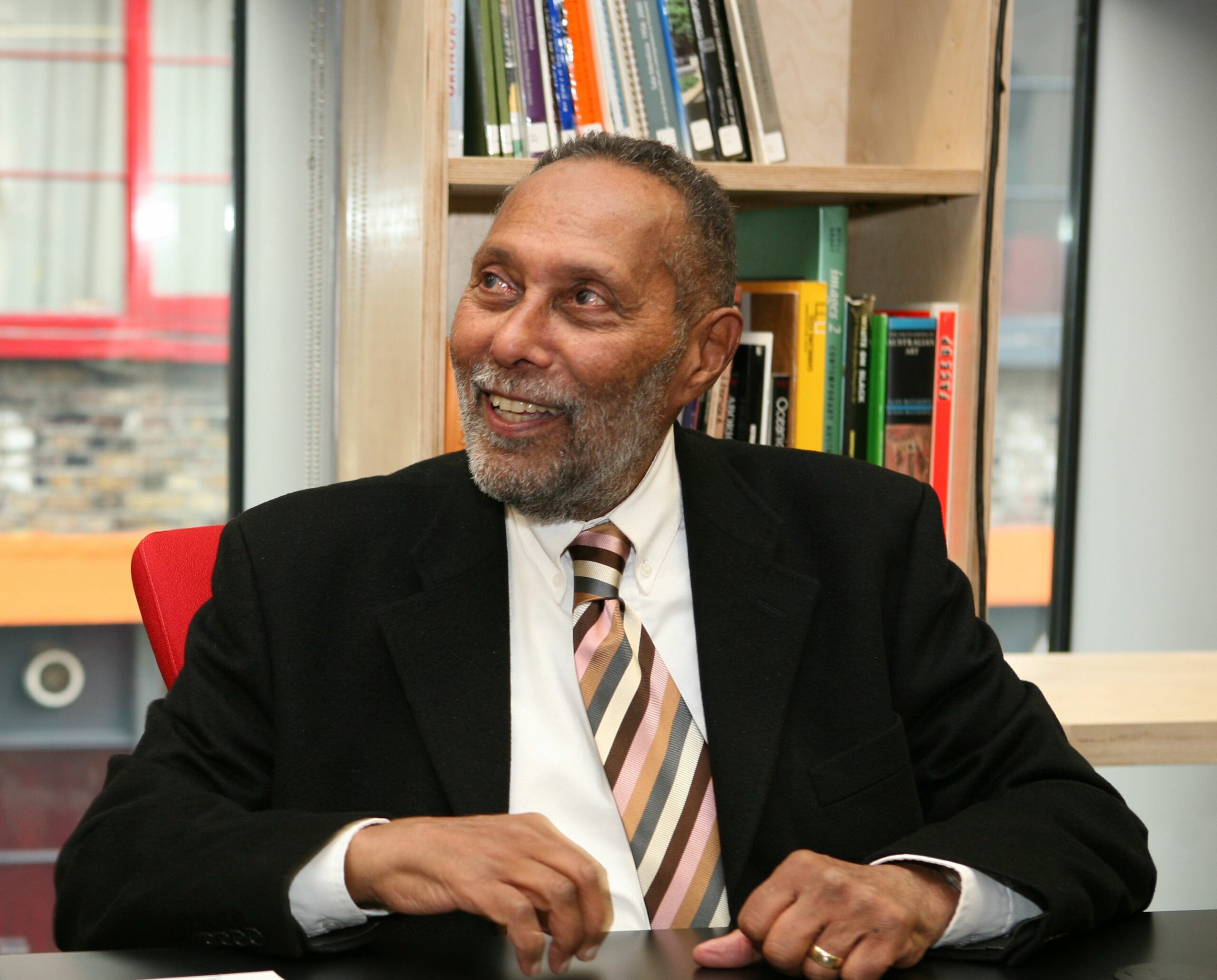
For many Open University students, Stuart Hall was a teacher encountered through television as well as books. He joined the university as Professor of Sociology in 1979 and remained until his retirement in 1997. His teaching brought questions about race, identity and culture into distance education. Television was both a way of reaching students and one of the media whose influence he wanted people to understand.1
From Kingston to a new field of study
Hall was born in Kingston, Jamaica, in 1932. He came to Oxford on a Rhodes Scholarship in 1951 to study English at Merton College. After his degree he began research on Henry James, but left the doctorate unfinished as his political and cultural interests developed. Teaching in London and editing New Left Review connected him with debates outside conventional literary scholarship. At Birmingham’s Centre for Contemporary Cultural Studies, he became its first research fellow and later its director. Collaborative research was central to his approach: books and working papers brought staff and students into shared investigations of the society around them.2
What happens when we watch television?
Hall’s essay on encoding and decoding examined the distance between a programme’s production and its reception. Broadcasters make choices about images, language and whose explanations receive authority. Audiences then interpret the resulting programme through their own experience and social position. Its intended meaning cannot simply be assumed to arrive unchanged.3
He outlined possible responses ranging from accepting a programme’s dominant interpretation to modifying it or understanding it through an opposing account of society. These were propositions for investigation, rather than fixed personality types into which every viewer could be sorted. His argument made room for active audiences while retaining attention to the institutions that produce and distribute messages. A disagreement with a broadcast could involve power and politics, rather than a failure to understand its words.3
Crime, politics and the classroom
That attention to public explanations also shaped Policing the Crisis, written with Chas Critcher, Tony Jefferson, John Clarke and Brian Roberts. The book examined how economic, social and political conflicts in 1970s Britain became concentrated in arguments about crime. News production, public opinion and state authority were connected parts of its investigation. This was a collective study of how a society described its troubles and responded to them, with questions about race and political power at its centre.4
Hall later explained how this research changed his teaching. In a recorded discussion for the Open University in 1990, he described moving from the Birmingham project into work on the course Crime and Society. Research into political attitudes also fed into The State and Society. He linked the subjects students could study to practical support for academic work: access to libraries, assistance with research, and time to think and write. The route from research project to course was part of his account of what a university should make possible.5
Identity has a history
In Cultural Identity and Diaspora, Hall approached Black Caribbean identity through both shared histories and differences. Recovering connections disrupted by slavery and colonialism could have enormous political and creative value. Yet those histories had also produced different places, experiences and ways of living. A common past did not make everyone interchangeable.6
For Hall, identity continued to take shape through historical change and cultural expression. Film, photography and writing helped people describe who they were and what they might become. This gave his thinking a particular relevance to migration: a relationship with a place of origin could coexist with lives formed elsewhere. His account offered a way to discuss connections across the diaspora while remaining attentive to differences within it.6
Making space for other people’s work
Hall’s involvement in visual culture extended to the organisations that supported it. He chaired both Iniva and Autograph until 2008 and helped the project to establish Rivington Place in London. Such work linked his arguments about representation with the practical question of where artists could show, discuss and preserve their work.7
Autograph had begun in 1988 as the Association of Black Photographers. Initially it organised projects through other galleries, museums, festivals and public spaces. The move to Rivington Place in 2007 provided a permanent setting for exhibitions, learning and its photographic collection. Hall formally opened the building that October as the project’s champion. Jointly commissioned by Autograph and Iniva, it made room for work that their programmes had already been developing over many years. The building gives a physical form to this part of Hall’s public life: helping other people’s images, research and arguments reach an audience.8
Sources and further reading
1. Open University: Featured content: Stuart Hall.
2. Merton College: Stuart Hall 1932–2014.
3. Internet Archive: Encoding, decoding, in The Cultural Studies Reader.
4. Bloomsbury: Policing the Crisis: Mugging, the State and Law and Order.
5. Open University: Stuart Hall and OU Research, 1990: transcript.
6. Iniva: Cultural Identity and Diaspora.
7. Iniva: Stuart Hall.
8. Autograph: History of Autograph.
Featured image. Rivington Place, the visual arts centre in London, photographed in 2012. Photograph: Patterncutter, 17 September 2012, via Wikimedia Commons. Image record · CC BY-SA 3.0
