A field of wheat in Essex became the starting point for one of Althea McNish’s best-known textiles. In Golden Harvest, familiar English plants took on an intensity of colour associated with her Trinidadian background. Developed while she was studying and subsequently produced by Hull Traders, the design brought different landscapes together on furnishing cloth. It also demonstrated a practical achievement: preserving the energy of a drawing in something that could be printed repeatedly.1
From drawing to printed cloth
Born in Port of Spain in 1924, McNish was already drawing, painting and exhibiting before she moved to London in the early 1950s. Her mother designed and made clothes; her father was a writer and publisher. McNish initially intended to study architecture, then took a different route through printmaking, evening classes with Eduardo Paolozzi and postgraduate study at the Royal College of Art.2
Technical education gave her room to experiment. She understood screen printing, the arrangement of repeating patterns and the use of different colour combinations. That knowledge mattered when a drawing had to become a manufactured fabric. She could discuss production directly with printers, working out how layers of colour would retain their depth and how a design would function across a continuous length of cloth.2
A portfolio becomes a collection
Liberty dates her first freelance collection for the company to 1958. Its chairman, Arthur Stewart-Liberty, commissioned designs for both clothing and furnishings after seeing her work. The range of her approach is visible in the company’s archive. Chelsea presents flower bouquets through a textured, almost sponged treatment. Cascade, created in 1959, uses loose trails of spots against a richly worked background. These were different answers to the same commercial challenge: making cloth distinctive at a glance while sustaining interest across a larger surface. Her patterns could be exuberant without all looking alike.3
Another Liberty design, Tepeaca, dates from 1960. Cooper Hewitt’s textile collection describes its starting point as lengths of African beads. Botanical forms were therefore one strand within a wider visual vocabulary. McNish’s commissions also travelled far beyond British shops. In 1962 she was chosen to decorate the first embassy building of newly independent Trinidad and Tobago in Washington, DC. Cloth and interior design connected her professional life in Britain with an international Caribbean presence.4
Designing the whole room
Her work could shape an entire setting. Research by design historian Rose Sinclair identifies McNish’s panels for the liner SS Oriana in 1960 and her room for a single woman at the 1966 Ideal Home Exhibition. In 1973 she also helped present Caribbean art on BBC2’s Full House. Each commission required attention to a different scale and audience: passengers moving through a ship, visitors imagining a home, or viewers encountering art through television.5
Colour as a working method
The success of Golden Harvest makes particular sense alongside this versatility. Cooper Hewitt traces it to early trial prints before its association with Hull Traders. The wheat motif could move from an observed landscape to a vivid commercial pattern because McNish combined drawing with knowledge of printing. The result does not divide neatly into British subject matter and Caribbean decoration. Those experiences worked together in the design itself.1
Teaching, and a return to the archive
McNish also supported younger designers. Sinclair records an annual colour design award, briefs set for local secondary schools, and mentoring of students in further and higher education. These activities placed her experience of making and manufacturing within reach of people still developing their own practice.5
In 2022 the William Morris Gallery presented Althea McNish: Colour is Mine, developed with Sinclair through research into McNish’s personal archive. The exhibition brought original work into a new account of mid-century design, while Liberty reissued a selection of her patterns. The archive offered a way to examine decisions behind the finished fabrics as well as their visual impact. McNish had died in 2020, but the surviving designs, studies and textiles make it possible to follow the movement between an individual artist’s work and the objects sold, worn and lived with by others.6
Sources and further reading
1. Cooper Hewitt: The Glow of Althea McNish.
2. V&A: Althea McNish – an introduction.
3. Liberty: A Spotlight On… Althea McNish.
4. Cooper Hewitt: Althea McNish: An Exceptional Talent.
5. Goldsmiths: Goldsmiths lecturer curates first retrospective of textile innovator Althea McNish.
6. William Morris Gallery: Althea McNish: Colour is Mine.
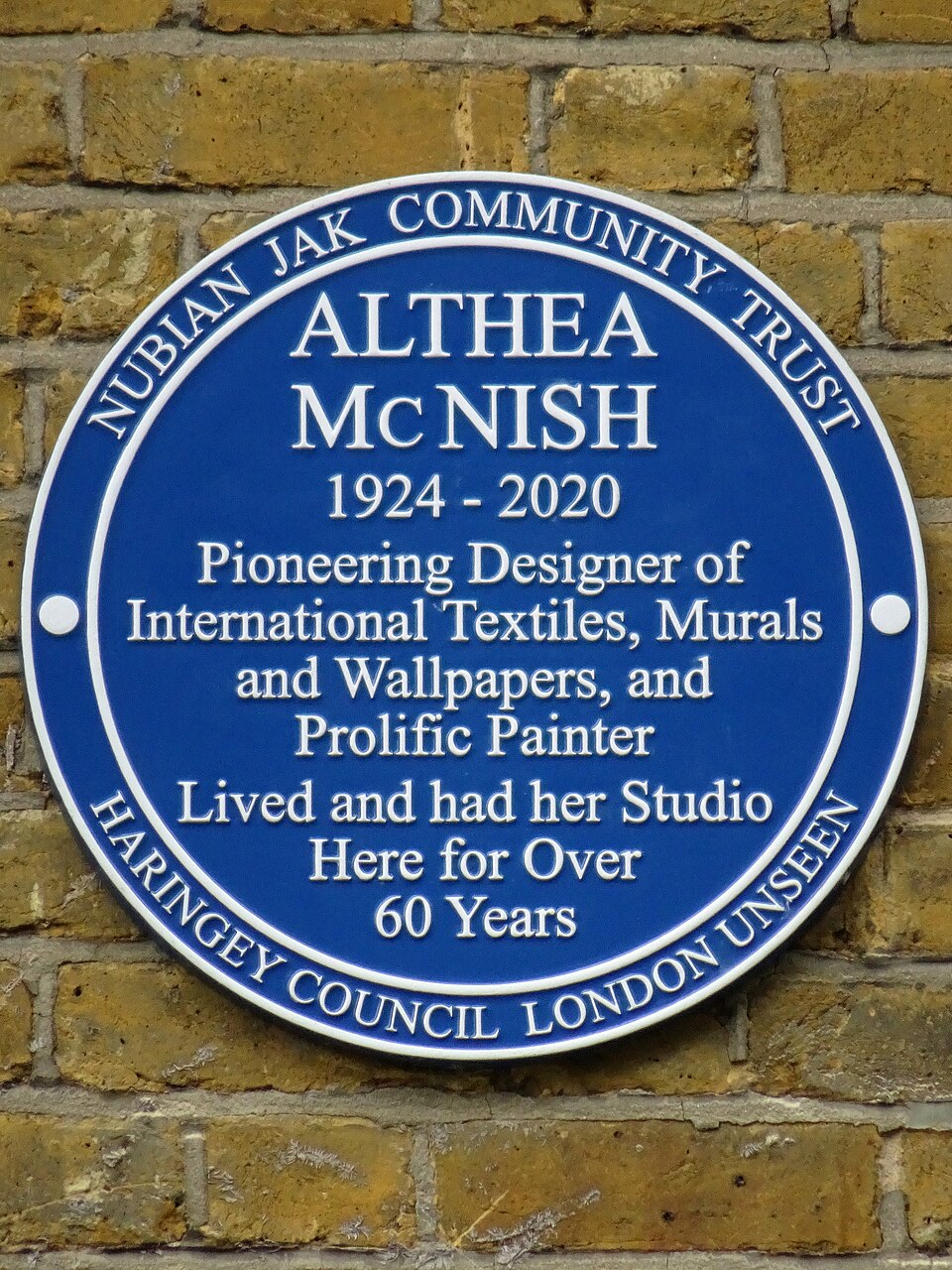
Featured image. The Nubian Jak plaque at Althea McNish’s former home and studio, 142 West Green Road, Tottenham, photographed in 2023. Photograph: Spudgun67, 21 May 2023, via Wikimedia Commons. Image record · CC BY-SA 4.0
