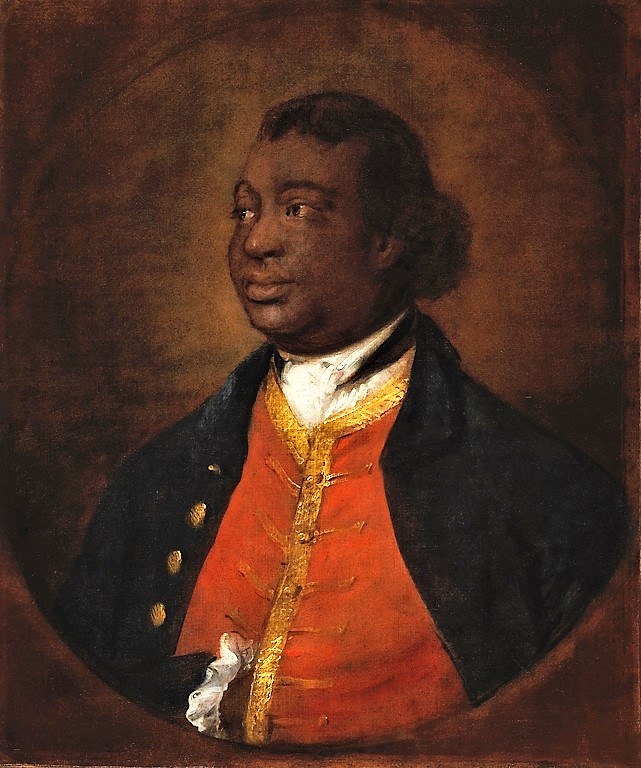
In a letter written in July 1778, Ignatius Sancho approved a friend’s decision to give up tea, then joked that her visitors should drink twice as much so his business would not lose out. It is a small moment, but a useful introduction. The writer concerned himself with friendship, health and the fortunes of his grocery shop in the same breath. His surviving letters allow us to meet a person with work to do, opinions to argue and people to care about.1
Piecing together an early life
Sancho was born around 1729. The short biography published with his letters describes his birth aboard a slave ship and a childhood in Greenwich, where he was placed in a household of three sisters. It credits the Duke of Montagu with encouraging his reading. These details have shaped almost every later account, but they come through a posthumous narrative. They should be distinguished from the adult letters in which Sancho speaks directly for himself.1
That biography describes his later employment in the Montagu household and, towards the end of 1773, the establishment of a shop with his wife. Domestic service brought access to wealthy patrons, books and social contacts, while also placing his livelihood within an unequal relationship. The move into shopkeeping changed the terms of his working life. His correspondence from the following years reveals how much effort that independence required.1
A household and a business
On 17 December 1758, Sancho married Ann Osborne at St Margaret’s, Westminster. The parish records also preserve the baptisms of their children and the deaths of several of them. Ann belongs within the account of his public life: the shop and household were shared undertakings, and his letters repeatedly refer to her views, health and greetings to friends. Their family experienced the ordinary demands of raising children alongside the particular pressures facing a Black household in Georgian London.21
From the shop in Charles Street, Westminster, Sancho maintained an extensive correspondence. His letters move from news of a sick child to a book recommendation, from an errand to an argument about politics. The movement between subjects is part of their appeal. They show intellectual activity taking place within everyday work, rather than waiting for some separate, uninterrupted life of leisure.1
Music made for use
Sancho was also a published composer. Collections of his music appeared between 1767 and 1779, including songs, minuets, country dances and cotillions. They were practical publications, offering music that people could sing, play and dance to. Some advertised several possible instruments, among them violin, flute, mandolin and harpsichord. Their survival gives this part of his working imagination a form that can still be performed.3
The title of one collection, A Collection of New Songs Composed by an African, placed his African identity before potential purchasers. That wording belonged to the world in which the music was published; it does not tell us exactly how audiences heard it. Nor do the surviving sources establish a complete account of his musical education or every instrument he played. The firm starting point is the music itself and the range of activity documented on its title pages.3
A reader who answered back
Sancho’s reading was active and argumentative. In one letter, he compared Henry Fielding and Laurence Sterne as writers, defending their distinct qualities and encouraging his correspondent to read again before deciding. Elsewhere, he recommended history, poetry and a carefully chosen library. Books supplied pleasure and a language for discussing character, judgement and the obligations people owed one another.1
In 1766, he wrote to Sterne urging him to use his influence against slavery. Sancho recognised that a celebrated author could reach readers who might never encounter the testimony of an enslaved person. His appeal asked literary feeling to produce a public response. The exchange later circulated in print, carrying Sancho’s intervention beyond its original recipient.4
The collected letters appeared in 1782, after Sancho’s death, and gave that voice a wider readership. Their editors gathered correspondence from people who had received it; the book was therefore shaped by what friends preserved and chose to make available. The resulting collection is substantial, but it is not an unfiltered transcript of an entire life. Remembering that process helps us appreciate both its richness and its silences.41
Thinking about Britain and its power
A 1778 letter to a young acquaintance in India shows Sancho challenging the easy assumptions of empire. His correspondent had criticised the conduct of local people. Sancho asked him to consider how European greed and cruelty had shaped those encounters. He then connected British activity in India, the Caribbean and Africa, condemning the slave trade and the pursuit of wealth at others’ expense.1
In the same letter, he expressed affection for Britain and gratitude for freedoms he enjoyed there. The two positions sit together: attachment to a country could accompany a severe judgement of its conduct. His language also carried assumptions of his own period. Reading the whole argument, rather than extracting a single uplifting line, reveals a writer working through difficult questions about commerce, Christianity and human responsibility.1
His political writing could be immediate as well as reflective. During the Gordon Riots in June 1780, he sent accounts of disorder in London as events unfolded. These letters convey alarm and uncertainty; their crowd estimates and reports need to be read as contemporary observations. They record how public violence entered the life of a household and business trying to make sense of what was happening nearby.1
What the voting records show
Sancho voted in Westminster elections in 1774 and 1780. He is often described as Britain’s first Black voter, or the first whose vote is documented. Research by historian Gillian Williamson has identified an earlier example: John London voted in the Westminster by-election of 1749, and his vote survived a subsequent challenge. Sancho’s participation is well documented, but the claim that it came first no longer fits the evidence.5
The discovery also changes the question. Electoral records did not routinely identify voters by race, so names alone may conceal people whom later historians would recognise as Black. Sancho’s unusually rich surviving record makes him visible. It should not make everyone else disappear. His votes remain part of an important history of Black participation in British political life.5
Sancho died on 14 December 1780. His letters continue to offer more than evidence for a milestone. They preserve the voice of someone recommending a book, worrying about family, making music, criticising power and finding a joke in the sale of tea. Those details give his place in British history its particular depth.21
Sources and further reading
1. Letters of the Late Ignatius Sancho, an African (third edition, 1784) — Ignatius Sancho and the original editors; text hosted by Project Gutenberg.
2. Ignatius Sancho — Westminster Abbey.
3. Sancho’s Music — Rutgers University: The Letters of Ignatius Sancho.
4. Sancho’s Antislavery Legacy — Rutgers University: The Letters of Ignatius Sancho.
5. Black Voters in the Archive — Gillian Williamson; Newcastle University, Eighteenth-Century Political Participation and Electoral Culture.
Image credit. Thomas Gainsborough, Ignatius Sancho, 1768. National Gallery of Canada, Ottawa. Public domain, via Wikimedia Commons. View the image record.
