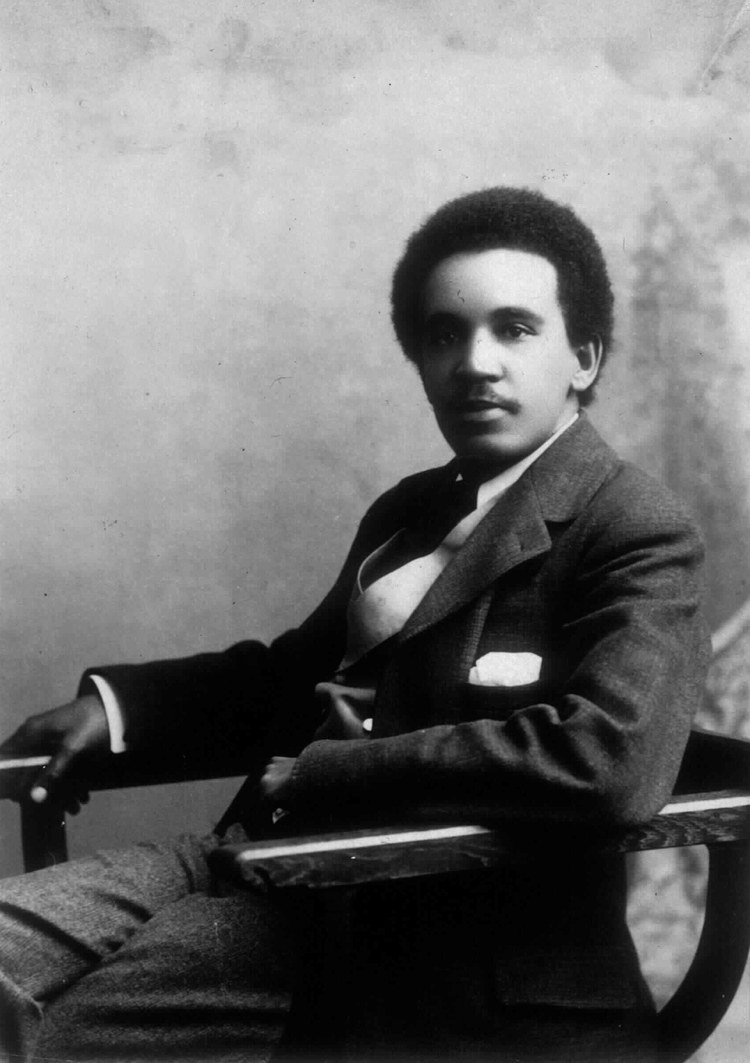
Samuel Coleridge-Taylor built a reputation that reached well beyond Britain. The success of Hiawatha’s Wedding Feast made his name familiar to choral singers, but he also wrote for instruments and solo voices, taught and conducted. His career grew through the ordinary structures of musical work: lessons, rehearsals, publishers, commissions and relationships with performers. Looking at those activities allows the composer to emerge with more detail than a single celebrated work can provide.6
Learning a profession
Born in London on 15 August 1875, Coleridge-Taylor grew up in Croydon. His mother was Alice Hare Martin; his father, Daniel Taylor, was a doctor from Sierra Leone. He entered the Royal College of Music in 1890, initially studying violin, and went on to study composition with Charles Villiers Stanford. He remained until 1897, composing extensively during his student years.12
That training placed him within the professional musical life of late Victorian Britain. Composing meant learning how to turn an idea into a score that other people could rehearse and perform. His early output, preserved among the College’s manuscripts, shows sustained work across different forms. It also provides evidence against any account that treats his achievement as something effortless or inexplicable.2
After his studies, teaching and conducting helped support his career. He taught at the Crystal Palace School of Music and conducted at the Croydon Conservatoire. A recommendation from Edward Elgar helped bring his orchestral Ballade in A minor to the Three Choirs Festival in 1898. The same year brought the premiere that would transform his public standing.1
The making of Hiawatha
Hiawatha’s Wedding Feast was first performed at the Royal College of Music on 11 November 1898, conducted by Stanford. Coleridge-Taylor drew its text from Henry Wadsworth Longfellow’s poem. Two further cantatas followed: The Death of Minnehaha in 1899 and Hiawatha’s Departure in 1900. What is often discussed as one work therefore developed through separate compositions and performances.3
On 22 March 1900, Coleridge-Taylor conducted the complete sequence at the Royal Albert Hall. Written for concert performance with singers and orchestra, these cantatas offered choral societies an extended narrative. Longfellow’s nineteenth-century literary treatment of an Indigenous American subject supplied the words; it should not be mistaken for Indigenous testimony. The music’s British performance history and the source of its story are different parts of the work’s history, both necessary to understanding it.3
What a working score can tell us
The Royal Society of Musicians holds annotated publisher’s proofs for Hiawatha’s Departure. They preserve corrections and instructions, including changes affecting expression and dynamics. Marks by different hands show the passage from a composer’s intentions towards a printed score that performers could use. The page carries evidence of revision and co-operation as well as invention.4
These materials were among the manuscripts donated by his daughter Avril, herself a composer and conductor. Their survival invites a close kind of attention. A familiar title becomes a set of choices about how voices and instruments should move, how loudly they should sound and what needs correcting before publication. This is one way an archive can return an admired historical figure to the practical detail of his work.4
Collaborations across the Atlantic
Coleridge-Taylor also developed relationships with Black writers, musicians and organisers. His collaboration with the African American poet Paul Laurence Dunbar produced African Romances in 1897 and Dream Lovers in 1898. Working together gave poetry and music a shared public form. In 1900, he helped arrange music for the Pan-African Conference in London, placing his professional skills within a wider gathering concerned with the rights and position of people of African descent.5
His first visit to the United States, in 1904, connected him with performers including Harry T. Burleigh and with admirers who had organised a choir bearing his name. These encounters involved people with their own musical knowledge and ambitions. They help explain why his interest in African and African American material should be understood through relationships and artistic choices, rather than treated as an automatic consequence of ancestry.5
Twenty-four melodies for the piano
A particularly revealing work is Twenty-Four Negro Melodies, Op. 59, published in 1905. The title uses the historical terminology of its period. The collection consists of piano pieces drawing on melodies identified with parts of Africa, the Caribbean and African American traditions. Its contents include Deep River, Sometimes I Feel Like a Motherless Child and Wade in the Water. Booker T. Washington contributed a preface.6
Coleridge-Taylor’s own foreword explains what he intended. He compared the project with the treatment of folk material by Brahms, Dvořák and Grieg. Each melody appears at the head of its piece, so the reader can distinguish the source tune from the music he built around it. He described using variations and explicitly separated that process from any suggestion that the original melody needed improving.6
The distinction gives a pianist or listener a useful way into the collection. A short tune becomes the basis for a larger musical argument, while remaining identifiable within it. The score makes the composer’s intervention visible. It also records where he obtained material, acknowledging collectors and musicians whose contributions formed part of the project. The finished pieces therefore connect composition with the movement of songs between people, places and printed sources.6
The foreword also contains racial generalisations and judgements about other musical cultures that require critical reading. Preserving the document does not require accepting those claims. Its value lies partly in showing how artistic ambition and the assumptions of an era could occupy the same page. Coleridge-Taylor was making a serious case for this material within the concert tradition, while using a language whose limits remain visible.6
A reputation beyond one lifetime
Commercial success did not bring Coleridge-Taylor a matching share of the income generated by Hiawatha’s Wedding Feast: he had sold its rights. He died of pneumonia on 1 September 1912, aged thirty-seven. His career had already crossed several musical worlds, but there was no long later life in which to develop its possibilities.1
Hiawatha continued to acquire new forms after his death. Spectacular staged productions appeared at the Royal Albert Hall from 1924, with further seasons through the 1930s. They adapted the concert works for a different kind of event. Distinguishing those productions from the original cantatas helps keep later theatrical choices separate from decisions made by the composer himself.7
Other music has had a less continuous public life. In 2022, the Royal College of Music announced the identification of Nourmahal’s Song among its manuscripts, a dramatic vocal work distinct from a piano piece with the same heading. Such discoveries expand what can be studied and performed. They also suggest a productive way to approach Coleridge-Taylor now: through the scores, with room for familiar successes, unfinished questions and music that many listeners have yet to hear.2
Sources and further reading
1. Happy Birthday, Samuel Coleridge-Taylor! — Library of Congress, NLS Music Notes.
2. Lost work by Samuel Coleridge-Taylor discovered at the Royal College of Music — Royal College of Music.
3. Royal Choral Society concert: 22 March 1900 — Royal Albert Hall performance archive.
4. Samuel Coleridge-Taylor: Hiawatha’s Departure — Royal Society of Musicians of Great Britain.
5. Samuel Coleridge-Taylor and the musical fight for civil rights — Royal College of Music, exhibition hosted by Google Arts & Culture.
6. Twenty-Four Negro Melodies, Op. 59: Original score and forewords — Samuel Coleridge-Taylor; Johns Hopkins University Sheridan Libraries, Sam Carner Sheet Music Collection, hosted by Internet Archive.
7. Hiawatha at the Royal Albert Hall, 1924–1939 — Museum of Music History.
Image credit. Henry John Kempsell, 1901. The National Archives, COPY 1/451/268. No known copyright restrictions, via Wikimedia Commons. View the image record.
