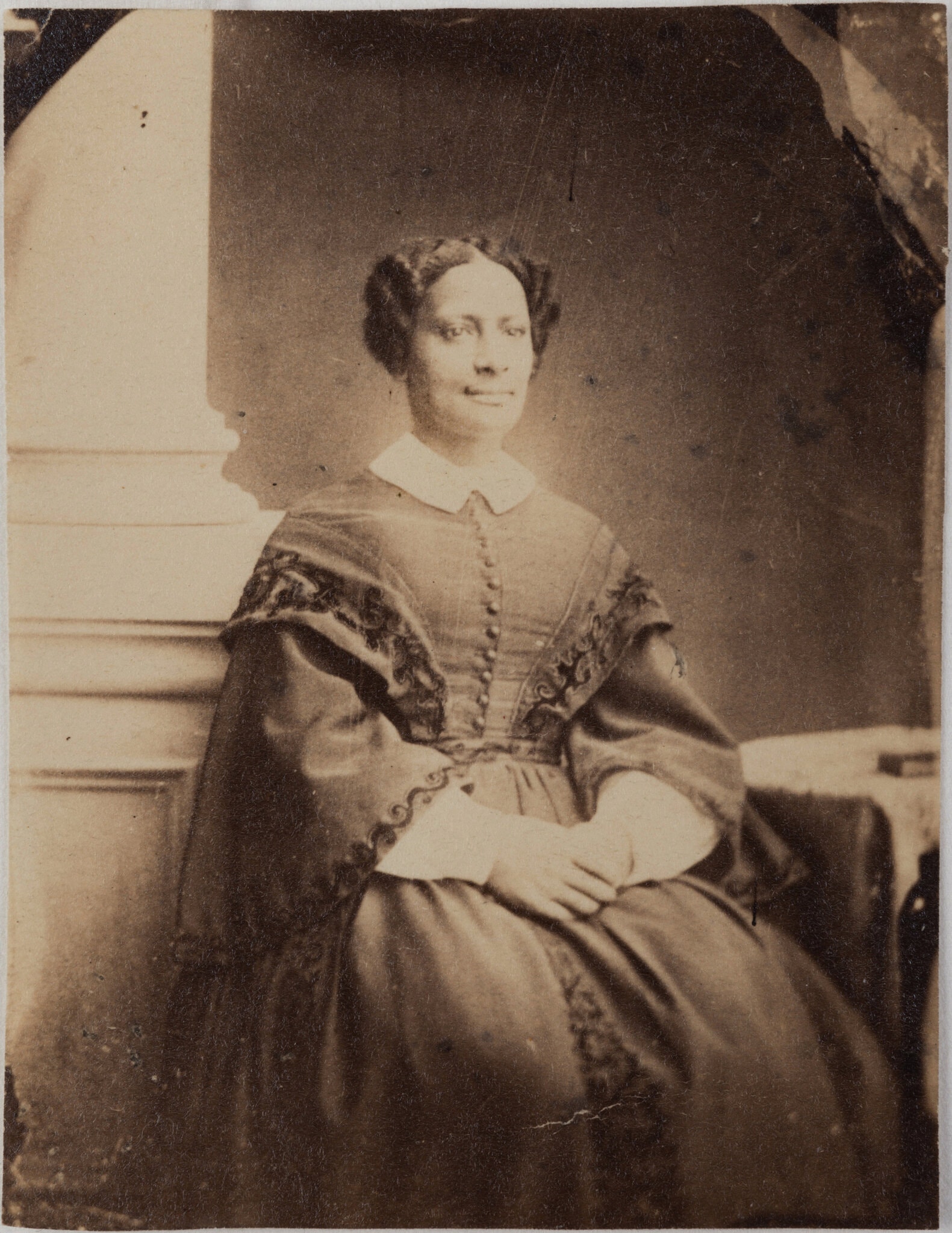
In October 1859, Sarah Parker Remond was trying to fit college into a busy life of anti-slavery lecturing. Writing from Warrington to Mrs Chapman, she explained that she would soon go to London to study. She intended to continue speaking whenever she could, although three successive evenings on the platform had recently proved too much. Her letter records the practical problem of making room for education while invitations to lecture kept arriving.1
An education interrupted
Remond was born free in Salem, Massachusetts, in 1826. Her life was shaped by the distinction between legal freedom and the opportunities that a racist society actually allowed a Black woman to pursue.2
In her autobiography, published in Britain in 1861, she described exclusion from school with particular clarity. She and her sister had passed an examination and entered a girls’ high school. Then the school committee decided that Black children should attend a separate school, regardless of their ages or level of attainment. The proposed arrangement would put advanced and younger pupils together in a single room. It would also require children to travel to that school wherever their families lived. Remond identified both the practical disadvantage and the public humiliation built into the decision.3
Her father protested, but the sisters were told to leave. Remond recalled the teacher accompanying them home to explain what had happened. Her account locates the decision in the school committee and the surrounding community, rather than in any failure of the pupils. She had met the school’s academic requirements. Race was the barrier. The passage explains why access to education remained a pressing personal issue even after she had become an accomplished public speaker.3
She also wrote about the strength her mother encouraged her children to find within themselves. Family support could help them withstand hostility, but could not remove the restrictions outside their home. Learning and the struggle against racial exclusion became closely connected in Remond’s account of her own development.3
Taking the argument to Britain
Remond’s autobiographical writing gives two reasons for wanting to cross the Atlantic: to experience greater freedom herself and to assist the anti-slavery cause. She continued speaking publicly in America until shortly before sailing for England in December 1858. The journey brought an experienced campaigner to a new audience. It also offered her a chance to pursue possibilities that prejudice had restricted at home.3
In a Manchester speech in 1859, she distinguished the circumstances of free Black Americans from those held in slavery. Wealth, education or intellectual distinction did not protect free people from social and political exclusion. Enslaved people faced a system that denied them control over domestic life as well as public rights. By placing the two conditions together, she challenged any comfortable assumption that the absence of legal enslavement necessarily meant equal citizenship.4
Her speeches also drew attention to the vulnerability of enslaved women and their children. She described a society in which white fathers could sell children born to enslaved mothers. This brought power within families, sexual exploitation and the transmission of enslaved status into the argument. A British audience was being asked to consider what slavery did to intimate human relationships, as well as what it produced for trade. Remond’s appeal gave those relationships a central place in the case for abolition.4
College and a continuing campaign
At Bedford College in London, where she studied from 1859 to 1861, Remond pursued subjects including history, English literature, French, Latin and music. Her course of study broadened the education she had worked to obtain for years. Lecturing and learning continued alongside each other: the public speaker was also a student developing her knowledge.2
Her British activities reached across England, Scotland and Ireland. In London she worked with abolitionists and women’s rights supporters, including the Ladies’ London Emancipation Society. She also supported fundraising for Italian unification, connecting her interests with other political movements.5
She became a British citizen in 1865. By then Britain had been a place of sustained work and study, with education forming a substantial part of her life abroad.2
From London wards to Florence
Her learning extended into hospital work. Historian Sirpa Salenius has examined recommendations preserved in Florence which describe Remond’s nursing training at University College Hospital. Sister Rosmonda and surgeon Berkeley Hill praised her care and attention to patients. In 1866 she moved to Florence to continue her studies at Santa Maria Nuova. She passed the entrance examination in 1867 and completed training that led to admission as a practitioner of midwifery in 1868. The London references thus connect her practical experience in Britain with the next stage of her professional education.5
The letter from Warrington catches that educational purpose while it was still being organised around lecture engagements. Remond was determined to continue campaigning, and equally determined to find time to learn. In Britain she pursued both commitments through sustained work. Her years there show freedom being put to use in choices about study, public action and the kind of work she wished to undertake.1
Sources and further reading
1. Letter to Mrs Chapman, October 1859, excerpt — Sarah Parker Remond; reproduced by Sirpa Salenius at UCL.
2. Sarah Parker Remond — UCL, Sarah Parker Remond Centre.
3. Autobiography, published in the English Woman’s Journal, June 1861 — Sarah Parker Remond; excerpts at Mass Humanities.
4. British anti-slavery speeches, 1859, excerpts — Sarah Parker Remond; reproduced by Sirpa Salenius at UCL.
5. In the words of Sarah Parker Remond — Sirpa Salenius, UCL.
Featured image. Sarah Parker Remond in a photograph dated to about 1865. Unknown photographer; reproduction via Wikimedia Commons. Public-domain photograph. Image record · Public domain
