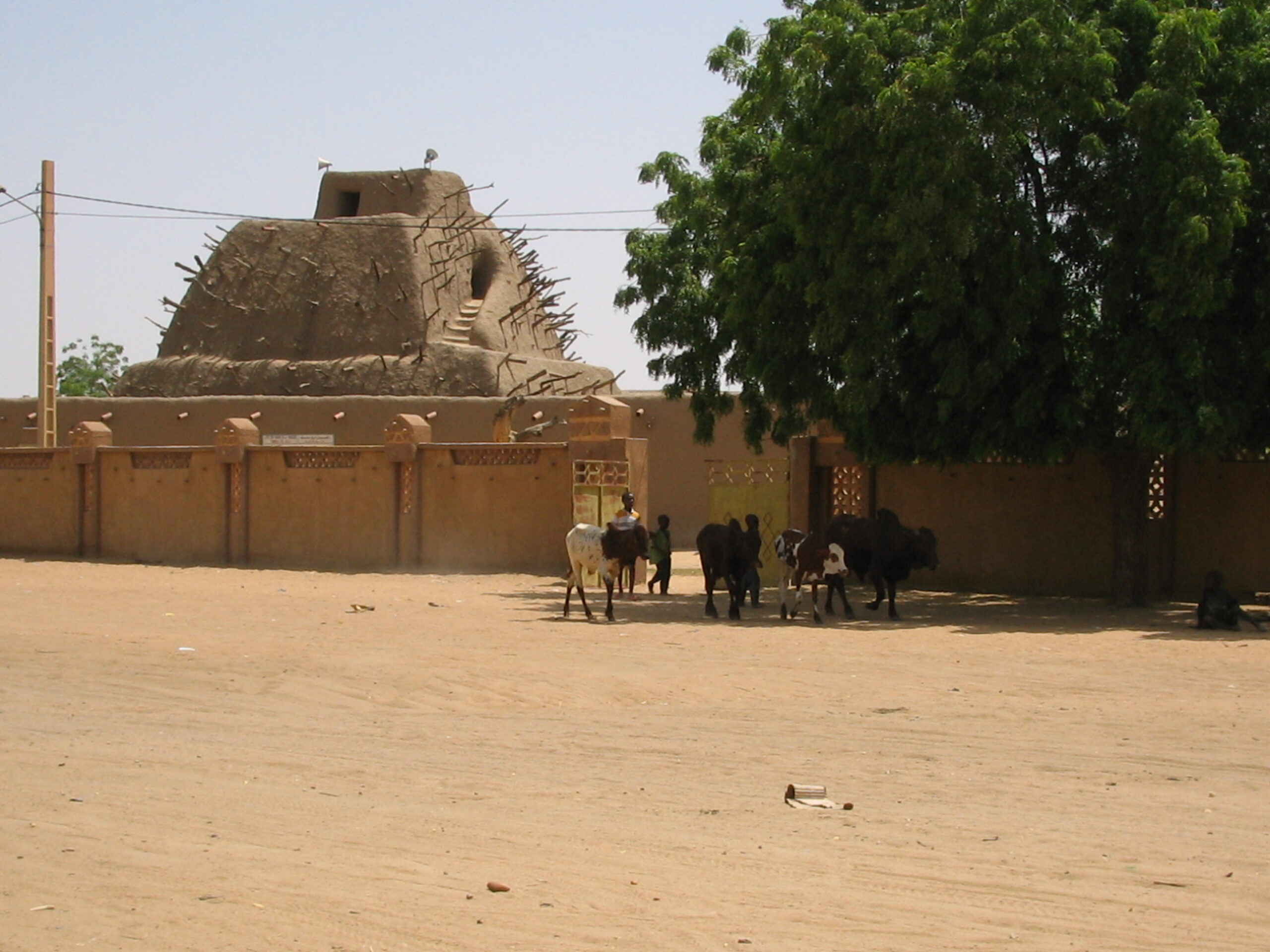
Gao’s best-known historic monument rises in steps above an enclosure of earthen walls. The structure usually called the Tomb of Askia belongs to a larger complex of mosques, burial grounds and an open assembly space. Together they place worship and public life within the memory of an imperial capital. The Songhai Empire’s history begins well before this monument, however, in the settlements and trading connections that made the Niger River a route through which people, goods and political power could move.1
A city with a history before empire
Excavations at Gao Saney, near the historic city, have pushed that story deep into the first millennium. Archaeologist Mamadou Cissé investigated deposits more than six metres thick containing traces of domestic occupation and the working of glass and copper. Material dated to approximately AD 700–1100 shows that substantial activity here preceded the best-known Songhai rulers by centuries. The finds provide a different starting point from a list of kings: people were making things, using imported materials and living in a settlement that accumulated through repeated occupation.2
Cissé’s research connected the site with the trading settlement called Sarneh in an Arabic account. That identification remains an interpretation drawn from several kinds of evidence, rather than a name conveniently written on an excavated house. The significance lies in the convergence of archaeology and descriptions of a trading landscape.2
Timothy Insoll’s work following surveys and excavations in 1993 also challenged a simple account of Gao’s development. Settlement patterns suggested connections between trade, possible defensive concerns and the gradual acceptance of Islam. The city’s history was therefore neither a single foundation event nor an automatic consequence of merchants arriving from the desert. Different activities and commitments shaped where people lived. Archaeology allows those relationships to be examined alongside written accounts and oral histories, whose authors and transmitters had their own interests. It also makes the material lives of people outside a royal genealogy part of the explanation of urban growth.3
Sonni Ali and the reach of the river
The empire associated with Songhai emerged from this established Niger landscape. In the fifteenth century, Gao escaped Mali’s authority and became the centre of a new expansion. Sonni Ali, also remembered as Sii Ali Beeri, combined cavalry with a fleet of riverboats. The combination mattered: armed power could operate across land and along waterways, allowing campaigns to reach strategically important trading towns. His seizure of Timbuktu in the late 1460s and subsequent conquest of Djenné extended his influence over major centres of exchange.4
The Metropolitan Museum’s account emphasises the different religious relationships of Sonni Ali and his successor. Sonni Ali retained connections with inherited religious practices, while Askia Muhammad placed greater weight on alliances with Islamic scholars. Their reigns should therefore be understood as distinct political projects. The empire expanded through warfare, but its rulers also had to establish relationships with the communities over which they claimed authority.4
Sonni Ali died in 1492. His son, Sonni Baru, succeeded him but soon faced a challenge from Muhammad Ture, a military commander and provincial governor. Defeat in April 1493 brought Baru’s short reign to an end. Ture became Askia Muhammad, beginning a new dynasty. The celebrated ruler’s accession was a struggle for power, with victory on the battlefield providing the opportunity to organise a different kind of royal authority.5
Under Askia Muhammad, provincial government increasingly depended on royal relatives and trusted appointees. Governors could raise forces and collect taxes, connecting local resources to the centre while retaining considerable authority of their own. His pilgrimage to Mecca also placed Songhai within wider Muslim networks. Religion, appointments and military resources worked together in the business of governing; conquest alone could not keep a large territory functioning.5
Rulers, scholars and the terms of authority
Historian John Hunwick described a negotiated relationship between Songhai’s rulers and its religious authorities. Scholars, mystics and other holy people offered moral standing and spiritual services. Rulers granted land, gifts and privileges, including exemptions from taxation. Religious figures could exercise rights of sanctuary or intervene on behalf of others. Such arrangements were especially important in conquered western territories, whose populations included communities with strong Islamic traditions and identities distinct from the ruling Songhai elite.6
These relationships also reveal inequalities within imperial society. The gifts exchanged could include enslaved people. Patronage that supported learning and religious institutions could therefore depend upon human exploitation. Recognising both aspects makes it possible to explain how an intellectual culture operated within the social arrangements of its time. The scholars’ standing gave them room to influence rulers, but did not place them outside the structures of wealth, dependency and political authority.6
A surviving textual tradition makes the connection between government and scholarship particularly clear. The Library of Congress describes a treatise in which Muhammad al-Maghili answered seven questions put by the emperor of Songhai. His responses concerned political and economic matters and urged the ruler to follow Islamic law and consult pious scholars. The work shows a ruler seeking arguments about legitimate government and a scholar claiming authority to provide them. As a prescriptive text, it records advice about how power should be exercised. It cannot by itself prove that officials everywhere followed that advice, but it gives historians access to questions discussed around the court.7
The work that supported the court
Imperial resources came from cultivated land as well as long-distance commerce. In his study of Songhai’s princely estates, Michał Tymowski examined accounts of rice cultivation along the Niger. The size of an estate depended partly on the land reached by seasonal flooding. Labour was allocated accordingly, with enslaved workers among those who produced the harvest. The organisation of farming tied the court’s resources to knowledge of water, soils, agricultural timing and the work of people whose own choices were constrained.8
Boats carried harvests towards stores in major centres. Gao received produce from estates in the south-eastern province of Dendi, while Tendirma served important military and administrative functions farther west. The river connected fields, granaries and government. A map showing only the empire’s borders misses this practical structure: food had to be grown, collected, loaded, transported and distributed. The system depended on labour and coordination as much as on the authority announced by a royal title.8
Askia’s government also regulated commerce through standardised weights and measures and officials who inspected trade. Markets exchanged salt, gold, cloth, horses and enslaved people. Regulation could facilitate transactions and the collection of revenue, while the trade in human beings exposed the violence within the same economy.5
Tondibi and the years of resistance
In 1591 an army sent by the Moroccan sultan Ahmad al-Mansur defeated Songhai forces at Tondibi, near Gao. The invading commander, Judar, brought soldiers whose firearms helped change the military balance. Historian Lansiné Kaba connects the expedition to Morocco’s commercial and political needs, particularly the ambition to gain control of the gold trade. The battle broke the power of the imperial centre, but it did not give the victors effortless control over the region.9
Resistance continued under Askia Nuhu. Kaba describes a prolonged struggle in which Songhai fighters used mobility and difficult southern terrain to exhaust the invaders. Moroccan forces encountered revolts and problems of coordination, including rivalry between officials. By 1612, the ability to win a major battle had still not translated into secure command over all the people and places once claimed by Songhai. The distinction matters: the defeat of an empire and the ending of its inhabitants’ resistance were different events.9
The invasion also produced competing records. Research by Mauro Nobili in Moroccan manuscript collections identified a royal letter announcing the conquest to the people of Fez and a copy of al-Sa‘di’s seventeenth-century chronicle, the Tarikh al-Sudan. A proclamation from the conquering court and a chronicle written in the Niger region approached events from different positions. Comparing them helps historians investigate how victory was announced, defeat remembered and authority justified. Even familiar episodes can be reconsidered when another manuscript becomes available. The surviving archive is still capable of changing the questions asked about Gao and its former empire.10
Memory, performance and an earthen monument
Songhai history also travelled through performance. The narrator Nouhou Malio recounted the Epic of Askia Mohammed over two evenings at Saga, near Niamey. Thomas A. Hale’s edited English translation, published by Indiana University Press, brought that performance to another readership. Malio was a jeseré, a specialist narrator often described in English as a griot. His work belongs to a living practice of remembering and interpreting rulers, relationships and the origins of authority.11
An epic is shaped for listeners and carries meanings beyond a sequence of dates. Reading it alongside chronicles and archaeology allows these different forms of historical knowledge to retain their character. The performance is evidence for how Askia Muhammad was remembered and made significant to later audiences. It also preserves the voice and skill of a named African interpreter of that past.11
The monument in Gao invites similar care. Art historian Mark Dike DeLancey has questioned its familiar identification as Askia Muhammad’s tomb, noting the absence of demonstrated burial evidence and disagreement among local people. In a 2024 research presentation, he proposed a comparison with the minaret of Cairo’s Mosque of Ibn Tulun and interpreted the structure as a political statement linked to Askia’s pilgrimage. This is a scholarly proposal, not an established explanation that replaces every earlier one. It nevertheless shows why the building deserves investigation in its own right, beyond assumptions that an African monument must simply imitate an Egyptian pyramid. He also challenged claims of dramatic deterioration since Heinrich Barth described the structure in 1854, arguing that the evidence suggested substantial continuity. Even assessments of its physical condition carry a history of interpretation.12
Its survival also depends on practical knowledge. A UNESCO account of restoration at the site describes Gao’s masons renewing earthen plaster, replacing timber supports and working with local heritage staff and the imam. A nursery supplied hasu trees used in the structure; women helped prepare and maintain the planting area. Roof repairs and drainage addressed damage caused by water. The work included replacing eucalyptus poles with hasu, valued for its durability, and preparing the earthen mixture known as banco before plastering. Knowledge of trees and building materials belonged within the same conservation effort. These activities connect the landmark with the people who care for it, their materials and their skills. Gao’s imperial history remains visible partly because successive communities have continued the work of maintaining an earthen building.13
Sources and further reading
1. UNESCO World Heritage Centre: Tomb of Askia.
2. Mamadou Cissé; Rice University: Archaeological Investigations of Early Trade and Urbanism at Gao Saney (Mali).
3. Timothy Insoll; University of Manchester / The Journal of African History: Iron Age Gao: An archaeological contribution.
4. The Metropolitan Museum of Art: Sahel: Art and Empires on the Shores of the Sahara — Songhay Empire.
5. OpenStax, Rice University: World History, Volume 2, section 3.2: The Songhai Empire.
6. John O. Hunwick; The Journal of African History: Secular Power and Religious Authority in Muslim Society: the Case of Songhay.
7. Library of Congress: Ancient Manuscripts from the Desert Libraries of Timbuktu — Law and Politics in the Songhai Empire.
8. Michał Tymowski; Annales / Persée: Les domaines des princes du Songhay.
9. Lansiné Kaba; The Journal of African History: Archers, Musketeers, and Mosquitoes: The Moroccan Invasion of the Sudan and the Songhay Resistance (1591–1612).
10. Mauro Nobili; History in Africa: West Africa Seen from Moroccan Manuscript Archives.
11. Indiana University Press; Thomas A. Hale and Nouhou Malio: The Epic of Askia Mohammed.
12. Mark Dike DeLancey; University of Illinois Chicago: The Tomb of Askia Muhammad: Pilgrimage, Politics, and Colonial Myth.
13. UNESCO World Heritage Centre: Strengthening resilience by restoration and enhancement of the Tomb of Askia in Gao (Mali).
Photograph
The mosque complex commonly known as the Tomb of Askia in Gao, Mali, photographed on 18 September 2006. Photograph: David Sessoms, CC BY-SA 2.0. Photo: David Sessoms, Tombeau dAskia in Gao by David Sessoms.jpg, CC BY-SA 2.0. Original Commons image; no further edits made.
