On a plateau in northern Angola, Mbanza Kongo preserves the traces of a capital that organised political and spiritual life across a substantial African kingdom. Royal grounds, burial places and a sacred tree belong to a landscape whose significance extends beyond its surviving stone buildings. The city was already a large settlement before Portuguese involvement. Its history asks us to look at African institutions on their own terms, then follow the changes that overseas relationships brought.1
Kingship, town and countryside
The kingdom emerged during the fourteenth century, south of the Congo River, in territory encompassing parts of present-day Angola and the Democratic Republic of the Congo. Its boundaries and influence changed over time; it should not be confused with either modern state. A king ruled through a court and appointed provincial governors. Religious authority helped sustain government, while the relationship between a central ruler and powerful provincial officeholders shaped political life.2
The capital depended on a much wider working society. Rural producers supported the urban elite through taxation, while regional commerce circulated copper, salt, animal hides, ivory and woven cloth. Enslaved people were also traded. Courtly splendour therefore rested on farming, skilled production and unequal claims on other people’s labour. Looking only at kings or diplomatic visitors leaves this economic structure out of view. The kingdom’s governing class could accumulate resources because people beyond the capital produced food and goods, and because officials drew wealth from those connections.3
Christianity in Kikongo
In 1491, King Nzinga Nkuwu accepted baptism and the name João. His son Mvemba Nzinga, better known as Afonso I, subsequently made Christianity central to royal policy. Young aristocrats received instruction locally and in Portugal, learning Christian teaching and written Portuguese. This was also a work of translation. A Portuguese–Kikongo catechism published in 1624 used an African language to communicate doctrine, carrying ideas between religious worlds rather than simply replacing one vocabulary with another. Conversion developed unevenly: baptism became widely established, whereas Christian marriage had more limited acceptance, particularly beyond elite circles. Kongolese practitioners, local ritual specialists and visiting clergy participated in a religious landscape whose meanings remained open to negotiation.4
Local teachers played a central part in this religious life. Lay schoolmasters, known as alongi a aleke, handled basic instruction, while priests concentrated more on sacraments and advanced teaching. Christianity consequently spread through African educators whose work extended beyond the limited reach of visiting European clergy.13
A brass crucifix now in the Metropolitan Museum of Art makes that negotiation visible. Dating from the sixteenth or seventeenth century, it presents Christ with broad, flattened hands and feet and a face shaped through a Kongo artistic vocabulary. Smaller figures pray around him, including figures sitting above the cross’s horizontal arms. Art historian Cécile Fromont interprets this arrangement through the relationship between living people and the dead. That reading is an interpretation of the object, not an inscription explaining exactly what its maker intended. Even so, the sculpture demonstrates how artists transformed an introduced image into locally meaningful religious art.7
Crosses could also function as elite insignia, connecting devotion with political office. Within Kongo understandings, a cross could evoke the relationship between visible life and an ancestral or spiritual realm. An object worn, displayed or carried in public consequently operated through several overlapping meanings. Christian practice grew within the kingdom’s own intellectual and social history.2
Cloth, craftsmanship and diplomatic gifts
Raffia textiles reveal another sophisticated field of knowledge. Makers prepared fibres from palm leaves, dividing and working them into material suitable for weaving. A plain foundation weave supported additional threads that created loops and raised surfaces. Cutting those loops produced a dense pile, while carefully arranged geometric designs gave the finished cloth depth and movement. Such work required controlled preparation, repeated decisions and familiarity with the behaviour of the fibre. Cloth could circulate as a valuable commodity and a form of currency, as well as an exceptional luxury. The surviving pieces therefore connect aesthetic achievement with systems of exchange, although museum examples cannot represent every kind of cloth people used. Historical descriptions mention red, yellow and blue textiles, whereas many surviving luxury pieces retain raffia’s natural golden colour. That difference raises further questions about colouring, preservation and what collectors chose to retain.5
Some Kongo textiles entered European collections remarkably early. Examples were recorded in the Prague collections of Emperor Rudolf II in 1607. In England, John Tradescant the Younger listed a cloth in his Lambeth collection in 1656; it is now in Oxford’s Pitt Rivers Museum. These records establish that European collectors valued the work, but they do not explain every transaction through which it travelled. Gifts, purchases and later transfers must be investigated individually. The exact circumstances surrounding many early acquisitions remain uncertain, a gap that should stay visible alongside admiration for the makers’ skill.6
An ivory trumpet preserved in Florence offers a more specific, though still qualified, diplomatic possibility. A Medici inventory recorded ivory horns in 1553. Museum scholarship links one elaborately carved Kongo example to a likely gift from Afonso to Pope Leo X, associated with the appointment of Afonso’s son Henrique as a bishop. The connection is probable rather than conclusively documented. Such an object helps explain how art could carry an argument about status: carved ivory communicated royal generosity and technical accomplishment within an exchange between African and European courts.11
An Atlantic relationship under strain
The costs of Atlantic commerce emerge with unusual force in Afonso’s correspondence. Writing to Portugal’s João III in 1526, he complained that merchants were supplying goods in ways that weakened obedience to his government. More gravely, traders and their associates were seizing people who should have been protected: free subjects, nobles and members of royal families. His account describes a trade escaping the controls he sought to impose. He asked for the traffic to stop and contrasted the goods arriving with the priests, teachers and religious supplies he wanted. The letter is an African ruler’s testimony about kidnapping, commercial pressure and damaged sovereignty. It also requires careful reading: his particular insistence on the unlawful enslavement of free subjects does not by itself establish a modern programme to abolish every form of slavery.8
The wider relationship contained that contradiction from its beginnings. Portuguese treaties exchanged manufactured goods for African commodities and enslaved people while missionaries promoted Christianity. Meanwhile, expanding Atlantic plantation production increased demand for coerced labour. Religious affiliation offered Kongo’s rulers a language in which to address European monarchs as fellow Christians, but it did not guarantee that merchants or imperial authorities would respect their requests. Commercial incentives and royal diplomatic ambitions could move in sharply different directions.9
An embassy in Rome
Kongo nevertheless maintained diplomatic ambitions beyond a relationship mediated entirely through Portugal. In 1608, António Manuel Nsaku ne Vunda reached Rome as King Álvaro II’s ambassador. He was seriously ill and died shortly after arrival; Pope Paul V visited him during his final illness. His burial and commemorative bust in Santa Maria Maggiore preserved the memory of the embassy. Its importance lies partly in its destination. Kongo’s ruler sought direct recognition and contact at the papal court, navigating the influence that Portugal exercised over Catholic affairs overseas. The ambassador’s death curtailed a particular mission, but the mission itself demonstrates an African government conducting international affairs.10
Civil war and Kimpa Vita
Diplomatic standing did not protect the kingdom from military catastrophe. In 1665, Portuguese forces killed King António I at the battle of Mbwila. Conflict between competing claimants then helped fragment political authority, and Mbanza Kongo was abandoned during the ensuing struggles. Early in the eighteenth century, Dona Beatriz Kimpa Vita proposed a religious answer to this broken political world. In 1704 she announced that Saint Anthony spoke through her. Her teaching placed sacred history in Kongo: she presented Jesus and other Christian figures as African and associated the Holy Family with Mbanza Kongo. These were her movement’s religious claims, not historical statements about the location of biblical events. They made restoration of the capital and the kingdom matters of spiritual urgency.12
Kimpa Vita’s movement challenged established religious and political authorities. She was executed by burning on 2 July 1706, together with João Barro, while her baby was spared. Historian John Thornton’s account emphasises that the movement survived its founder’s death. In 1709, forces loyal to Pedro IV took the capital and broke its position as an Antonian centre. The later history is less securely documented, especially in rural districts, where the absence of records limits what can be said about continued practice. Modern religious movements have claimed Kimpa Vita as a predecessor. Those claims form part of her subsequent legacy, while the precise connections between later communities and her original followers require their own evidence.13
Authority, colonial partition and inheritance
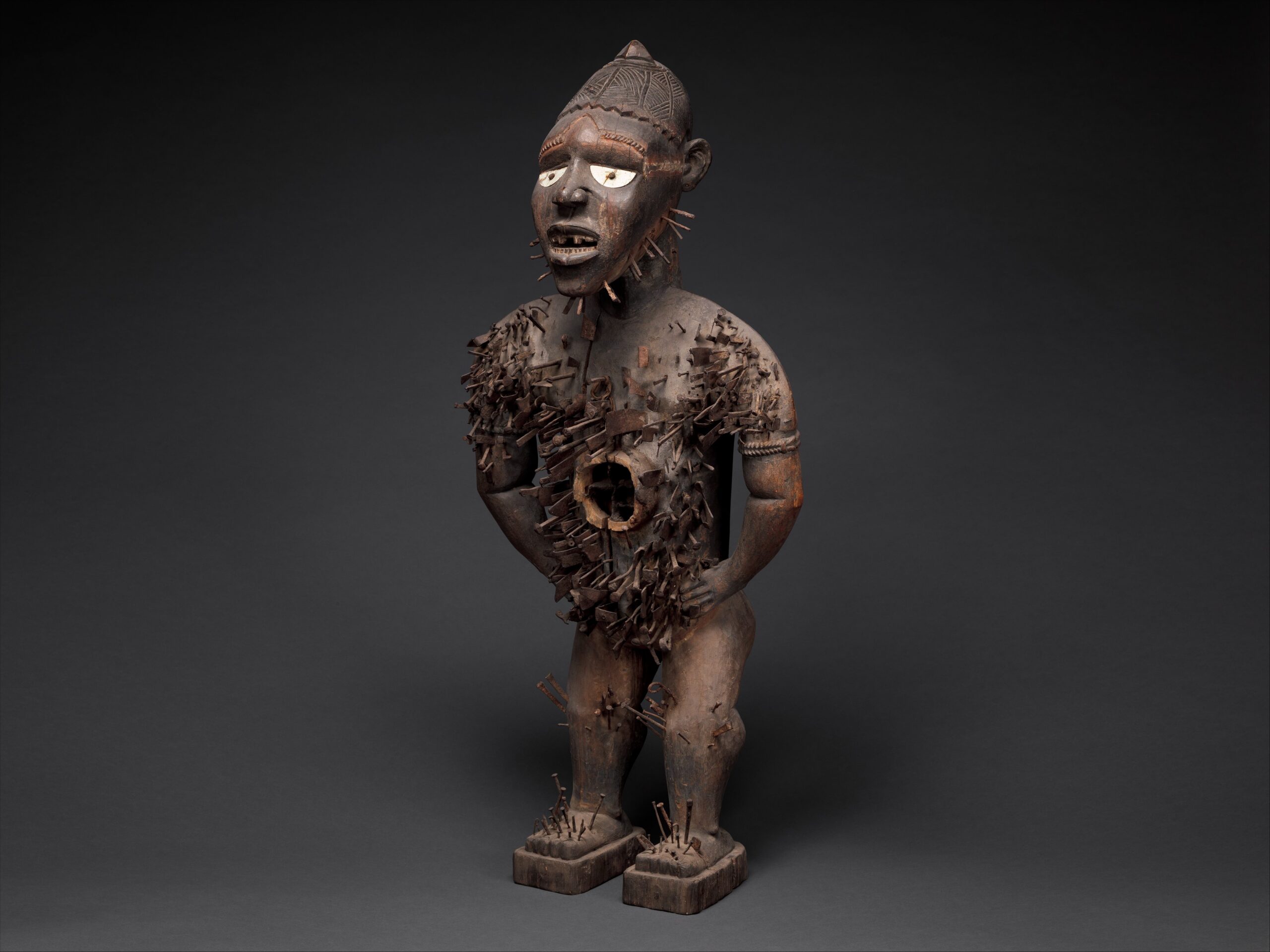
A later Kongo work, the Mangaaka power figure, gives material form to efforts to uphold collective authority. The example pictured with this article was made by a Yombe-Kongo artist and a ritual specialist around 1880–1900. Its forceful stance, cap and hands planted at the hips announce a commanding presence. Materials placed in its abdominal cavity contributed to its spiritual efficacy. The metal driven into such a figure recorded commitments and matters of justice, including agreements that a community expected people to honour. This was a specialised collaboration between sculptural and ritual knowledge. It belongs to the later history of Kongo communities and should not be treated as a portrait of a medieval king.14
By the later nineteenth century, commercial pressure and colonial expansion were transforming the wider region. During the 1880s, European powers partitioned Kongo-speaking lands between territories controlled by Portugal, France and Leopold II of Belgium. The resulting colonial borders cut through older cultural and political connections. Objects also moved into European ethnographic collections under these unequal conditions. Earlier courtly exchanges and later colonial collecting belong to different circumstances, even when the resulting works now stand in neighbouring museum cases. Following an object’s history therefore means asking who made it, what authority it once exercised, and how it was removed or transferred.15
Mbanza Kongo, inscribed on UNESCO’s World Heritage List in 2017, remains a place of historical and spiritual significance. Its customary institutions, sacred places and memories connect the former capital to living communities. The kingdom’s inheritance survives across modern borders and in languages, religious practices and objects whose histories continue to be researched. The city provides a geographical centre for that much wider story.1
Sources and further reading
1. UNESCO World Heritage Centre: Mbanza Kongo, Vestiges of the Capital of the former Kingdom of Kongo.
2. Cécile Fromont / Yale MAVCOR: Kongo Triple Crucifix.
3. The Metropolitan Museum of Art: Crucifix, Kongo artist (1999.295.4).
4. Carlos Almeida / The Metropolitan Museum of Art: Christianity and Kongo Visual Culture.
5. Christine Giuntini and Susan Brown / The Metropolitan Museum of Art: Patterns without End.
6. Dora Thornton / The Metropolitan Museum of Art: Kongo Textiles in Renaissance European Collections.
7. The Metropolitan Museum of Art; commentary by Cécile Fromont: Crucifix (Nkangi Kiditu), Kongo artist (1999.295.7).
8. World History Commons / translated primary letter: Excerpt of letter from Nzinga Mbemba to Portuguese King João III.
9. James Diskant / World History Commons: Christianity and Slavery in the Kingdom of Kongo, 1480s–1520s.
10. Sabina Pavone / VIVE, Italian Ministry of Culture: Converted Rome: an ambassador from Congo at the time of Pope Borghese.
11. The Metropolitan Museum of Art: Kongo exhibition label: Oliphant (side-blown trumpet).
12. Alexander Ives Bortolot / The Metropolitan Museum of Art: Dona Beatriz: Kongo Prophet.
13. John K. Thornton / Dictionary of African Christian Biography: Kimpa Vita (Dona Beatriz).
14. The Metropolitan Museum of Art: Power Figure (Nkisi N’Kondi: Mangaaka), 2008.30.
15. The Metropolitan Museum of Art: Kongo: Power and Majesty — Exhibition Galleries.
Photograph
Mangaaka power figure (Nkisi N’Kondi), made by a Yombe-Kongo artist and ritual specialist, about 1880–1900. The Metropolitan Museum of Art, 2008.30. The photograph’s date is not supplied. Photo: The Metropolitan Museum of Art; photographer not identified in the collection record, Power Figure (Nkisi N’Kondi: Mangaaka), Yombe-Kongo artist and nganga, about 1880–1900, accession 2008.30, CC0 1.0 / The Metropolitan Museum of Art Open Access. Original museum image downloaded without editing. No crop, colour changes or artificial reconstruction.