Ile-Ife occupies a central place in Yoruba histories of creation, kingship and belonging. The city in south-western Nigeria is also known for sculptures whose carefully modelled faces have drawn international attention. Yet an account centred only on celebrated heads leaves much outside the picture. Their makers worked within a society of religious observance, political authority, exchange and urban settlement, traces of which survive in objects and in the ground.3
A city with sacred significance
In Yoruba traditions, Ife is associated with the creation of the world. Sacred groves made religious relationships part of the city’s physical landscape. Ore Grove has yielded stone monoliths and human and animal figures, while Iwinrin is associated with terracotta heads and fragments of figures on a human scale. These places connect sculpture with settings in which objects acquired meaning and were preserved. Their histories also connect different materials and forms, rather than a single preferred style. Beliefs about creation express Ife’s sacred standing; they should be considered alongside, rather than converted into, archaeological dates for particular objects or settlements.3
The famous metal heads found at Wunmonije Compound illustrate both achievement and uncertainty. Building work in 1938 led to the recovery of seventeen brass and copper heads and the upper part of a figure. One head now in the British Museum, dated approximately 1300–1450, wears an elaborate beaded headdress on which traces of red and black pigment survive. It represents a person of authority, possibly an ooni, or ruler, but its precise identity and original function remain uncertain. The naturalism of a face does not itself prove that it is a portrait of a named king. The museum’s account places these works within a city that flourished as a commercial and spiritual centre during the early centuries of the second millennium.2
The many forms of Ife art
Terracotta gives a broader view of the artistic tradition. Surviving works include human and animal figures, vessels and beings whose forms are more abstract. Their sizes vary considerably. Some figures display royal regalia, while others portray attendants, captives or people marked by illness. This variety complicates the idea that Ife art consisted entirely of idealised rulers. Findspots close to and farther from the palace also suggest that its uses extended beyond a single royal setting. Many objects were recovered where they had been used again for religious purposes, making their earliest functions difficult to establish. Alice Apley’s account for the Metropolitan Museum additionally raises the possible contribution of women, given women’s work in Yoruba clay traditions. That is a useful question about makers whose names are lost, although a later division of craft work cannot establish the identity of every medieval artist.1
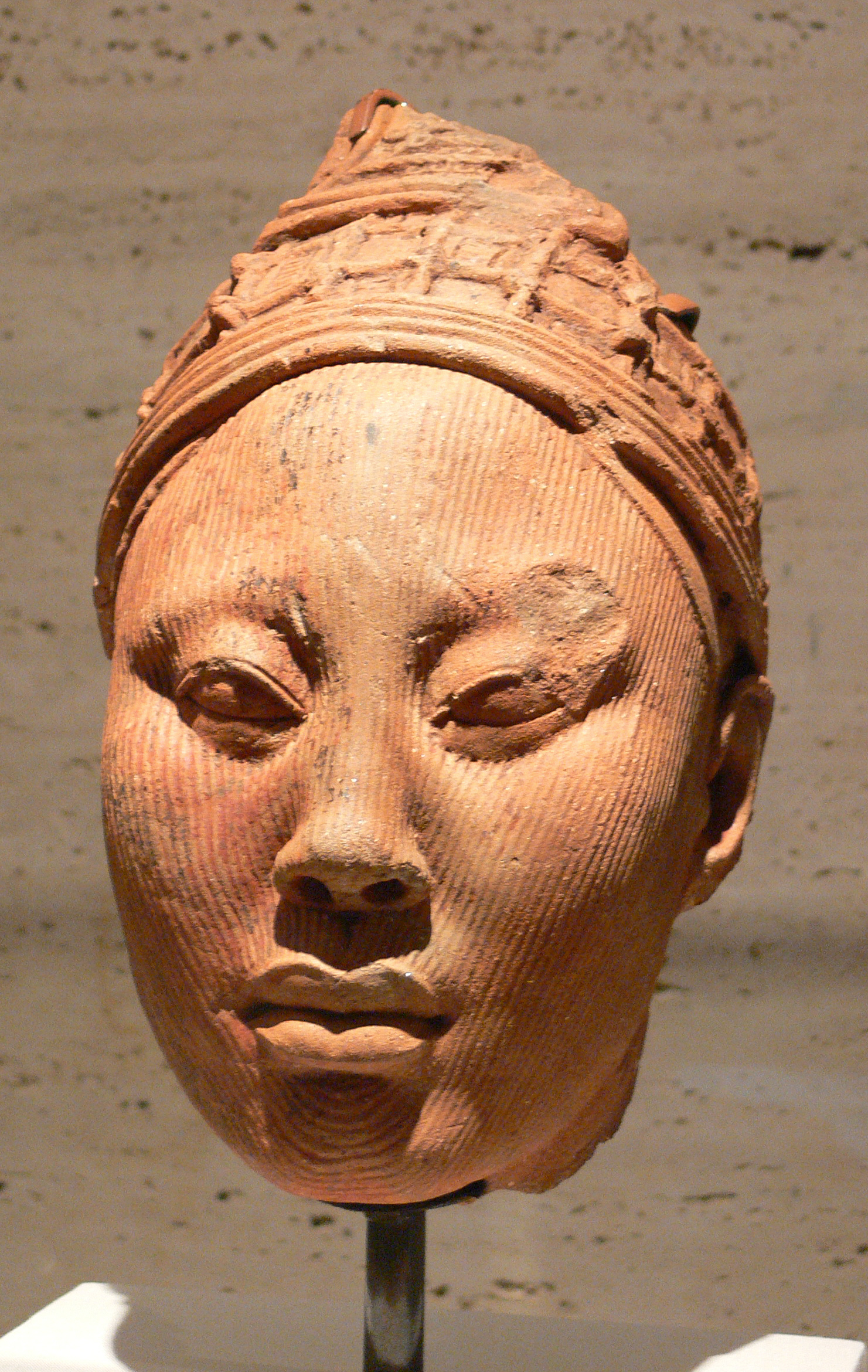
The terracotta head in the Kimbell Art Museum offers a particularly detailed example. Its elaborate crown combines a conical form with four rectangular panels and a pattern resembling intersecting beads. Fine incised lines cross the face and may represent scarification. Residues of red pigment and mica indicate that its surface once differed from the bare clay appearance viewers might expect. The museum dates it to the twelfth to fourteenth centuries and cautiously titles it Head, possibly a King. That wording leaves room for uncertainty about a person whose dignity and authority are powerfully conveyed without a securely recovered identity.10
Making metal speak
Lost-wax casting required skills in both clay and metal. An artist first modelled a form in wax and enclosed it in layers of clay. Heating removed the wax, leaving a cavity into which molten metal could be poured. After cooling, the mould was broken away. Hollow works involved additional planning around an internal core. Temperature, thickness and the behaviour of materials all affected the result. These were demanding practical achievements. The conventional label “bronzes” can also conceal different metals: brass combines copper and zinc, whereas bronze normally combines copper and tin. Ife artists worked with different copper-based materials, so identifying a sculpture’s composition is part of understanding how it was made.4
Animals could communicate political ideas too. A terracotta horse head catalogued by the Metropolitan Museum, dated to the twelfth to fifteenth centuries, has a carefully rendered bridle, a styled mane and a ridged plate at its forehead. The horse evokes the ruler or warrior who could command such a mount. The museum relates comparable works from royal shrines to visual expressions of oríkì, a Yoruba poetic tradition that characterises and addresses its subjects. Reading the object through that association connects craft to language and public ideas about authority. It also expands the story beyond the human face to the attributes through which status was expressed.9
Objects associated with Ife circulated beyond the city. The seated copper figure found at Tada, on the Niger, is thought likely to have been made at Ife because of its style and exceptionally thin casting. The identification remains an attribution rather than a documented commission. Northwestern University’s Caravans of Gold exhibition places Tada within routes linking Ife to wider exchange. In the early twentieth century, the figure was still involved in local ritual life and was taken to the river for washing. Its history therefore includes both an uncertain medieval beginning and later relationships with a community. The place where an object was found need not be the place where its story began.11
At fifty-four centimetres tall, the Tada figure is a substantial hollow casting. The Metropolitan Museum’s technical account describes several separate pourings used in its production. The artist therefore had to resolve practical problems of joining and metal flow while sustaining the form of the body. This detail makes the sculpture evidence of a sophisticated process as well as a compelling representation.4
Glassmakers and a history of invention
One of Ife’s most revealing industries produced objects small enough to pass through a hand. Excavations at Igbo Olokun have recovered glass beads and evidence of their manufacture. A study by Abidemi Babalola and colleagues, published in Antiquity in 2017, placed the main period of glassworking between the eleventh and fifteenth centuries. Its analysis suggested a technological tradition largely independent of glassmaking elsewhere. This challenged assumptions that such beads necessarily arrived from distant centres or were made only by reheating imported glass. The excavated production materials provide a basis for recognising local technical knowledge within a region connected to wider networks of exchange.5
Chemical analysis makes that argument more concrete. Research on material from the 2011–2012 excavations examined glass containing unusually high levels of lime and alumina. The excavation recovered almost thirteen thousand beads, many crucible fragments and quantities of production waste. Together, the materials and their composition support the identification of local manufacture. Researchers compared potential ingredients, including local rock and shell, and identified deliberately added colourants, although complete recipes remain under investigation. Their results also connected the distinctive glass with finds elsewhere in West Africa. Beads thus reveal both specialist knowledge within Ife and movement beyond it. A small manufactured object can record a technological relationship that a monumental sculpture alone would leave invisible.6
One proposed recipe combined material derived from pegmatite, a rock containing quartz and feldspar, with a source of lime such as shell. The researchers tested this possibility through comparisons of chemical composition. It remains a reconstruction of a process, rather than a surviving written instruction from an Igbo Olokun glassmaker.6
The city beneath the artworks
Excavation also brings attention back to compounds and surfaces on which people moved. At Ita Yemoo, a 2015 investigation recorded potsherd pavements and layers beneath them. Five charcoal samples supported an early-thirteenth-century date for an underlying accumulation of refuse. The investigators placed the laying of the pavement after the 1220s, while explaining that they could not date the surface directly. A space used for discarded material had become a carefully prepared floor. The team also documented pavement fragments elsewhere and urged more systematic protection. These surfaces show that urban form involved the reuse and arrangement of modest materials as well as prestigious art. Broken pottery became part of the fabric of a city, preserving traces of work and decisions that rarely enter a history written around royal objects.8
Further work by the Ife-Sungbo Archaeological Project has investigated domestic space. Excavations at Oduduwa College in 2018 and 2019 exposed a dwelling built on a compacted clay platform, while work in 2022 recorded stone and potsherd pavements and vessels remaining in position. The project is coordinated by Adisa Ogunfolakan of Obafemi Awolowo University and Gérard Chouin of William and Mary, with Nigerian institutions and students involved in the research. Its attention to houses and spatial organisation broadens the range of historical questions. How people arranged a dwelling or maintained a surface can tell us about urban life alongside the objects through which elites represented themselves.7
Whose knowledge shapes the interpretation?
Yoruba language and thought are essential to this work of interpretation. Art historian Rowland Abiodun taught a course on Yoruba art in the Yoruba language at the University of Ife during the 1980s. He has since argued that scholars must engage seriously with such knowledge when interpreting objects. One example is ìwà, the essential nature of a person or thing, which he presents as fundamental to understanding ẹwà, or beauty. Judgement involves knowing a subject’s character, not only admiring its appearance. Poetry, oral traditions and language supply ways of investigating those meanings. His argument also challenges the automatic identification of naturalistic heads as kings. It belongs to an ongoing scholarly discussion, but makes a clear demand: the intellectual traditions of the people who made the art must help frame the questions asked about it.12
Museum histories need similar care. The Kimbell head’s published provenance begins with a private collection in Switzerland, then records an art dealer and acquisition by the museum’s foundation in 1994. That sequence does not by itself explain the object’s original excavation or every stage of its removal from Nigeria. A catalogue can identify what is documented while leaving earlier circumstances unresolved. The gaps belong in the account, alongside the object’s date and physical description.10
Preservation in Ife also concerns the evidence that never becomes a portable museum object. During the Ife-Sungbo project, discovery of a pavement during building work at Ita Yemoo led to intervention to protect the area from construction. Such cases show why archaeological investigation depends on decisions made within a living city. Houses, schools, religious sites and historic deposits occupy connected spaces. Recording and protecting them allows the history to remain open to further questions, including those asked by Nigerian researchers and residents whose own surroundings hold the evidence.7
Sources and further reading
1. Alice Apley; The Metropolitan Museum of Art: Ife Terracottas (1000–1400 A.D.).
2. British Museum, via Google Arts & Culture: Ife head: Brass head of a ruler.
3. British Museum / Smarthistory: Kingdom of Ife: sculptures from West Africa.
4. Alice Apley; The Metropolitan Museum of Art: African Lost-Wax Casting.
5. Babalola, McIntosh, Dussubieux and Rehren; Antiquity: Ile-Ife and Igbo Olokun in the history of glass in West Africa.
6. Babalola and colleagues; Journal of Archaeological Science: Chemical analysis of glass beads from Igbo Olokun, Ile-Ife (SW Nigeria): New light on raw materials, production, and interregional interactions.
7. IFRA-Nigeria: Ife-Sungbo Archeological project 2018–2026.
8. Ife-Sungbo Archaeological Project / IFAS-Research: Ife-Sungbo Archaeological Project: Summer 2015 Report.
9. The Metropolitan Museum of Art: Horse head.
10. Kimbell Art Museum, via Google Arts & Culture: Head, possibly a King.
11. Northwestern University, Caravans of Gold, Fragments in Time: Ife and its orbit (13th–14th century).
12. Rowland Abiodun; University of Florida Center for African Studies: On the Imperative of Language for Understanding African Art.
Photograph
Terracotta Head, possibly a King, from Ife culture in south-western Nigeria, dated to the twelfth–fourteenth century; Kimbell Art Museum, AP 1994.04. Photograph taken in October 2009. Photo: FA2010, Africa Ife Head 1 Kimbell, Public domain (photographer’s worldwide release). Original Commons image bytes; no further edits made. The photographer released the photograph worldwide into the public domain; the authoritative grant is on the Commons file page. The Public Domain Mark link describes its status and is not itself the photographer’s licence grant.
