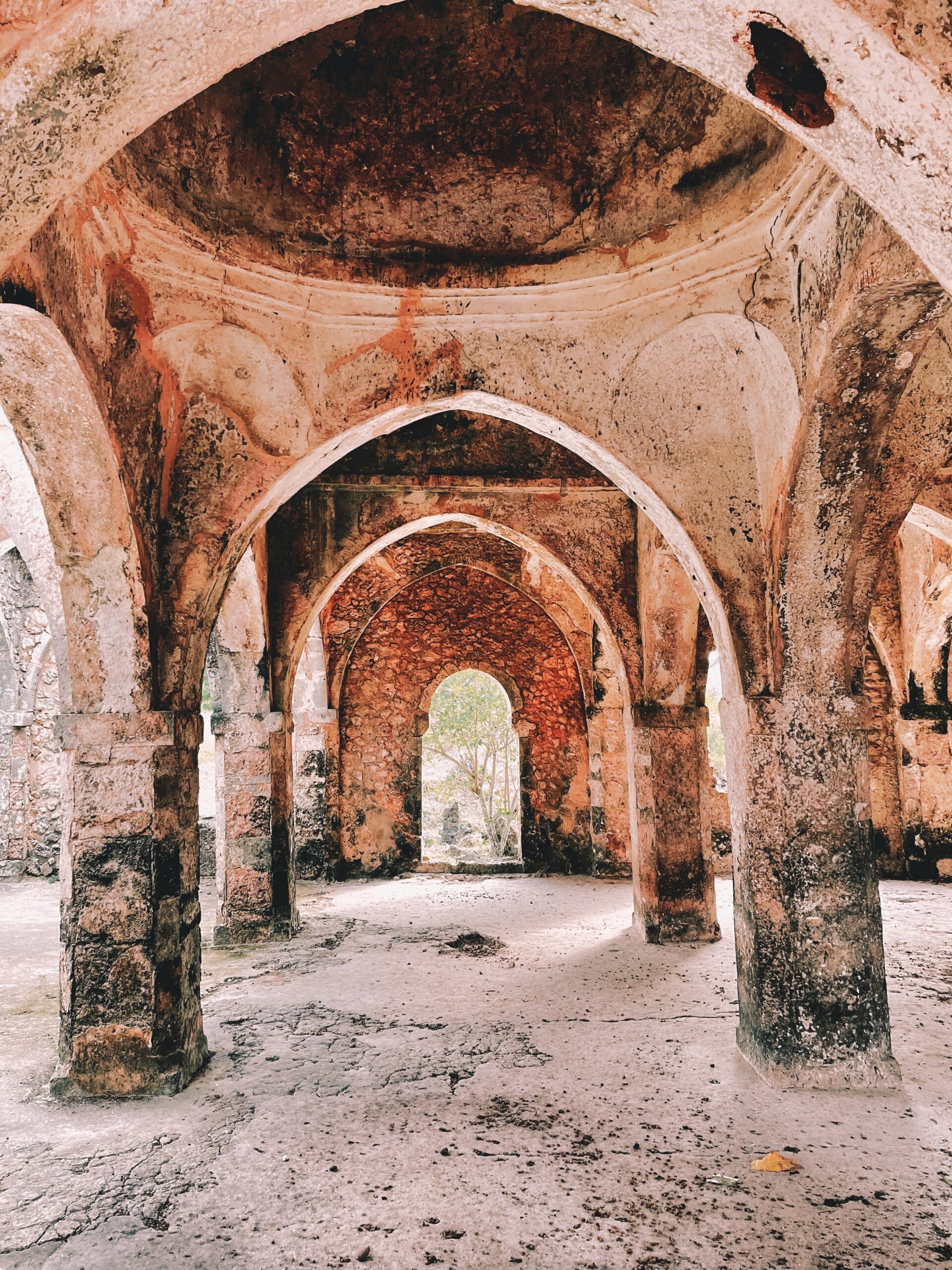
On an island off the coast of present-day Tanzania, Kilwa Kisiwani preserves the remains of a city that prospered through its Indian Ocean connections. Mosques, palaces and houses record centuries of building. The surviving ruins belong to an African urban history in which local communities participated in extensive commercial and cultural exchanges, long before European powers attempted to dominate the sea routes.1
An African city with overseas connections
Older interpretations often explained Swahili towns as settlements created by outsiders from Arabia or Persia. That approach made African residents secondary to the history of their own coast. Research on settlements and material culture has challenged it. In a reassessment of Swahili coinage, archaeologist John Perkins describes trading ports that developed from local villages and became active participants in the Indian Ocean world. Overseas relationships mattered, but they were relationships through which African communities also made choices and exercised power. A city could draw on foreign goods and Islamic traditions without being merely a copy of a distant society. Kilwa’s history is therefore best approached through the interaction of local development and wider connections, rather than a search for a single imported origin.7
The chronology continues to change as excavators obtain better evidence. A study published in 2022 analysed twenty-one radiocarbon dates from a trench excavated in 2016 beside an earlier excavation area. Its model placed the first coral buildings and coins at the end of the tenth century. These findings sharpen the sequence of Kilwa’s development, rather than supplying a date for everything visible on the island. A date from a buried deposit relates to a particular context; it cannot automatically be applied to a neighbouring monument. By comparing dated layers with buildings and artefacts, researchers can test older accounts of when the town grew and when its activities changed.2
Trade, wealth and the built city
Kilwa’s importance rested partly on its place between African producing regions and overseas markets. Gold and ivory travelled from the interior into networks that connected the coast with Arabia, India and China. In the other direction came goods including silver, perfumes, Persian ceramics and Chinese porcelain. These exchanges placed the city within commercial systems extending across several regions. The imported objects surviving in archaeological deposits are evidence of those connections, although a luxury vessel alone cannot reveal the full route by which it arrived or the circumstances in which its owner obtained it.11
The Great Mosque makes the scale of urban ambition visible. Its building history includes an eleventh-century mosque and substantial later enlargement. Coral stone and lime mortar were used to create spaces articulated by arches, vaults and domes. The monument was a place of religious gathering as well as an architectural achievement. Its successive phases matter: the structure visitors encounter is the result of work over time, not a building produced in one uninterrupted campaign. Reading those phases helps connect changes in worship, resources and construction with the wider history of the town.1
Husuni Kubwa gives a more intimate view of royal resources. Built under Sultan al-Hasan ibn Suleiman in the early fourteenth century, the palace combined private rooms for the ruler’s family with an audience court and large courtyards. Its octagonal bathing pool is among its distinctive surviving features. The arrangement brought household life, formal reception and displays of wealth into one complex. These spaces reveal a court that made authority visible through the organisation of movement and access as well as through the scale of its buildings.12
A traveller’s view of people and power
The North African traveller Ibn Battuta visited Kilwa in 1331. His account admired the town’s appearance and described Sultan Abu’l-Muzaffar Hasan’s generosity. It also referred to warfare against neighbouring non-Muslim communities and to the distribution of the resulting spoils. These observations show that wealth and generosity could coexist with organised violence. The same account that praises charity points towards coercion beyond the city. Ibn Battuta was an observer with his own religious and social priorities, rather than a neutral surveyor. His description of wooden buildings also reminds us that today’s surviving coral monuments do not represent every kind of structure he encountered. The ordinary built environment could look different from the remains that later became famous.4
He also recorded information supplied by a merchant about Sofala, farther south, and gold arriving from the African interior. This was reported knowledge, rather than a journey he himself made to every place described. Keeping that distinction visible prevents a traveller’s narrative from becoming a map of proven direct observation. It also shows how information about distant markets could move through conversations, joining people who had never visited one another’s homes.4
What the coins can tell us
At nearby Songo Mnara, archaeologists recovered more than three hundred copper coins of Kilwa types from the foundations of a stone house, together with a carnelian necklace. The deposit was dated to the late fourteenth or very early fifteenth century. Some coins bore the name of Ali ibn al-Hasan, a ruler associated with the late eleventh and early twelfth centuries, showing that older types had remained in circulation for centuries. John Perkins, Stephanie Wynne-Jones and Jeffrey Fleisher interpret the foundation deposit as a possible investment of value in the house itself. The find connects political authority and exchange with the making of a particular home.5
The question is not simply how many goods a coin could buy. Wynne-Jones and Fleisher’s study of coins in their archaeological settings examines their roles in local economic, commemorative and ritual practices. Money could carry meanings connected with authority and social relationships as well as exchange. That approach resists treating every recovered coin as a straightforward equivalent of modern cash. Its position, the objects found with it and the history of the surrounding space all matter. Small artefacts can consequently open questions about ordinary activities and values that are much harder to recover from accounts concerned mainly with rulers and international commerce.6
Research also warns against assuming that all Swahili towns followed the same timetable. The revised Kilwa chronology emphasises regional diversity in growth and decline. One settlement’s prosperity need not coincide exactly with another’s, even where they shared trading connections. This makes comparisons with neighbouring sites useful, but only when their separate histories remain visible. Kilwa offers evidence about one powerful centre within a varied coastal world, rather than a complete template for every community along it.2
Building a maritime landscape
The infrastructure of commerce extended beyond the shoreline. Edward Pollard’s study of Kilwa’s intertidal landscape identified artificial causeways and platforms associated with the major building period between the thirteenth and sixteenth centuries. Their exact purposes require care. The research considered several possible functions, including assistance with navigation, protection from waves, access to marine resources and ceremonial use. A feature could also serve more than one purpose. What these structures establish is that the working city reached into the tidal environment. Understanding Kilwa requires looking at the approaches to its harbour as well as the mosques and palaces that stand on land.8
Maritime archaeology has investigated possible wreck sites through concentrations of pottery and ballast. A study of evidence from Kilwa distinguished a reef-approach assemblage dated through pottery to the eighth to tenth centuries from a harbour assemblage associated with the thirteenth to sixteenth centuries. Such findings are clues to activity and loss at sea, not automatically the remains of an identifiable ship with a known crew or destination. They extend the evidence beyond surviving buildings and emphasise the difficulties of reconstructing shipping from scattered objects. The sea was both a route connecting communities and a place where material evidence could be dispersed.9
Later power and the history of enslavement
Kilwa remained inhabited after its medieval prominence diminished. Its later history included Portuguese intervention and control exercised from Zanzibar under Omani rulers. The Metropolitan Museum’s account identifies a renewed role in the Indian Ocean ivory and slave trades by the late eighteenth century. Later buildings and alterations, including Makutani Palace and the conversion of the Portuguese fort into a prison, also record Omani control. Enslaved people must be included in the account of commercial wealth. This needs attention to period and place, without projecting every later trade onto the medieval city or confusing Kilwa Kisiwani with other settlements bearing the Kilwa name.10
Recovering and protecting the evidence
Modern knowledge also depends on the survival of excavation records. The British Institute in Eastern Africa’s Kilwa collection includes photographs, field notebooks and records of artefacts from Neville Chittick’s excavations in the 1960s and early 1970s. Digitising this material allows researchers to revisit evidence collected before recent methods became available. Older interpretations can be questioned without discarding the observations on which they were based. An excavation changes a site as it proceeds, so notebooks and photographs preserve relationships that may no longer be visible in the ground. They are part of the historical record, not merely illustrations to a finished account.3
The World Heritage property comprising Kilwa Kisiwani and Songo Mnara was placed on UNESCO’s List of World Heritage in Danger in 2004 because of deterioration. In June 2014 it was removed following improvements in management and safeguarding. That decision recognised progress; it did not mean that erosion or maintenance needs had disappeared. The distinction matters when reading older descriptions, some of which continue to repeat a danger-list status that has changed. Conservation is ongoing work, while an international listing records an assessment made at a particular time.11
Between 2005 and 2009 the Zamani Project carried out four field campaigns, producing spatial records of buildings including the Great Mosque, Husuni Kubwa, Gereza and Makutani. Plans, panoramas and digital models make their forms available for study. These records cannot substitute for preserving the structures themselves, but they can support research and comparison. They also give people who cannot visit the island a more substantial understanding of its architectural spaces.13
A Tanzanian management plan dated November 2025 sets out ambitions for the period 2025–2035. Its preparation involved heritage authorities, universities, local representatives, guides and boat attendants. The plan connects conservation with community participation and livelihoods, rather than treating the island solely as a collection of ruins for visitors. Its proposed actions should be distinguished from completed results. Nevertheless, the range of participants expresses a practical truth about Kilwa’s future: protecting buildings and buried deposits depends on the people who live near them and work with them. Their needs belong within the continuing history of this African maritime city.12
Sources and further reading
1. UNESCO World Heritage Centre: Ruins of Kilwa Kisiwani and Ruins of Songo Mnara.
2. Horton, Olsen, Fleisher and Wynne-Jones; African Archaeological Review: The Chronology of Kilwa Kisiwani, AD 800–1500.
3. Archaeology Data Service / British Institute in Eastern Africa: BIEA Kilwa Collection.
4. Fordham University, Internet History Sourcebooks: Ibn Battuta: Travels in Asia and Africa, 1325–1354 (translated extracts).
5. Perkins, Wynne-Jones and Fleisher; Azania: A deposit of Kilwa-type coins from Songo Mnara, Tanzania.
6. Wynne-Jones and Fleisher; Cambridge Archaeological Journal: Coins in Context: Local Economy, Value and Practice on the East African Swahili Coast.
7. John Perkins; Afriques: The Indian Ocean and Swahili Coast coins, international networks and local developments.
8. Edward Pollard; International Journal of Nautical Archaeology: Inter-tidal Causeways and Platforms of the 13th- to 16th-Century City-State of Kilwa Kisiwani, Tanzania.
9. International Journal of Nautical Archaeology: Shipwreck Evidence from Kilwa, Tanzania.
10. The Metropolitan Museum of Art / World Monuments Fund: Historic Towns of Kilwa Kisiwani and Songo Mnara, Tanzania.
11. UNESCO World Heritage Centre: Tanzania’s Ruins of Kilwa Kisiwani and Songo Mnara removed from List of World Heritage in Danger.
12. Tanzania Wildlife Management Authority: Ruins of Kilwa Kisiwani and Songo Mnara World Heritage Site Integrated Management Plan 2025–2035.
13. Zamani Project: Kilwa Kisiwani: Swahili monuments.
Photograph
Interior of the Great Mosque of Kilwa Kisiwani, Tanzania, photographed on 8 July 2021. Photo: Halidtz, Great Mosque Kilwa Kisiwani, CC BY-SA 4.0. Original Commons image bytes; no further edits made. Source metadata records an existing RNI Films Fuji Natura 1600 + preset.
