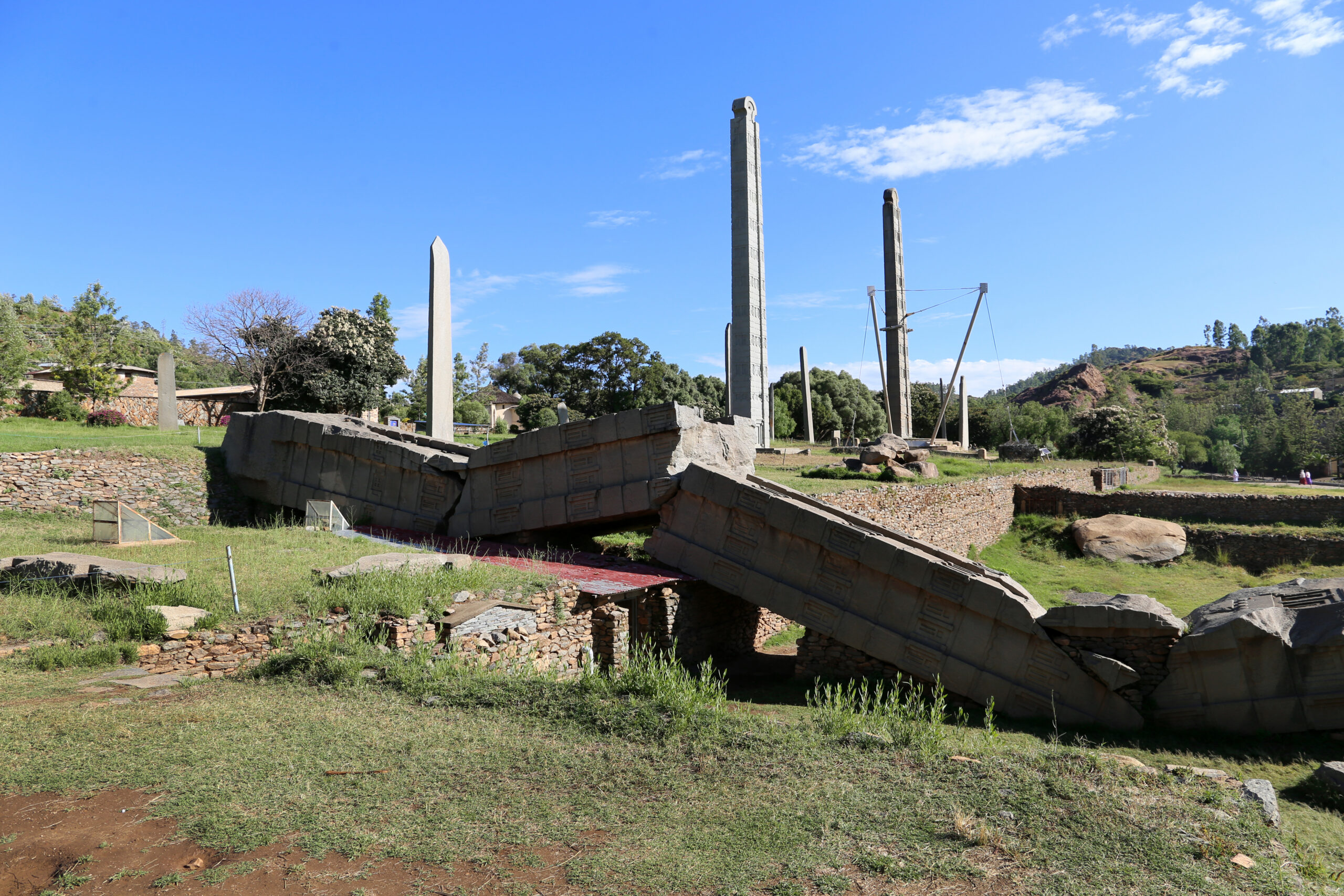
A gold coin, a towering stone monument and a fragment of writing offer different ways into Aksum’s history. Each records choices made within an African kingdom centred on the highlands of present-day northern Ethiopia and Eritrea. Flourishing during much of the first millennium CE, Aksum connected communities across the Red Sea while developing its own traditions of government, architecture and worship. Its history can be reconstructed partly through objects that its rulers commissioned: their names, titles and changing religious symbols survive where a continuous written account of their reigns does not.1
Roots in the highlands
The kingdom did not appear in an empty landscape. During the first millennium BCE, communities across the northern Ethiopian and Eritrean highlands built settlements, practised specialised crafts and participated in exchanges with South Arabia. Inscriptions preserve the name of an earlier polity, D’mt, and indicate a Sabaean presence. These connections once encouraged explanations that made outsiders the principal creators of highland civilisation. Archaeological work has complicated that picture. Local settlement histories and African cultural continuities matter alongside movement across the sea. South Arabian influence is evidence of interaction, not sufficient proof that a foreign population founded everything that followed. Aksum emerged from this older, changing regional world.2
Its prosperity also rested on ordinary production. At Beta Samati, an excavated settlement between the highlands and the Red Sea, charred remains include teff, wheat and barley. Animal bones record cattle, sheep, goats and chickens, alongside small numbers of donkeys and camels. These finds bring cultivation, herding, food preparation and transport into a story often dominated by kings. They also show why imported luxuries alone cannot explain an urban society: communities needed dependable food supplies and the labour that produced them.3
From inland routes to the Red Sea
An unusually revealing witness is the Periplus of the Erythraean Sea, a first-century trading account. Its author describes the port of Adulis, in present-day Eritrea, and a journey inland through Koloe to Aksum. Ivory gathered farther inland passed through this network towards the coast. The text lists exports including ivory, rhinoceros horn and tortoiseshell; incoming goods included cloth, glass, copper and iron, with wine and fine metal vessels among the items sought by customers and rulers. Iron also supplied practical needs, including tools. Read closely, the account describes more than distant luxury markets. It connects hunters and inland suppliers with carriers, coastal merchants and buyers across the water, revealing the many stages between an African resource and its eventual sale.4
Excavation at Adulis allows that written picture to be tested against physical evidence. Transport jars reached the port from several regions, and even their inner coatings can disclose connections. A scientific study published in 2022 analysed residues used to line vessels. Identifying bitumen helped researchers reclassify some fragments previously mistaken for a different amphora type, strengthening evidence for connections with the Sasanian trading world. The significance lies in the correction: an ordinary broken container can change a map of commerce. Aksum’s maritime setting involved overlapping routes towards the Mediterranean, Arabia and the wider Indian Ocean, rather than a single exchange with Rome.5
Royal power in the hand and on the horizon
Coinage made royal authority portable. A gold coin of Endybis in Oxford’s Ashmolean Museum, approximately dated to 295–310 CE, measures only fifteen millimetres across. Both faces show a draped ruler wearing a headcloth, framed by wheat stalks, with Greek inscriptions identifying his authority. The use of Greek placed an Aksumite king within a language familiar around the eastern Mediterranean, without turning him into a Roman ruler.6
Later coins display a different religious language. A copper-alloy issue of King Joel, dated by the British Museum to approximately 550–600, carries a conspicuous cross. Aksum’s coin designs had changed after the fourth-century adoption of Christianity by King Ezana. Over time the cross became increasingly prominent, making belief part of the ruler’s public identity. Gold pieces and small copper coins also prevent us from imagining Aksumite money as a single kind of prestige object. Different metals and designs survive, although individual specimens cannot tell us precisely who handled them or how every transaction worked.7
Writing reached beyond these royal images. Long inscriptions in stone are relatively few, but Greek and Ge’ez appear in Aksumite written evidence, while short graffiti survive on rocks and pottery. Names scratched onto a vessel could identify an owner; marks on a rock might record someone’s presence. Archaeologist David Phillipson stresses how these less formal inscriptions broaden the evidence for literacy beyond monumental declarations. They do not permit a calculation of how many people could read. They do, however, preserve traces of people whose purposes differed from those of a king announcing victories. The kingdom’s written culture included both carefully staged authority and small, personal acts of identification.8
In Aksum itself, authority also occupied the skyline. The great carved stelae are associated with elite burial grounds and belong principally to the third and fourth centuries. Their surfaces imitate buildings, with rows of windows and false doors: monumental houses for the dead expressed through solid stone. One standing example rises more than twenty-three metres. The largest fallen stele, roughly thirty-three metres long, may have collapsed during erection. Its failure is part of the history, exposing the risks within extraordinary construction. These monuments required an ability to gather labour and resources, while their differing scale makes social distinction visible even where the identities of the buried remain uncertain.9
The architectural language came from a built environment as well as funerary imagination. Palatial compounds stood on raised platforms and combined stone walls with timber elements; projecting beam ends and framed openings became recognisable features. Craftspeople translated such details into the surfaces of stelae. Other evidence reveals inventive reuse: imported glass could be reworked into decorative inlays. The result was neither a sealed local tradition nor passive imitation of foreign goods. Builders and makers selected materials, adapted forms and gave them new purposes. Monumental architecture consequently records skilled decisions as well as a patron’s wealth, even when the workers’ names have not survived.10
Christianity: a king’s decision and a wider history
Ezana’s adoption of Christianity during the fourth century was a major change, but its familiar explanation comes partly from later Christian historians. Rufinus and Socrates associated the kingdom’s conversion with Frumentius, a young man from Tyre who reached the royal court and eventually became a bishop. These accounts connect Christian merchants, court service and missionary activity. They are valuable evidence for how conversion was remembered, but they were written to explain Christian history and should not be treated as an eyewitness transcript of each event. The coins and inscriptions produced under Ezana provide a different kind of evidence, contemporary with the king whose beliefs they advertised.11
The relationship between those sources remains open to interpretation. In a study published in 2026, scholar Aaron Michael Butts argues that Ezana presented Christianity differently to different audiences, using religious language strategically in ways comparable to Constantine. He also suggests that Christianity spread through society from below, rather than simply being imposed after a royal conversion. This is a scholarly argument, not a final resolution of every uncertainty. Its value is to unsettle an overly tidy sequence in which one ruler changes religion and an entire population immediately follows. Public statements of royal faith establish what a king chose to proclaim; they do not, by themselves, reveal every household’s beliefs or the pace of religious change.12
Beta Samati gives that wider history material substance. Excavators uncovered a basilica alongside evidence of trade, food consumption and administrative activity. Christian crosses and inscriptions occur in a setting that also yielded cattle figurines and objects shaped like bulls’ heads. The excavators suggest a mingling of older practices with early Christianity, while acknowledging uncertainties about particular objects. The building therefore resists a simple division between sacred and everyday life. Its surroundings connected worship with exchanges, meals and local authority. Such evidence makes religious change a question about communities and repeated practices, rather than only the declared allegiance of a monarch.3
Across the sea, and beyond political decline
Faith also became entangled with warfare. In 525, King Kaleb sent forces across the Red Sea into Himyar, in present-day Yemen, following the persecution of Christians at Najran under the Jewish ruler Joseph, also known as Dhu Nuwas. Kaleb’s intervention established a Christian regime and involved support from the Byzantine world. Yet Aksum was pursuing its own regional ambitions, not merely carrying out another empire’s wishes. Kaleb’s inscriptions helped present conquest as divinely supported kingship. The episode reveals the dangerous combination of religious allegiance, competing rulers and control of a strategically important coast. It also places an African monarch among the active makers of sixth-century Red Sea politics.13
Aksum’s later contraction was a process, not a single disappearance. Phillipson identifies signs of economic difficulty around the capital from the middle of the sixth century: reduced occupation, buildings reused or allowed to deteriorate, and quarrying left unfinished. Changes in coin quality and metal content add evidence, although their exact interpretation and dating are difficult. Pressure on land and timber may have contributed alongside changing political and commercial conditions. This chronology matters because some difficulties preceded the seventh-century expansion of Islam. A story that attributes the kingdom’s decline entirely to a sudden religious blockade obscures the earlier changes visible on the ground and the uncertainties that remain.14
Political contraction did not erase the institutions and artistic practices associated with Aksumite Christianity. The church continued to shape Ethiopian religious life, while inherited architectural forms, manuscript culture and sacred imagery developed in later settings. Its Christian legacy became part of a longer history in which successive communities preserved selected traditions while creating new ones. The surviving objects belong to that history of adaptation as much as to an account of ancient greatness. State power and religious institutions followed different paths, leaving a legacy that cannot be measured by the kingdom’s lost territory alone.15
One monument acquired a further political history in the twentieth century. Italian troops removed a great stele to Rome in 1937 during the occupation of Ethiopia. It returned to Aksum in 2005, and its reassembly was completed in 2008. The operation involved engineering expertise, but its meaning exceeded the technical achievement: an object taken as a trophy again stood in the landscape to which it belonged. Alongside coins, inscriptions and excavated settlements, the restored stele helps make Aksum visible through evidence that has itself travelled, been interpreted and sometimes been violently displaced. Recovering this African kingdom’s history requires attending to those journeys too.16
Sources and further reading
1. Ashmolean Museum, University of Oxford: Aksum: a Late Antique Empire of Faith in Africa.
2. Deutsches Archäologisches Institut: From Monuments to Landscape: Archaeology at Aksum, 1905/1906–2005.
3. Antiquity / Cambridge University Press: Beta Samati: discovery and excavation of an Aksumite town.
4. Princeton University Press; hosted by University of Warwick: The Periplus Maris Erythraei: Text and Translation, translated by Lionel Casson.
5. Heritage Science, 10, 162 (2022): The organic residues of lining in transport vessels from the Red Sea coast of Eritrea: a further element to understand past commercial relations.
6. Heberden Coin Room, Ashmolean Museum: Aksumite gold coin of Endybis, HCR54097.
7. British Museum / Google Arts & Culture: Coin of King Joel.
8. David W. Phillipson; Boydell & Brewer / Cambridge Core: Aksumite Languages and Literacy, in Foundations of an African Civilisation.
9. UNESCO World Heritage Centre: Aksum.
10. Kristen Windmuller-Luna; Metropolitan Museum of Art: Monumental Architecture of the Aksumite Empire.
11. Emma George Ross; Metropolitan Museum of Art: African Christianity in Ethiopia.
12. Aaron Michael Butts; Aethiopica 28 (2025), published 19 May 2026: Ezana of Aksum: The First Christian African King.
13. Glen W. Bowersock; Institute for Advanced Study: The Rise and Fall of a Jewish Kingdom in Arabia.
14. David W. Phillipson; Boydell & Brewer / Cambridge Core: Decline and Transformation of the Aksumite State, in Foundations of an African Civilisation.
15. Metropolitan Museum of Art: Foundations of Aksumite Civilization and Its Christian Legacy (1st–7th Century).
16. UNESCO World Heritage Centre, 1 August 2008: Mission accomplished: Aksum Obelisk successfully reinstalled.
Photograph
Stelae in Aksum’s Northern Stelae Park, photographed on 16 November 2018. Photo: Sailko, Aksum, parco delle stele settentrionali, 03, CC BY 3.0. Original Commons image bytes; no further edits made. Source metadata records Adobe Photoshop CC 2017 processing, with no description of the individual adjustments.
