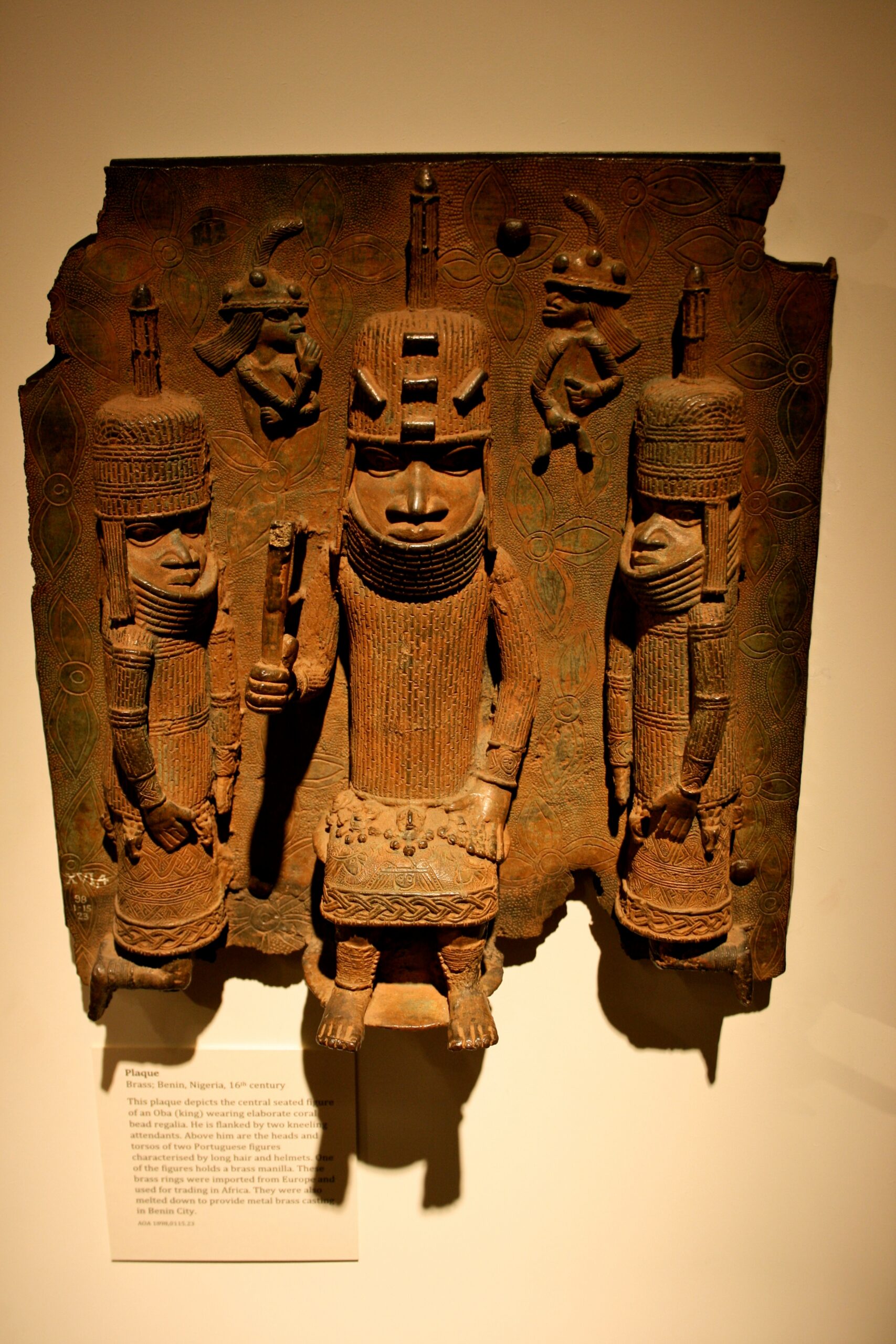
The Kingdom of Benin developed around Benin City in what is now southern Nigeria, distinct from the modern Republic of Benin further west. Its history belongs to the Edo people and to institutions that connected government, religious authority and artistic production. Edo oral traditions recall an earlier dynasty of Ogiso rulers and link the later dynasty of obas to Oranmiyan of Ife. These traditions describe political relationships and the legitimacy of kingship, rather than supplying an uncontested modern chronology. By the medieval period, a royal court was established whose specialist craft guilds would produce works for coronations, annual festivals and the commemoration of royal ancestors.1
Building royal power
Oba Ewuare, who took the throne around 1440, became associated with the remaking of the capital and the organisation of palace chiefs and royal ceremonies. Government nevertheless involved more than a king issuing commands. Hereditary chiefs, including the uzama, could balance or oppose royal authority, while town chiefs advised on affairs of state. Within the palace, three associations divided responsibilities. Iwebo included royal artists and ceremonial specialists; Iweguae attended to the ruler’s household and personal needs; Ibiwe served his wives and children. This was a differentiated political system, with offices, competing interests and obligations, whose relationships were made visible through clothing, ornaments and the arrangement of people at court. Imported coral beads and red cloth acquired ceremonial importance through overseas trade. Edo traditions associated Ewuare’s coral regalia with Olokun, the deity of water and prosperity. Such accounts made valuable materials part of a political and sacred vocabulary, linking the ruler’s visible magnificence to powers beyond the palace.2, 3
The city’s great earthworks, known as iya, combined excavated ditches with banks of the displaced soil. They belonged to an extensive network extending beyond the capital into surrounding communities. Their chronology remains under investigation: it is misleading to imagine a single wall built in one reign. Archaeological surveys also connect boundaries and gateways with sacred trees, shrines and ritual protections. In research published in 2025, investigators recorded about six surviving kilometres of the 12.4-kilometre Inner City Iya, illustrating the damage caused by expanding development. These banks preserve evidence of land organisation and collective labour as well as defence; their survival matters alongside the better-known portable artworks.4
The palace and the working city
At the centre stood a palace complex of courtyards, galleries and residences, repeatedly enlarged and rebuilt. It was both an administrative centre and a sacred place associated with successive rulers. Olfert Dapper’s seventeenth-century description, compiled from other travellers’ reports, described wooden pillars covered with metal plaques. He had not visited the city himself, a reminder to read European descriptions critically. Even so, surviving plaques and other evidence establish the importance of decorated architecture. Royal art belonged within buildings where officials assembled and rituals were performed, rather than in the isolated display conditions familiar from museums.5
Beyond the palace, production sustained the city and its military reach. Archaeology identified established ironworking at Benin by the thirteenth and fourteenth centuries. A late-sixteenth-century Dutch account described markets selling iron tools, fishing equipment, knives and weapons. Such goods connect urban history with farmers, fishers, traders and smiths whose labour is less conspicuous than royal commissions. Iron technology supported Benin’s expansion before European firearms became important. The kingdom’s power therefore rested partly on existing regional skills and exchanges, even as later overseas commerce supplied additional materials and opportunities.6
Inside the workshops
The brass casters’ achievement began with modelling. In the lost-wax process, an artist formed a wax design, sometimes around a clay core, then covered it with layers of clay. Heating removed the wax; molten metal filled the resulting cavity. The outer mould had to be broken to recover the casting. This sequence demanded control of materials and temperature as well as sculptural judgement. Conservation of the Met’s Horn Player has identified hard, iron-rich clay in the recesses as probable remains of the original mould, rather than ordinary dirt. How much clay artists intentionally retained remains uncertain. Even a sculpture’s surface can preserve questions about workshop decisions. The surfaces visitors see also reflect later treatment. After 1897, some works in England received varnish and pigmented wax that darkened their appearance. From 1980, Met conservators worked to remove these coatings. Recovering the brilliance of brass changes how we understand an art whose polished surfaces once contributed to its ceremonial effect.7
The familiar name Benin Bronzes conceals another material distinction: many works are brass, an alloy principally of copper and zinc. In 2023, Tobias Skowronek and colleagues compared lead isotopes and trace elements in artworks and metal currency rings called manillas. Their findings connected much of the brass supply with manufacture in the German Rhineland and the early Portuguese Atlantic trade. The evidence does not establish that every casting used an identical recipe; recycling and mixed metals complicate the picture. It does show how Edo artists transformed imported raw material into objects conceived for their own political and religious world.8
Images of rank and remembrance
The plaques made relationships legible. One example in the Metropolitan Museum, dated approximately 1540–70, shows an oba on horseback surrounded by attendants. The figures differ in scale according to rank, giving viewers a structured account of authority rather than a naturalistic crowd scene. Across the wider series, the close rendering of dress and equipment preserves evidence about offices and ceremonial roles. Their original architectural placement also matters: repeated images gave the palace a visual language of government. Looking closely at who stands beside a ruler, and how they are represented, reveals the organised human relationships behind the apparent splendour.9
Commemorative heads served a different purpose. A succeeding oba established an altar for his predecessor, where cast heads could support carved elephant tusks. In Edo understandings, the head was associated with character, judgement, authority and success; royal imagery extended that responsibility to the welfare of the kingdom. These sculptures generally present an ideal of mature leadership rather than recognisable likenesses of individual faces. An early head’s restrained regalia and thin casting contrast with more elaborate later examples. Such changes help historians investigate chronology, although style alone cannot recover all the names and circumstances lost when altar arrangements were broken apart.10
Women also occupied significant positions within this political world. Idia, mother of the sixteenth-century Oba Esigie, was an influential adviser whom her son honoured through the title iyoba, or queen mother. The celebrated ivory pendant mask associated with her was part of the king’s ceremonial dress and a protective object. Its finely worked headdress combines small Portuguese figures with mudfish, creatures whose movement between water and land evoked the dual human and divine character of kingship. The mask joins a particular woman’s authority to the wider symbolism of the court. It also demonstrates why Benin’s artistic history cannot be confined to metal alone.11
Commerce, conflict and conquest
Overseas trade brought wealth, but its history included exploitation. Pepper, textiles and ivory were important exports, and rulers negotiated with successive European trading partners. Benin also sold war captives into Atlantic enslavement. Historians connect increased participation during the eighteenth century with regional warfare, disputes over succession and demand for European firearms. Artistic patronage and coercion existed within the same political economy. The court’s ability to regulate commerce changed as rulers and powerful chiefs competed, especially during the nineteenth century. By Ovonramwen’s reign, internal divisions accompanied mounting British pressure to reshape trade on terms favourable to imperial interests.12
In January 1897, a British party attempted to reach Benin City despite Ovonramwen’s request that the visit be postponed. Edo chiefs organised an ambush in which seven British officials and many African servants and porters were killed. British authorities responded with a force of about 1,200 troops, intending to remove the oba and take control of the kingdom. This invasion followed years of commercial and territorial pressure, including an imposed protection treaty in 1892. Troops occupied and plundered the palace, taking thousands of objects from royal compounds and other sites. Calling the operation punitive repeated the invaders’ justification; its consequences included the overthrow of a government and the violent removal of a cultural inheritance.13
Ovonramwen was exiled to Calabar. The dispersal of palace objects also damaged the historical record: sculptures made for particular ancestral altars were separated from the arrangements that explained them. Museums and private collectors acquired objects through an international market created by military seizure. An artwork could survive physically while information about its maker, patron and ritual setting disappeared. Recovering that context has become a central task of Benin scholarship.12
Rebuilding and recovering history
The invasion did not end Edo cultural life. Following Ovonramwen’s death in 1914, his son became Oba Eweka II within a colonial order that sharply restricted royal power. Eweka II and his successor Akenzua II commissioned replacement artworks and restored ceremonies. An altar honoured Ovonramwen, while a collective altar commemorated earlier rulers. These decisions responded to the losses of 1897 rather than simply reproducing an untouched past. In 1938, the return of some of Ovonramwen’s coral regalia to Akenzua II restored objects with particular ancestral significance. Renewal involved both material reconstruction and decisions about how kingship could continue under changed political circumstances.14
Archaeology is recovering other parts of that history. Excavations undertaken for the Museum of West African Art between 2022 and 2024 investigated previously unexcavated areas of the historic palace complex. A published report describes successive walls and floors, pottery, ritual deposits and evidence of metalworking, including scorched pits containing lead slag. Preliminary radiocarbon results indicate a main sequence beginning in the fourteenth century, with further dating still under way. These findings allow researchers to compare buildings and everyday materials with oral histories and collections abroad. They also show why the ground beneath a growing modern city is an archive requiring careful investigation before construction removes it.15
Restitution has begun to change the relationship between collections and their place of origin. In November 2022, London’s Horniman Museum transferred ownership of 72 Benin objects to Nigeria’s National Commission for Museums and Monuments; six were physically returned that month. Objects retained for display became loans. The museum’s subsequent display also commissioned Edo artist Osaru Obaseki to create a new sculpture celebrating Edo women. Together, these developments place historical repair beside continuing artistic production. Benin’s inheritance comprises the works dispersed abroad, the city’s surviving fabric and the people who keep interpreting and making its culture.16
Sources and further reading
1. National Museums Scotland: The court arts and history of the Kingdom of Benin.
2. Art Institute of Chicago: Oba Ewuare and the Portuguese.
3. Art Institute of Chicago: The Hierarchy at Court.
4. African Archaeological Review / Springer Nature: Current Condition of the Iya in Benin City, the Gates and Future Preservation Strategies.
5. Art Institute of Chicago: The Oba’s Palace.
6. Penn Museum, Expedition: Benin, Oyo, and Dahomey.
7. Metropolitan Museum of Art: Recovering the Brilliance of a Benin Bronze.
8. PLOS ONE: German brass for Benin Bronzes: Geochemical analysis insights into the early Atlantic trade.
9. Metropolitan Museum of Art: Plaque with equestrian ọ́bà (king) and attendants, ca. 1540–70.
10. Metropolitan Museum of Art: Ùhúnmwèlaò (head of an ọ́bà), early 15th–mid-16th century.
11. Metropolitan Museum of Art: Pendant mask of Ìyọ́bà Idià.
12. Metropolitan Museum of Art: The Legacy of Benin Court Art: From Tragedy to Resilience.
13. National Museums Scotland: The British raid on Benin 1897.
14. Art Institute of Chicago: The British Conquest of Benin and the Oba’s Return.
15. Antiquity / Cambridge University Press: MOWAA Archaeology Project: enhancing understanding of Benin City’s historic urban development and heritage through pre-construction archaeology.
16. Horniman Museum and Gardens: Benin Kingdom Display.
Photograph
Sixteenth-century Edo brass plaque showing an oba with attendants and Portuguese figures, photographed at the British Museum on 27 June 2010. Photograph by Mike Peel (www.mikepeel.net), CC BY-SA 4.0. Photo: Mike Peel (www.mikepeel.net), Benin Bronzes at the British Museum 2, CC BY-SA 4.0. Original Commons file supplied byte for byte; no edits made. Metadata records Aperture 3.0.3; specific processing before upload is undocumented.
