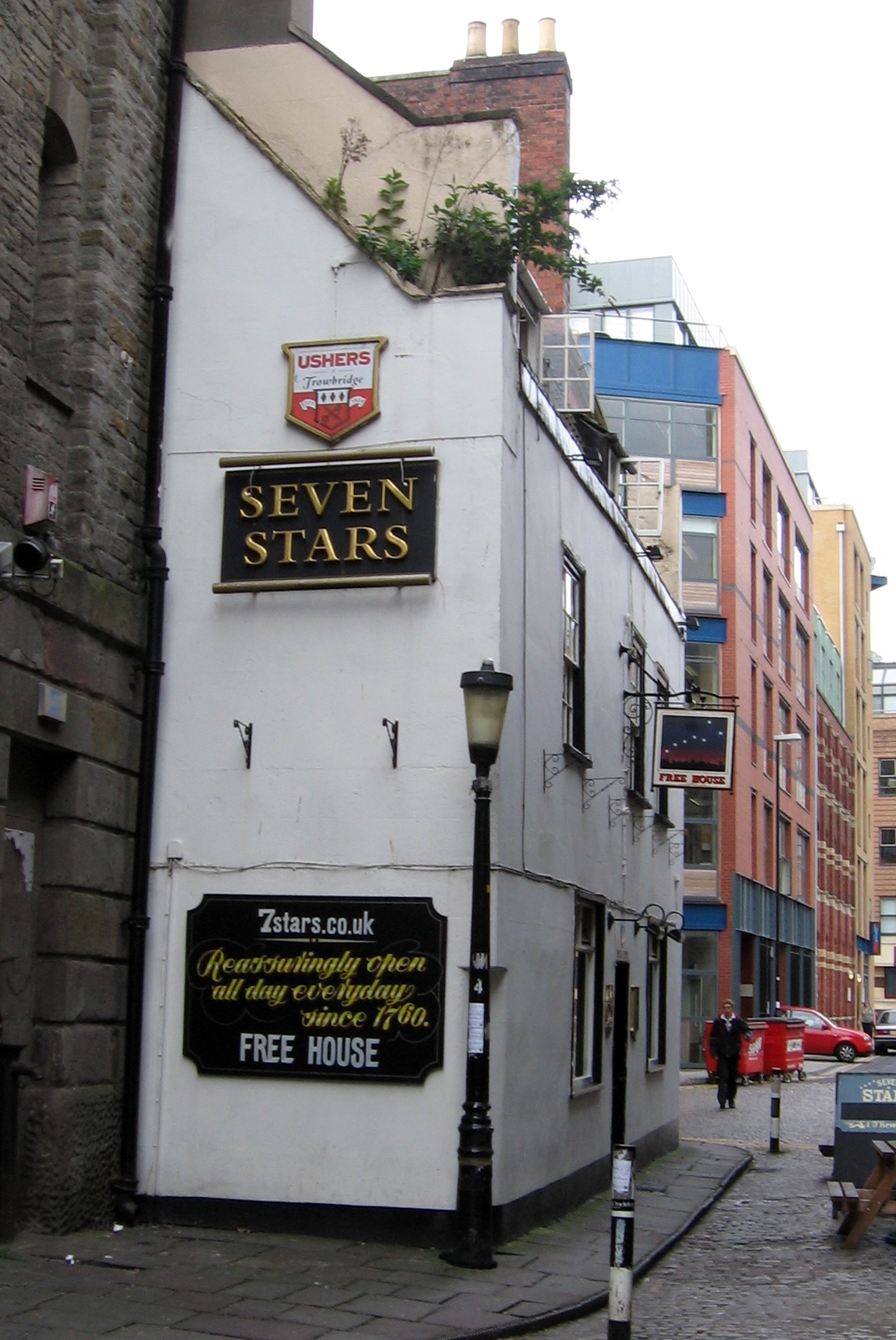
The Seven Stars in Bristol offers a way into the history of abolition through an everyday place. A public house could be somewhere to find food, accommodation, work and information. In 1787, its landlord became an important contact for Thomas Clarkson as he investigated the slave trade. Historic England’s account of the building identifies that role, now commemorated by plaques on its exterior. The story begins with local knowledge: someone who understood the port helped an outsider discover how its business operated.1, 4
A surviving place in the city
The pub stands on Thomas Lane. Historic England describes the present building as eighteenth-century, with two storeys and an attic beneath a mansard roof, and records its Grade II listing in 1975. Its scale is modest beside the grand houses and civic buildings through which Bristol’s commercial past is often remembered. That makes it a useful place to begin a different kind of enquiry. Here, the historical importance lies partly in conversations and relationships whose consequences extended beyond the building itself.2
The wealth around the harbour
Bristol’s connections with slavery reached beyond the ships that carried captive Africans across the Atlantic. Plantation wealth entered the city through merchants, lenders and property. John Pinney, whose former home is now the Georgian House Museum, made his fortune from sugar plantations in Nevis. With James Tobin, he developed a business involving shipping and loans to plantation owners. When borrowers could not repay, their property could pass to creditors, including the people they enslaved. This financial world formed part of the setting in which abolitionists worked.3
Reading the Seven Stars alongside such places connects opposition to the system it challenged. A campaign against the trade threatened established commercial relationships and assumptions about property. Bristol contained people with different interests and convictions, rather than a single united attitude. The buildings that survive can help make those relationships visible, but they need explanation: a merchant’s house does not announce all the labour and coercion that contributed to its owner’s wealth.3
Why Clarkson came to Bristol
In May 1787, a national committee was established to campaign for the abolition of the slave trade. Clarkson soon began a journey through British ports to gather information and recruit support. The Wisbech and Fenland Museum’s chronology follows him through Bristol, Liverpool and other towns that year. His work combined investigation with organising: finding people who could testify, encouraging petitions and connecting local supporters with the national campaign. Bristol was one part of that journey, and the evidence collected there would have to travel if it was to influence Parliament.4
The landlord’s knowledge
Clarkson’s own history, published in 1808, names the Seven Stars landlord as Thompson. He describes a man who boarded sailors between voyages and helped them find employment. According to Clarkson, Thompson refused to send men into the slave trade, believing that doing so would damage his house’s reputation. This placed him in a useful position. He understood seafaring employment and knew the people involved, while refusing one of the practices that Clarkson wanted to investigate.5
Thompson accompanied him around establishments where sailors were recruited. Clarkson described men encouraged to run up debts and then pressured to choose between joining a slave ship and imprisonment. He recorded making these rounds nineteen times. The account is a campaigner’s recollection, written after the events, but it gives specific substance to the landlord’s contribution. Thompson supplied access and continuing information, making it harder for the workings of the trade to remain hidden behind respectable commercial language. Thompson also alerted him when sailors were made to sign agreements they could not read. Clarkson’s account follows the warning into further investigation aboard a ship. The relationship could prompt immediate action, as well as adding evidence to a later parliamentary case.5
What the investigation uncovered
Bristol Museums’ account explains how Clarkson investigated the treatment of both captives and crews. He heard reports of severe punishments and suspected murders, and examined records showing high mortality among sailors. He also met surgeons with experience aboard slave ships. Alexander Falconbridge had served on four voyages; James Arnold had completed three and was preparing for another. Their knowledge helped carry the investigation beyond the recruitment offices and public houses of Bristol to conditions at sea.6
Falconbridge published an account of his experiences, while Arnold kept a journal aboard the Ruby that Clarkson used as evidence. These sources came from men who had worked within the trade. Reading them requires attention to that position: they could describe what they had seen, but the voices of captive Africans remained essential to understanding enslavement itself.6
Making the evidence travel
Clarkson collected material objects as well as spoken accounts. The chest preserved by the Wisbech and Fenland Museum contained instruments associated with coercion, alongside African textiles, seeds and other goods. These objects served different purposes. Implements of punishment made violence visible to audiences far from the ships; manufactured goods and produce challenged the claim that trade with Africa depended on buying and selling people. The collection became a practical aid to public speaking, allowing an argument to be illustrated through things an audience could examine.7
That method helped connect research with persuasion. Information obtained in a port needed a form that could circulate through meetings and correspondence. The chest brought evidence into public view and placed examples of African skill and production beside the objects of exploitation. It offered an alternative commercial argument alongside the demand to end cruelty.7
Black people speaking for themselves
Olaudah Equiano was an author and campaigner whose own interventions were central to the abolition movement. His autobiography, published in 1789, described enslavement and freedom. He promoted the book through travel, corresponded with politicians and addressed the government in published letters. One letter to Lord Hawkesbury was presented as evidence to a parliamentary committee. Equiano was therefore helping to shape the public case against slavery, drawing on personal experience and making arguments directed at those who exercised power. In 1788 he attended debates in the House of Commons. The same campaigner could address readers through a book, approach officials by letter and observe how arguments were handled in Parliament.8
In the same year that Clarkson visited Bristol, Ottobah Cugoano published Thoughts and Sentiments. Cugoano combined autobiographical testimony with religious, philosophical and economic reasoning. He attacked both the traffic in human beings and slavery itself, calling for immediate abolition and emancipation. His work makes clear that Black opposition went beyond supplying stories of suffering for others to use. It included independent political thought about rights, responsibility and the action required to end enslavement.9
Cugoano wrote while working as a servant for the artists Richard and Maria Cosway at Schomberg House in London. The address appeared in the 1787 book as a place where copies could be obtained. It connects a publication with the practical circumstances of its production and circulation. Campaigning involved finding readers and making writing available, as well as formulating the argument itself.9
From a port to Parliament
The evidence did not speak with one voice. Parliament’s account of the inquiries describes testimony from witnesses who contradicted one another about kidnapping and conditions aboard ships. The inquiry established by William Pitt produced a report running to around nine hundred pages. Clarkson’s arguments about other forms of African trade were supported by a manufacturer who examined cotton from Senegal, while Equiano also advocated commercial exchange with Africa. Campaigners had to confront defenders of the trade, test claims and show how evidence fitted together.10
A campaign within Bristol
Bristol’s abolition committee developed in 1788 after Clarkson’s visit. A public meeting in January resolved to raise money, organise a committee and collect signatures. Around eight hundred people signed the first petition. The campaign used meetings, letters, newspapers and poetry, making it possible for the issue to reach people who would never attend a parliamentary debate. Women participated, including through the boycott of sugar produced by enslaved labour. Decisions made in shops and households became a means of registering opposition.11
The local coalition also contained complicated histories. Some Quaker supporters came from families connected with slave trading or the manufacture of goods exchanged in West Africa. Campaigning therefore involved changing positions within a city whose economy was closely entangled with the trade. Writers including Ann Yearsley and Hannah More contributed to public debate, while religious networks gave the campaign places to meet and audiences to address.11
What changed in 1807
After repeated parliamentary defeats, the British slave trade was abolished in 1807. This was a major achievement for a campaign sustained through evidence, petitions, publications, boycotts and political pressure. It did not free people already enslaved in British colonies. Keeping that distinction clear is essential when reading the plaques and commemorations associated with abolition. The campaign against the trade and the struggle to end slavery were connected, but they did not conclude at the same moment. A date marking legislative success could coexist with continuing forced labour and punishment overseas.12
Freedom was also fought for in the Caribbean
Enslaved people continued to resist the system directly. In Jamaica, Samuel Sharpe and fellow organisers planned to withhold labour after Christmas in 1831. The movement spread, developed into armed rebellion and was violently suppressed. Sharpe was captured and condemned to death. The National Library of Jamaica places this struggle within the history of resistance to slavery. It reminds readers that emancipation cannot be explained only through British debates. People subjected to slavery were themselves acting to change the conditions of their lives, accepting risks that legislators and distant supporters did not face.13
The terms of emancipation
The Slavery Abolition Act of 1833 began the process of ending slavery across most British colonies, taking effect in 1834. Its settlement included twenty million pounds in compensation for enslavers. Many of those who had been enslaved were required to continue labouring through an apprenticeship system, which lasted until 1838 in the British Caribbean. The National Archives preserves records of registration and compensation that document this settlement. Legal change was substantial, but its terms show the continuing power of property owners over the transition to freedom.14
Remembering the whole story
The Seven Stars has also become a place where the interpretation of abolition is discussed. In 2009, Caribbean historian Richard Hart unveiled a narrative plaque outside the pub. Bristol Museums records the occasion with a photograph of Hart holding his book Slaves Who Abolished Slavery. That pairing is instructive. Remembering Clarkson and Thompson can sit alongside recognising the agency of enslaved people and Black campaigners. The pub provides one entry into a much larger history, connecting a local act of assistance with struggles carried through writing, organising, resistance and the demand for freedom.15
Sources and further reading
1. Historic England: Bristol Historic Pub Walk — The Seven Stars.
2. Historic England: The Seven Stars Public House, list entry 1202634.
3. Historic England: Bristol and the South West — Enslavers and Plantation Wealth.
4. Wisbech and Fenland Museum: Thomas and John Clarkson: Abolition and Peace timeline.
5. Thomas Clarkson; Project Gutenberg transcription: The History of the Rise, Progress and Accomplishment of the Abolition of the African Slave Trade, Volume I (1808).
6. Bristol Museums, PortCities Bristol: Thomas Clarkson in Bristol.
7. Wisbech and Fenland Museum: Thomas Clarkson — Campaign techniques and Clarkson’s chest.
8. UK Parliament Heritage Collections: The Transatlantic Slave Trade — Olaudah Equiano.
9. English Heritage: Ottobah Cugoano: author and anti-slavery campaigner.
10. UK Parliament: The evidence.
11. Bristol Museums, PortCities Bristol: The campaign in Bristol.
12. UK Parliament: 1807 Abolition of the Slave Trade.
13. National Library of Jamaica: Samuel “Sam” Sharpe.
14. The National Archives: Slavery and the British transatlantic slave trade — research guide.
15. Bristol Museums: M Shed’s Historical Walks: Bristol Abolition.
Photograph
The Seven Stars public house in Bristol, photographed on 25 April 2007. Photo: William Avery, Seven Stars Bristol, CC BY-SA 2.5. Original Commons image version; no further edits made.
