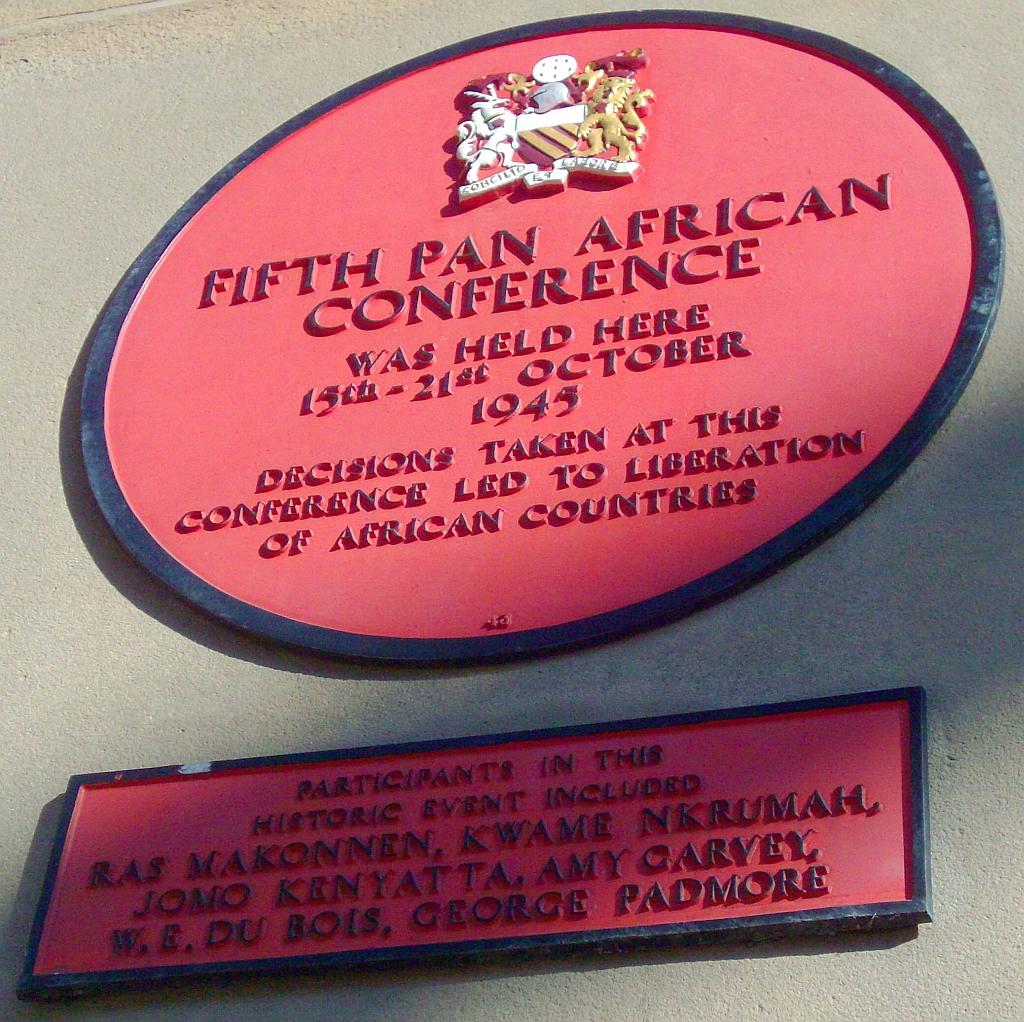
In October 1945, delegates gathered at Chorlton-on-Medlock Town Hall in Manchester to discuss the future of people living under colonial rule. Among them were Kwame Nkrumah, Jomo Kenyatta, George Padmore and W. E. B. Du Bois. The Fifth Pan-African Congress would become an important meeting in the history of African independence. It also belonged to Manchester: to its residents, workplaces and organisations, and to people who understood that freedom abroad and equality in Britain were connected questions.1
A movement across borders
Pan-Africanism brought people of African descent into conversation across national and imperial boundaries. The Manchester meeting inherited a longer history of organisation. Du Bois, the African American scholar and activist, had organised the first Pan-African Congress in 1919; he was seventy-seven when he attended in 1945. His presence linked generations of campaigners. For younger delegates, the task was to turn international discussion into effective movements capable of challenging colonial governments.1
The organisers behind the meeting
George Padmore was central to that work. Born in Trinidad, he developed an international career as a writer and political organiser, connecting anti-colonial movements during the 1930s and 1940s. The George Padmore Institute identifies the organisation of the Manchester Congress as one of his major contributions. His work with Nkrumah continued before and after Ghanaian independence in 1957. That continuing relationship helps explain the Congress as part of sustained organising: people met, developed arguments and maintained connections that could support political action elsewhere.2
There was practical work behind every international gathering. A programme needed people willing to prepare it, organisations willing to send representatives and contacts able to reach across distance. Padmore’s combination of writing and organising made those tasks part of the same political project. Ideas travelled through personal relationships as well as through published arguments.2
Why Manchester mattered
Manchester already had an active Black political community. Dr Peter Milliard, a physician born in British Guiana, had established a medical practice in Lower Broughton and supported Black seafarers arriving through Salford docks. He organised opposition to Italy’s invasion of Ethiopia and founded the Negro Association, Manchester, in 1943. The historical name survives in the association’s membership records, now held by the People’s History Museum. Those records place individual residents within a network of organised activity.3
The association raised support for striking Nigerian workers in 1945. Such activity connected events in West Africa with people living and working in Greater Manchester. The Congress therefore came to a city with existing relationships, experienced organisers and a record of solidarity. Looking at a membership ledger alongside photographs of famous delegates changes the scale of the story. It reveals the community through which an international political meeting became possible. The museum’s ledger contains names and addresses, bringing people usually absent from accounts of high politics into view. Its evidence also changes the questions a reader can ask: who joined, where they lived, and how neighbours and fellow workers became involved in wider campaigns.3
Food, friendship and finance
Ras Makonnen’s businesses provided another foundation. An oral history interview with Alfred Gaisie, recorded in 1995 and discussed by the Ahmed Iqbal Ullah Centre, describes the importance of his friendship with Makonnen. After working and studying in Manchester, Gaisie found stable accommodation and a community through that relationship. Their ventures created places where people could eat, meet and work. The account connects the earnings of Makonnen’s businesses with the financing of the Congress.4
These connections gave political organisation a material base. A restaurant could provide an income, employment and somewhere to exchange information. A room could make the difference between attending a meeting and being excluded by the difficulty of finding accommodation. Gaisie’s memories invite us to recognise that hospitality and friendship were forms of practical support. The history of the Congress includes that everyday labour alongside the speeches delivered from its platform.4
Workers within the movement
Thomas Bangbala offers another route into this Manchester history. Born in Nigeria in 1907, he arrived in Liverpool as a young seaman and later trained as an electrical engineer. He moved to Manchester in 1928 and joined the Electrical Trades Union in 1940. An active Labour Party member and campaigner against racism, he attended the Congress. The People’s History Museum holds material relating to his life. His experience connects professional skill, migration and political participation: the person entering the meeting hall was also a worker with a history of seeking a place within the city’s institutions. According to the museum, he was the first Black member of the union’s Manchester branch. That achievement did not remove the broader difficulties facing Black workers. It does, however, make visible a participant whose influence depended on sustained involvement in local political and working life, rather than on becoming a national leader.5
Britain was on the agenda
The first session, chaired by Amy Ashwood Garvey, addressed racial discrimination in Britain. In the published proceedings, speakers described difficulties securing work, the treatment of Black seamen and the position of British-born children. E. J. Duplan discussed promises made to wartime workers and the discrimination that followed. Aki-Emi connected obstacles to earning a living in Britain with imperial conditions in the countries people had left. These contributions made everyday livelihood part of the discussion about freedom.6
Alma La Badie, representing the Universal Negro Improvement Association, raised the welfare of children born to Black American servicemen and British women. Her contribution called for practical support. Later in the Congress, Ashwood Garvey drew attention to the limited discussion of Black women. Their interventions show that family life, care and women’s experiences were political questions within the meeting, even when the most familiar accounts concentrate on male leaders and future statesmen. The discussion ranged beyond Britain. Delegates describing Caribbean conditions linked political restrictions with low wages and the concentration of land ownership. These accounts gave the demand for self-government a social content, extending to conditions in which people worked and raised children.6
A programme with specific demands
The Congress belonged to a wider effort to make colonial grievances precise and public. An open letter from the Pan-African Federation to the British prime minister in September 1945 demanded immediate self-determination. The surviving catalogue describes proposals concerning education, equal pay in colonial government employment, racial discrimination in Britain and the treatment of African troops. These were demands about how power operated through institutions and everyday decisions, as well as about who held political office.7
The Congress’s press releases also record discussions organised around different regions, including West Africa, South Africa, East and Central Africa, and the Caribbean. Issues included voting, land, education, freedom of movement and association. Delegates did not need identical circumstances to recognise shared problems. Their task was to relate particular grievances to a broader challenge to imperial rule while retaining enough detail to make action possible. The catalogued West African session included representatives of Gold Coast railway employees and cocoa interests, the Nigerian trade union movement and the West African Students’ Union. Their presence brought different kinds of experience into a common discussion, connecting study, agricultural production and organised labour.7
How could independence be won?
The means of achieving freedom mattered as much as the declaration of an aim. Historian Christian Høgsbjerg’s study describes debates about mass organisation, non-violent action and the use of force. Activists considered the example of India and the possibilities offered by trade unions, co-operatives and political organisations. The Congress favoured peaceful methods while allowing for force as a last resort against continued coercion. There was discussion and disagreement within that position, rather than a single uncomplicated formula. Wallace-Johnson of Sierra Leone, for example, complicated a simple division between force and non-violence by discussing the pressure created by fasting. Such exchanges show delegates testing the language of political action against practical examples, rather than merely approving a prepared declaration.8
This emphasis placed organised people at the centre of change. Colonial rule could be challenged through strikes, public meetings and sustained political pressure, drawing strength from people acting together. The approach required patient work beyond a conference: recruiting members, developing leadership and creating organisations able to survive setbacks. In this reading, Manchester mattered because it helped clarify a strategy whose success would depend on movements taking root elsewhere.8
From discussion to national movements
Nkrumah’s subsequent career shows one way those connections continued. He returned to the Gold Coast in 1947 to become general secretary of the United Gold Coast Convention. In 1949 he established the Convention People’s Party, which demanded immediate self-government. Its campaign of positive action in 1950 used protest, strikes and non-cooperation. Nkrumah was imprisoned, then released after the party’s electoral success in 1951. Ghana became independent in 1957, with him as prime minister. These developments involved local struggles, supporters and changing political conditions. The Congress formed part of that history; it did not make independence inevitable.9
The work continued in Manchester
Local anti-racist organising also continued after the delegates dispersed. In 1946, Len Johnson and Wilf Charles helped establish the New International Society in Moss Side. Charles’s oral history describes their ambition to create an international centre that would campaign for racial equality. The organisation supported local and overseas causes, and Paul Robeson sang there in 1949. Such activity provides a Manchester context for the Congress’s wider significance. International solidarity was maintained through places where residents could gather, discuss and organise, and through friendships that extended beyond one historic week.10
Keeping the record open
The fiftieth anniversary in 1995 generated six recorded interviews with people who had attended the Congress or lived in Manchester at the time. Preserved by the Ahmed Iqbal Ullah Centre, these accounts include memories of racism and of the city’s Black communities. They broaden the historical record beyond resolutions and photographs. A participant’s recollection may reveal what made attendance possible, how a place felt or why an event remained meaningful many years later.11
The seventy-fifth anniversary in 2020 brought together regional universities, community organisations, historians, writers and artists. Events connected the Congress to Manchester’s local people and urban culture as well as to African independence. The continuing value of that work lies in keeping both scales visible: the international demand for self-rule and the residents who supplied the relationships, experience and resources on which organisation depended. The Congress becomes easier to understand when those people remain within the story.12
Sources and further reading
1. History@Manchester, University of Manchester: The 1945 Pan African Congress in Manchester.
2. George Padmore Institute: About George Padmore.
3. People’s History Museum: Africa Speaks in Manchester: Pan-Africanism, Manchester and a collection gem.
4. Ahmed Iqbal Ullah Centre, University of Manchester: Meaningful Connections: how strong communities make stronger movements.
5. People’s History Museum: From “unskilled” to “essential”: histories of migrant workers in PHM’s collection.
6. Pan-African Federation; transcription at Marxists Internet Archive: Colonial and Coloured Unity: A Programme of Action — proceedings, edited by George Padmore, 1947.
7. Ahmed Iqbal Ullah Centre, University of Manchester: Pan-African Congress 1945 and related celebratory events 1982–1995, GB3228.34.
8. Leeds African Studies Bulletin, University of Leeds: Remembering the Fifth Pan-African Congress — Christian Høgsbjerg.
9. Kwame Nkrumah Memorial Park, Ghana: Biography of Osagyefo Dr. Kwame Nkrumah.
10. Ahmed Iqbal Ullah Centre, University of Manchester: Ours is a Very Active Life.
11. Ahmed Iqbal Ullah Centre, University of Manchester: The 1945 Pan-African Congress: Manchester and the Fight for Equality.
12. University of Manchester: Universities mark 75th anniversary of Manchester’s role in the African independence movement.
Photograph
A plaque commemorating the Fifth Pan-African Congress in Manchester, photographed on 1 June 2009. Photo: KGGucwa, Manchester fifth Pan-African Congress commemorative plaque, CC BY-SA 3.0. Current Commons version, reduced in resolution by the photographer; no further edits made.
