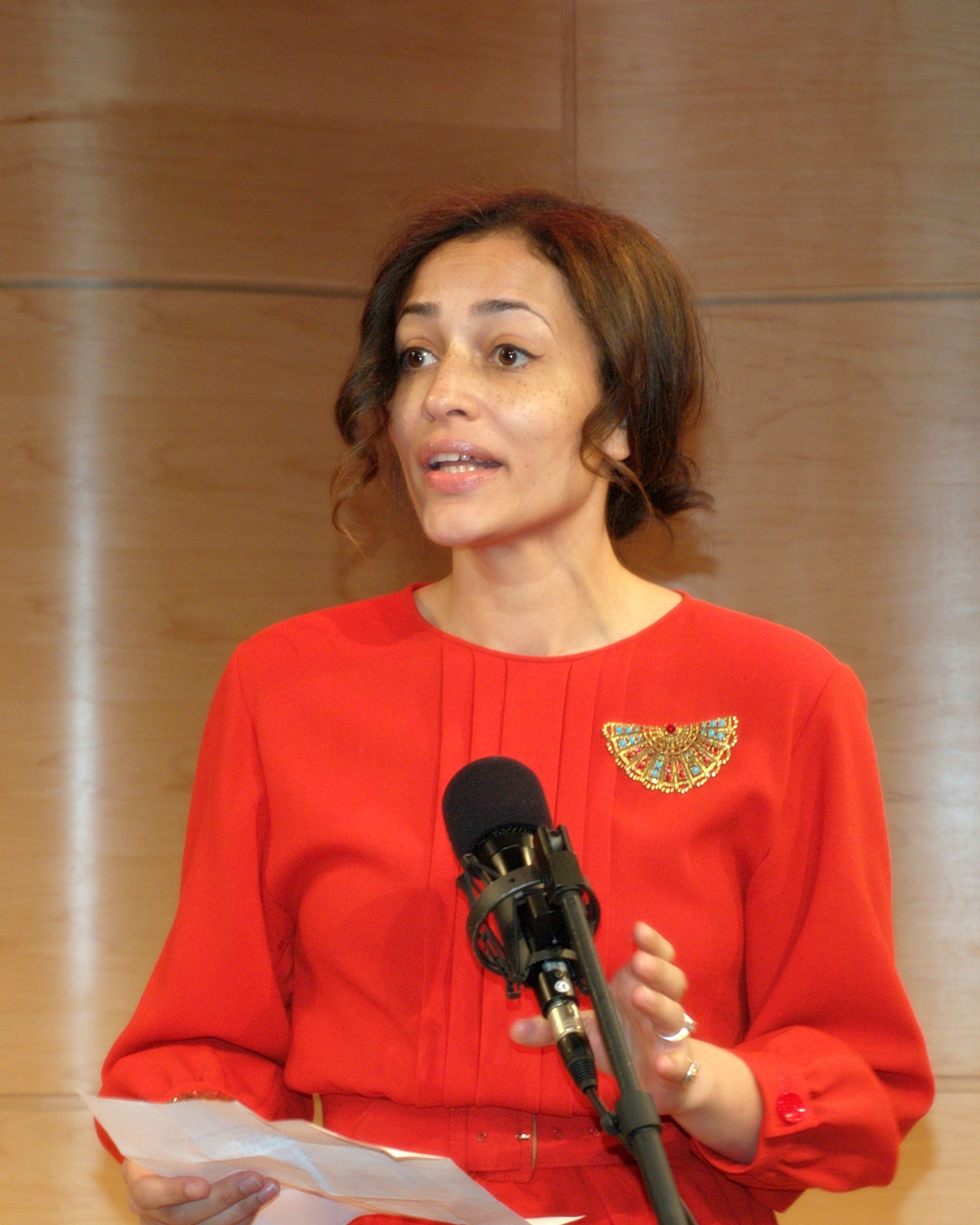
A neighbourhood can contain people who live within walking distance of one another yet inhabit different worlds. That is fertile territory for Zadie Smith. Across her fiction, north-west London becomes a place where family history, money, education and ambition shape encounters between neighbours. The city supplies much of her material, while her writing also travels into American universities and celebrity culture. Belonging, in these stories, is something people negotiate through everyday relationships.1
A writer formed by reading
Smith was born in north-west London in 1975 to a Jamaican mother and an English father. She began White Teeth while studying at Cambridge. That background matters, but it cannot explain every imaginative choice she has made: her writing repeatedly enters households and experiences unlike her own. An interest in the pressures of moving between social worlds runs through both her career and the subjects she chooses.1
In an interview with Cambridge Edition, Smith remembered arriving at King’s College with her mother in a borrowed van bearing the name of Brent Social Services. They had become lost, arrived late and worried that she had already missed something essential. Reaching the college was an emotional moment after years of study. Her recollection gives the educational journey a human scale: a mother driving, a daughter impatient to arrive, and a long-imagined future becoming real.4
Speaking with the cartoonist Chris Ware in 2013, Smith described reading as her most important early apprenticeship. As a teenager, she sometimes copied stories by Agatha Christie or P. G. Wodehouse, learning from the workings of someone else’s sentences. Her school reading brought her into contact with writers including Milton, Austen and Shakespeare. Before university, she tried to work through an intimidating reading list because she assumed she was expected to finish it.2
That account offers a useful way to understand her development. A writer’s voice can emerge through close attention to other voices. Smith’s recollections place patience, curiosity and accumulated reading behind the apparent suddenness of a successful first novel. They also make literary education something active: noticing how a story works, trying its methods and discovering what a different sentence might do.2
The families of White Teeth
Published in 2000, White Teeth won the Whitbread First Novel Award, the Guardian First Book Award and the James Tait Black Memorial Prize for Fiction. Smith later recalled beginning the work at university as what she thought would be a long short story. Writing it offered relief from the pressure of academic work. The novel’s eventual scale grew from that comparatively modest beginning.3, 4
At its centre are Archie Jones and Samad Iqbal, friends whose histories reach back to the Second World War. Archie’s Jamaican wife, Clara, and their daughter, Irie, become entwined with Samad’s family, including his wife, Alsana, and their twin sons, Magid and Millat. Questions of religion, ancestry and education acquire force because parents and children want different things from the lives they share.5
The twins’ diverging paths complicate Samad’s hopes of controlling their futures. Irie’s interest in her ancestry and attraction to the educated Chalfen household raise further questions about the authority families possess. One way to read these relationships is as a challenge to neat accounts of assimilation. People inherit histories, but they interpret them unevenly; children can surprise their parents, and the supposedly secure household next door has its own conceits.5
The freedom to change direction
The Autograph Man turns towards Alex-Li Tandem, a young Chinese-Jewish dealer in celebrity signatures. Moving between London and New York, its story connects the collecting of famous names with desire, family and the search for meaning. The premise lends itself to a sharp question: what do people hope to possess when they buy a trace of someone else’s life? It also demonstrates Smith’s willingness to build a novel around a protagonist far removed from her public image.6
On Beauty places two families within an American university setting. Howard Belsey is a white English academic married to Kiki, an African American woman. His rivalry with the conservative Monty Kipps brings political disagreements into the home. Meanwhile, Kiki and Monty’s wife, Carlene, develop a friendship that crosses the lines their husbands draw. The novel won the 2006 Orange Prize for Fiction, now the Women’s Prize.7
Its family conflicts invite readers to compare professed beliefs with actual behaviour. Intellectual confidence does not prevent jealousy, betrayal or failures of attention. The younger generation’s encounters across class boundaries further unsettle the idea that sharing a racial identity guarantees shared experience. These are pressures that a campus argument alone cannot resolve; they have consequences inside marriages, friendships and households.7
NW and the distance between neighbours
With NW, first published in 2012, Smith returned closely to the territory of childhood. Leah, Natalie, Felix and Nathan have grown up on the same London council estate, but their adult lives have taken different directions. Housing, work and chance meetings bring past and present into contact. The shared starting point makes their differences especially visible: leaving an estate does not settle what its relationships and memories will mean later.8
Smith explained the novel’s broken and shifting form in a 2012 interview with The Harvard Crimson. She wanted to convey the interruptions and improvisations of moving through a modern city, while leaving room for the reader’s imagination. The gaps therefore belong to the book’s account of experience. They ask readers to make connections instead of receiving a complete explanation of every life. Form becomes part of the subject: the city cannot be understood from one uninterrupted point of view.9
In the same conversation, she described families as small societies, capable of freedom and affection but also of control. The arrangements people inherit can produce anxiety, negotiation and comedy. That observation helps connect her interest in the household with her interest in the street. Both contain people obliged to deal with differences they did not choose. Reading these relationships closely means allowing affection and resentment to coexist, instead of assuming that one cancels the other out. Smith finds room for that ordinary contradiction within the larger movements of city life.9
Friendship, dance and unequal opportunities
Swing Time begins with two girls who dream of dancing. Tracey has the stronger talent; her friend, the narrator, eventually works for a famous singer, Aimee. Their lives lead in different directions, and the story extends from London to West Africa as Aimee becomes involved in philanthropy. Dance connects private longing with questions about who receives opportunities, who attracts attention and who controls the terms of other people’s advancement.10
Discussing friendship with Penguin in 2017, Smith emphasised the freedom involved in choosing a friend. She recalled sharing cultural practices with school friends through invitation and curiosity. A tradition could become something offered between equals, without carrying all the expectations attached to inheritance or marriage. Her account helps explain why friendship occupies so much space in her fiction: another person can open a door onto a different way of living.11
Smith also described conversation as essential to her thinking. The resulting picture of friendship includes argument and difference alongside affection. It suggests a useful approach to the relationships she writes: pay attention to what friends allow one another to become, and to the expectations they impose. Those demands can endure even after the circumstances that first brought people together have changed.11
Short stories and a voice on stage
Her short-story collection Grand Union broadens the range of settings and possibilities. Its situations include an Antiguan migrant’s final day in 1959, a disgraced police officer and a teenager moving through virtual reality. The variety gives Smith room to examine different scales of experience. A short story can concentrate on an encounter or unsettling possibility without having to explain an entire family’s development across decades.12
The Wife of Willesden brought her writing to the theatre. First produced by Kiln Theatre in 2021, it relocates Chaucer’s Wife of Bath to contemporary north-west London. Its central figure, Alvita, recounts a life that includes five marriages to an audience in a pub setting. Directed by Indhu Rubasingham, the production made storytelling a public performance: a woman explaining herself, defending her choices and holding the room through the force of her speech.13
The essay as a place to think
Smith’s essays create another route into her interests. Feel Free brings subjects such as social media, the environment, cinema, Jay-Z and the novelist Karl Ove Knausgaard into the same collection. That range suggests an understanding of culture in which popular entertainment and literary argument can illuminate each other. The important question is what attentive thinking reveals about a subject, whether it arrives through a book, a song or a screen.14
Intimations, published in 2020, gathered six personal essays written during the first months of the coronavirus pandemic. Their circumstances matter: Smith was responding while events were still changing, trying to organise thoughts and feelings without the distance available to a later historian. The shorter form allowed her to work within uncertainty, addressing the experience of a period whose consequences were still unfolding.15
Dead and Alive, published in 2025, continues her engagement with art, public life and the losses that alter a reader’s world. It considers artists including Toyin Ojih Odutola and Kara Walker, and remembers writers including Toni Morrison, Joan Didion and Hilary Mantel. Alongside those subjects are walks through Kilburn and reflections on shared public life. The combination keeps the local street in conversation with a much wider cultural world.16
Looking back through The Fraud
The Fraud, published in 2023, turns to nineteenth-century Britain and Jamaica. The real Tichborne case provides its public drama: a claimant insists that he is the missing heir to a wealthy family. Among the novel’s central figures are Andrew Bogle, a formerly enslaved man who becomes a witness, and Eliza Touchet, connected to the household of novelist William Harrison Ainsworth. Literary reputation, inherited wealth and the power of persuasive stories meet within its historical setting.17
The novel’s movement between literary London and Jamaican plantations invites a broader view of British history. Lives presented as local or domestic are connected to labour, violence and wealth elsewhere. For readers approaching Smith through Black British history, this is a productive question to carry across her work: which relationships become visible when the frame widens? Her subjects change, but families, places and the stories people tell about themselves remain open to examination.17
Sources and further reading
1. Brown University: Acclaimed novelist Zadie Smith to read at Brown.
2. BOMB / LIVE from the New York Public Library: Zadie Smith and Chris Ware: a conversation.
3. Penguin Books UK: White Teeth: 25th Anniversary Edition.
4. Cambridge Edition: Interview: Zadie Smith.
5. Penguin Random House: White Teeth: Reader’s Guide.
6. Penguin Books Australia: The Autograph Man.
7. Women’s Prize for Fiction: On Beauty: reading guide.
8. Penguin Books UK: NW.
9. The Harvard Crimson: 10 Questions with Zadie Smith.
10. Penguin Random House: Swing Time.
11. Penguin Books UK: Zadie Smith: Adult friendships seem hopelessly diluted.
12. Penguin Books UK: Grand Union.
13. Kiln Theatre: The Wife of Willesden: production information.
14. Penguin Books UK: Feel Free.
15. Penguin Books UK: Intimations: Six Essays.
16. Penguin Random House: Dead and Alive.
17. Penguin Books UK: The Fraud.
Photograph
Zadie Smith at the National Book Critics Circle finalist announcement, 22 January 2011. Photo: David Shankbone, Zadie Smith photograph, CC BY 3.0.
