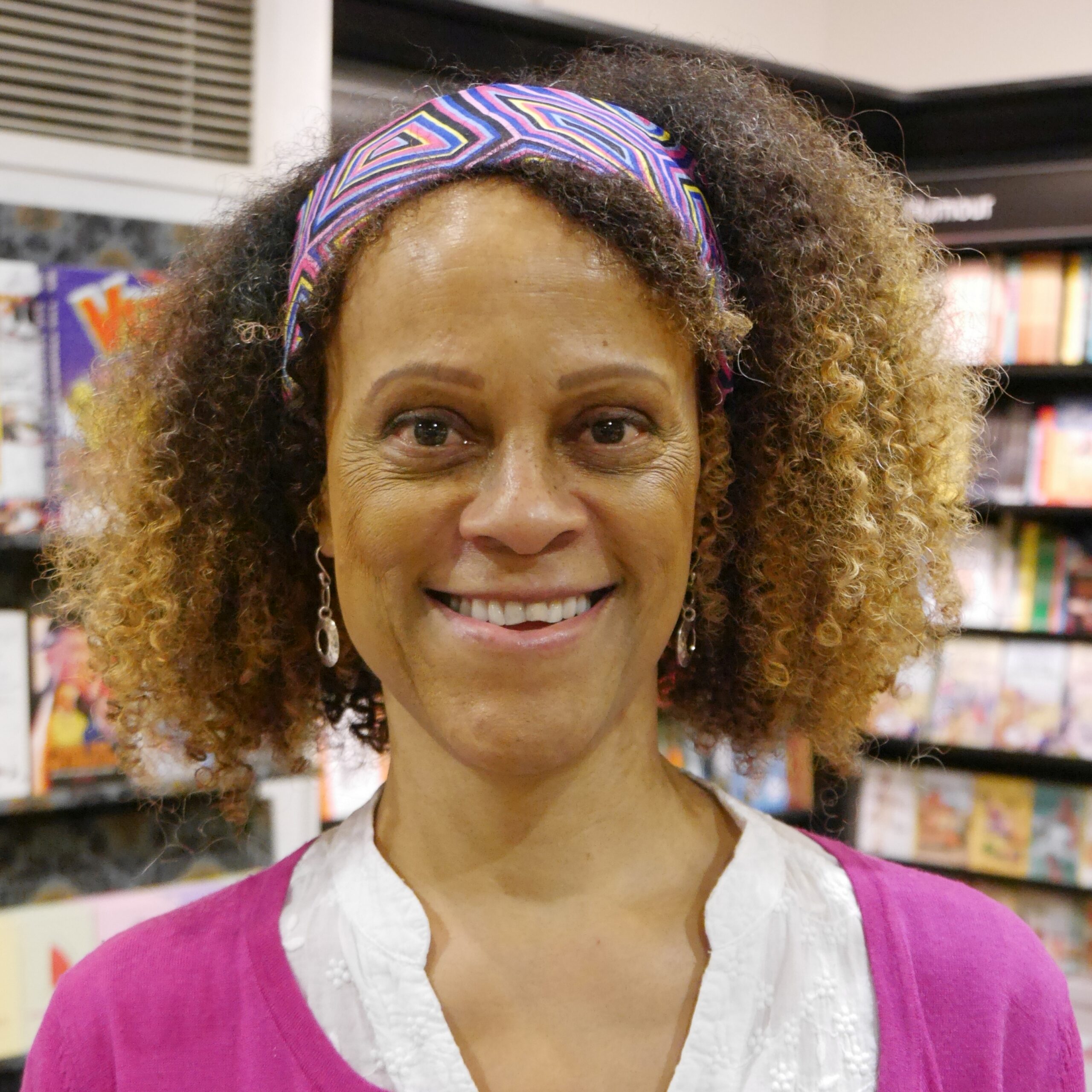
When Girl, Woman, Other shared the 2019 Booker Prize with Margaret Atwood’s The Testaments, Bernardine Evaristo became the first Black woman to win the award. The distinction drew attention to a writer whose work had already ranged across history, satire and contemporary life. It also brought a large new readership to a novel built around twelve different people, most of them Black women, whose experiences resist being gathered into a single representative story.1, 11
Woolwich, family and the theatre
Evaristo grew up in Woolwich, south-east London, the fourth of eight children. Her father was a Nigerian-born welder and local Labour councillor; her English mother was a schoolteacher. Her family history includes connections with Nigeria, Brazil, Ireland and Germany. Those intersecting histories would later become material for her fiction, although her characters and plots take her well beyond autobiography.2
As a teenager, she became involved with Greenwich Young People’s Theatre. She subsequently trained at Rose Bruford College, and in 1982 co-founded Theatre of Black Women with Patricia Hilaire and Paulette Randall. The company made work by and about Black women, addressing subjects including education, housing, health and the arts. Its existence gave its founders a practical means of choosing which lives and questions would occupy the stage.2, 3
Theatre also shaped Evaristo’s approach to character. In a 2022 Bookforum interview, she described drama school as a demanding process of self-examination, emotional openness and learning to listen to fellow performers. She connected that training to her later need to feel emotionally involved with the people she invented. The novelist’s work, in this account, begins with attention to another person’s inner life.4
A family history with many branches
Lara, first published in 1997 and expanded in 2009, makes the family itself a structure for travelling through history. A semi-autobiographical novel in verse, it follows a mixed-race girl growing up in London during the 1960s and 1970s, while reaching into the lives of earlier generations. Its geographical range includes England, Nigeria, Ireland, Germany and Brazil. The expanded edition traces seven generations across three continents.5
That design offers a useful challenge to the idea that ancestry supplies a single, simple answer to identity. A family line branches; marriages and journeys bring people into relationships with histories they may only partly understand. In Lara, a London childhood sits within that larger network. Readers can approach it as an exploration of how a personal story changes when grandparents and more distant ancestors are allowed their own histories.5
Evaristo later explained that revisiting Lara allowed her to develop the Irish and German strands she had previously left less explored. She also changed its presentation into shorter stanzas. Revision therefore concerned both what the family story contained and how readers encountered it on the page. Her account presents an earlier book as something that new knowledge can reopen.4
Black lives in other centuries
The Emperor’s Babe, published in 2001, moves to Roman London. Its central character, Zuleika, is a young Black woman whose parents have come from the region described in the novel as Sudan. Married as a child to a wealthy Roman, she lives within a city of sharp inequalities and elaborate performances of status. The book takes the form of a verse novel, bringing an invented young woman’s voice into a setting frequently imagined through emperors and monuments.6
Zuleika is a fictional character, and the novel’s comic language and imaginative freedoms belong to its literary method. Its historical value for a reader lies partly in the questions it provokes: who is permitted to appear in an imagined ancient Britain, and whose desires make the past feel inhabited? Those questions invite further historical enquiry without turning an invented narrative into documentary evidence.6
Soul Tourists, published in 2005, carries a related interest into a journey across Europe. Stanley, one half of a mismatched Black British couple, encounters figures from the continent’s past as ghosts. The book combines prose, poetry and script-like passages. Its travelling structure allows historical memory to interrupt the present, making belonging something the characters reconsider as the landscape changes around them.7
The figures include Mary Seacole, the Chevalier de Saint-Georges and Alexander Pushkin. Within the novel’s imaginative scheme, encountering them alters Stanley’s understanding of Europe. The device gives historical recovery a personal consequence: learning about the past can change how a traveller occupies the present. It also makes room for disagreement between the two living travellers. A journey can open up knowledge while exposing differences between the people sharing it, allowing historical enquiry and the complications of a relationship to develop together.7
Satire and the workings of power
Blonde Roots, published in Britain in 2008, approaches slavery through an invented reversal: Africans enslave Europeans. Its protagonist is a captured white woman trying to escape within an imagined world. Evaristo described it as her first novel written entirely in prose. The altered geography and social order create the conditions for satire, asking readers to encounter familiar justifications for domination from a disorienting angle.8
The premise should be understood as a deliberate fiction. Reading it as a claim that the historical Atlantic slave trade happened this way would miss the form of the book. A more useful question concerns the language power uses to make cruelty seem ordinary or deserved. By changing who occupies the dominant position, the novel invites scrutiny of the stories societies construct around supposedly natural hierarchies.8
Mr Loverman and the stories of older people
Mr Loverman, published in 2013, returns to contemporary London through Barrington Jedidiah Walker. He is a seventy-four-year-old Antiguan who has lived in Hackney since the 1960s: a husband, father and grandfather with a taste for stylish clothes and Shakespeare. He is also in a longstanding, secret relationship with his childhood friend Morris. His wife, Carmel, believes that his betrayals involve other women.9
That household creates a story about the consequences of concealment for more than one person. Barrington wants to change his life, but years of deception shape the choices available to everyone around him. One way to read the novel is to notice how age changes the stakes of a love story. Desire continues in later life, while decisions carry the accumulated weight of marriage, children, fear and habit.9
The book also led Evaristo towards new questions. In a 2019 interview, she explained that writing Carmel and the couple’s daughters had made her think about the scarcity of older and middle-aged Black women in fiction. Characters who had stood beside one protagonist began suggesting further stories. Her next novel would make room for many centres of attention.10
Twelve lives in Girl, Woman, Other
Girl, Woman, Other moves through generations, social classes and different parts of Britain. Its twelve central characters are connected through families, friendships and other relationships, but their circumstances and beliefs differ. The Booker Prize’s account emphasises that collective range. It is a useful starting point for reading a novel in which visibility does not require every character to share the same politics or understanding of the world.1
Its form grew partly from a BBC radio commission in 2014, for which Evaristo wrote about four Black female characters. She later described the style as “fusion fiction”: prose shaped by the movement and freedoms of poetry. In the novel, line breaks and lightly punctuated sentences help her move between memory and present experience, and between characters’ perspectives. She has also explained that this freedom made the long work demanding to revise.10
The effect can be understood as an invitation to read for rhythm as well as information. A shift in spacing or the turn of a thought can carry the reader into another moment. The technique makes the arrangement of language part of the relationship between lives. Experimental form, here, serves a recognisable narrative task: finding enough flexibility to follow people whose experiences overlap without becoming identical.10
The influences behind the invention
Evaristo’s account of her influences complicates an easy habit of comparing every experimental woman novelist with Virginia Woolf. In Bookforum, she identified a more direct connection with Ntozake Shange, recalling the impact of seeing Black women command a London stage in 1979. She also described the importance of encountering writers including Toni Morrison, Alice Walker and Audre Lorde. Her literary education involved actively searching for work that spoke to questions she was trying to explore.4
Her memoir Manifesto: On Never Giving Up, published in Britain in 2021, brings the making of that creative life into view. It looks back on childhood, theatre, political awakening and the determination to write stories she felt were missing. The book also considers race, class, sexuality, feminism and ageing through personal experience. Its place beside the fiction allows readers to examine how a working life develops through successive decisions and experiments.12, 16
Making space for other writers
Evaristo’s contribution to literature includes building opportunities for people beyond her own books. In 1995, she co-founded the writer development organisation Spread the Word with Ruth Borthwick. She later established The Complete Works, a mentoring programme for poets of colour that ran between 2007 and 2017. Thirty poets took part. Such programmes address the practical stages between having something to write and finding the support, contacts and confidence to bring it before readers.13
The Black Britain: Writing Back series takes another approach: returning neglected books to circulation. Working with Penguin, Evaristo selected titles and wrote introductions for a series whose first group included novels by C. L. R. James, Nicola Williams, Judith Bryan, Jacqueline Roy, S. I. Martin and Mike Phillips. The project treats literary history as something maintained through publishing decisions. A book becomes available to a new generation because someone reads it again, argues for it and makes a new edition possible.14
A body of work still being opened up
The Women’s Prize Outstanding Contribution Award recognised Evaristo in 2025, marking the prize’s thirtieth anniversary. Its judges considered her work across forms alongside her creation of opportunities for others. That breadth is a useful way to assess her place in Black British literature. Her novels ask who gets to occupy the centre of a story; her cultural work asks who receives the time, encouragement and readership to write one.15
For a new reader, the Booker-winning novel is one entrance into a much larger body of work. The family branches of Lara, the Roman setting of The Emperor’s Babe and the older lovers of Mr Loverman offer markedly different experiences. Together, they suggest a commitment to variety itself: Black British writing can hold comedy, historical invention, intimate argument and formal experiment without requiring any one book to speak for everybody.11
Sources and further reading
1. The Booker Prizes: Girl, Woman, Other.
2. Bernardine Evaristo official website: Biography and personal history.
3. University of Bristol Cultural Collections: Theatre of Black Women.
4. Bookforum: I Was Never Complacent: interview by Rhoda Feng.
5. Bernardine Evaristo official website: Lara.
6. Bernardine Evaristo official website: The Emperor’s Babe.
7. Bernardine Evaristo official website: Soul Tourists.
8. Bernardine Evaristo official website: Blonde Roots.
9. Bernardine Evaristo official website: Mr Loverman.
10. Penguin Books UK / Five Dials: Bernardine Evaristo: Older black women, who writes about that?.
11. University of Reading: About the Bernardine Evaristo Symposium.
12. Grove Atlantic: Manifesto.
13. Bernardine Evaristo official website: Community: literary projects and advocacy.
14. Penguin Books UK: Bernardine Evaristo rediscovers six novels for Black Britain: Writing Back.
15. Women’s Prize Trust: Announcing the recipient of the Women’s Prize Outstanding Contribution Award.
16. Bernardine Evaristo official website: Manifesto: UK publication details.
Photograph
Bernardine Evaristo at Waterstones Piccadilly, London, 5 December 2019. Photo: Edwardx, Bernardine Evaristo photograph, CC BY-SA 4.0.
