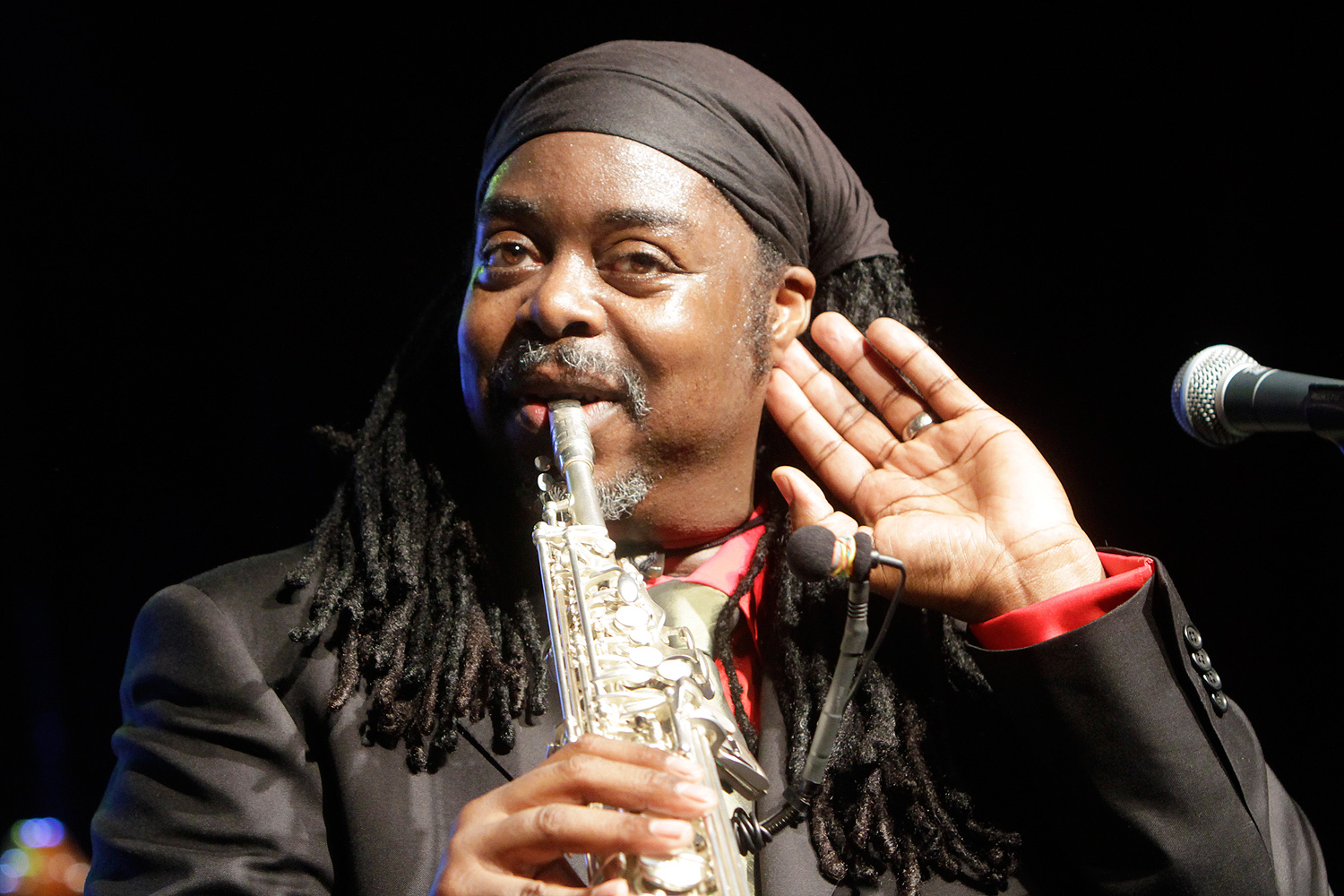
Courtney Pine has built a career around the possibilities of musical conversation. A saxophone can lead that conversation, but so can a flute, a bass clarinet or an encounter with a different generation of musicians. His work moves between jazz and the rhythms of British club culture, while his involvement in the Jazz Warriors helped establish a collective space for Black British players. Following those connections reveals a musician whose significance extends well beyond a famous debut.1
Learning to listen
Born in London in 1964, Pine encountered music through school, records and the people around him. In a 2026 interview with Chris Searle, he described learning recorder and clarinet at Rutherford School before gaining access to its saxophone. At home, ska and reggae recordings introduced him to sounds he later recognised as the work of Jamaican jazz musicians, including Tommy McCook, Roland Alphonso and Ernest Ranglin. A record borrowed from Brent Town Hall Record Library brought another discovery: Sonny Rollins’s Way Out West. Pine recalled being attracted by its cowboy imagery before becoming absorbed by the playing.2
That account gives libraries and school instruments their proper place in the story. Access to music depended on something practical: an instrument becoming available, a recording that could be borrowed and enough encouragement to keep exploring. Pine also remembered encouragement from drummer John Stevens and trumpeter Harry Beckett. Their example brought him into contact with London’s more exploratory jazz playing. Learning from older musicians meant hearing how experience could support risk, and how freedom in performance could grow through trust between players.2
There were living examples, too. Pine told interviewer Kevin Cooper that knowing the family of Osibisa’s Mac Tontoh allowed him to spend time around working musicians. Watching musicians at close quarters made an artistic career imaginable. Such encounters mattered alongside formal lessons: they connected the sounds on records with the work, relationships and everyday decisions through which music was actually made.7
The importance of a collective
In the 1980s, Pine became a principal founder of the Jazz Warriors, a Black British ensemble. A group creates opportunities that an individual performer cannot create alone. Musicians learn to hear themselves within an arrangement, respond to another player’s phrasing and sustain a shared performance. The Warriors’ collective identity also placed Black British musicians in view as makers of jazz with their own ideas and ambitions. Pine’s public profile grew from this wider musical environment, and his story belongs within it.1
Bassist Gary Crosby was another founding member. In 1991, Crosby and Janine Irons established Tomorrow’s Warriors, which developed its own approach to supporting young musicians, particularly Black musicians, women and people facing financial barriers. These were distinct organisations, with distinct founders and histories. Their connection through Crosby nevertheless shows how the relationships of one musical generation can contribute to the opportunities available to another. British jazz developed through the labour of organisers and educators as well as through the recordings that carried individual names.3
An album reaches a wider audience
Journey to the Urge Within reached number 39 in the UK album chart in 1986. The Official Charts record places its first appearance in October that year. This brought a young Black British jazz instrumentalist into a chart usually associated with popular singers and bands. For listeners discovering him there, the album offered an introduction to a much wider musical community.4
The debut’s personnel reveal the community behind that achievement. Its credits include bassist Gary Crosby, drummer Mark Mondesir, pianist Julian Joseph and vibraphonist Orphy Robinson. Pine’s compositions sit alongside music by Horace Silver and Wayne Shorter, while Susaye Greene contributes vocals. Her performance of Children of the Ghetto connected the recording to a song by Chris and Eddie Amoo. The record therefore offered several routes into its musical world: an original composition, an established jazz piece, a voice or the interplay of the band. Its range was present from the beginning.5
Jazz in the age of the turntable
Modern Day Jazz Stories, released in 1995, developed the relationship between improvisation and the music of the club. Pine’s account of its making describes taking his experience with DJs into a New York recording session. The credits place DJ Pogo alongside musicians including pianist Geri Allen, trumpeter Eddie Henderson and singer Cassandra Wilson. That combination makes a clear artistic proposition: the turntable can participate in a musical exchange alongside acoustic instruments and voices. The record’s methods followed the ways listeners were already moving between jazz, hip-hop and dance music, while leaving room for the individual decisions that make improvisation unpredictable.5
Recognition also came through the MOBO Awards, where Pine won Best Jazz Act at the inaugural ceremony in 1996. Placing jazz within an awards programme devoted to music of Black origin connected it publicly with a wider musical culture. It acknowledged a contemporary British jazz musician in a setting where audiences could also encounter other forms of Black musical expression.6
History carried through music
Pine continued to develop that openness on Devotion. Its contributors included singers Carleen Anderson, David McAlmont and Jacqui Dankworth, together with sitar player Sheema Mukherjee. The repertoire included songs associated with Joe Sample and John Martyn. In the label’s account, Pine described the recording as an expression of his Caribbean and African roots and his response to the society around him. That is a helpful way to understand the collaborations: each musician brings a particular sound and experience, and the arrangement has to make those contributions work together. A broad range of influences becomes meaningful through the details of the music. Anderson’s contribution to When the World Turns Blue and McAlmont’s interpretation of Bless the Weather gave this approach specific musical form, connecting individual voices with the band’s arrangements.8
House of Legends makes the historical dimension especially explicit. Its track list includes pieces named for Samuel Sharpe and Claudia Jones, alongside The Tale of Stephen Lawrence and Song of the Maroons. The album places the soprano saxophone within an acoustic setting that includes steel pan, horns and flutes. These choices allow heritage to enter through instrumentation as well as through titles. The names invite listeners to investigate lives and struggles outside the recording itself, without turning the music into a substitute for a history book. It is a useful example of how instrumental music can create an encounter with the past: a listener may come for the sound and leave curious about the person a composition remembers.9
A different scale of conversation
Song (The Ballad Book) brings Pine together with pianist Zoe Rahman. With bass clarinet and acoustic piano, the musical relationship becomes unusually exposed: there is no large ensemble to carry the exchange. The repertoire draws on writers including Duke Ellington, Donny Hathaway, Sam Rivers and Thad Jones. A familiar melody can provide common ground, while the two players decide how much space to leave around it. The album’s credits also identify Pine’s work on arrangement, production and engineering, showing how the project depended on decisions behind the recording as well as on the notes played in front of a microphone.10
Discussing the project with Kevin Cooper, Pine emphasised Rahman’s experience of playing in a duo and the musical understanding she brought to their performances. He also described the unusual position of the bass clarinet as a lead instrument. Choosing it changed the terms of the performance: a musician widely identified with the saxophone asked listeners to attend to another sound. His comments about instrumental songs suggest that melody can hold personal associations even when nobody sings the words. The aim was communication through a carefully chosen repertoire and an attentive partnership.7
Continuing to change the setting
For Black Notes from the Deep, released in 2017, Pine worked with Omar, whose voice appears on four tracks. The band included Alec Dankworth on bass, Robert Mitchell on piano and Rod Youngs on drums. Among the recordings was an interpretation of Herbie Hancock’s Butterfly, with backing vocals by Charleen Hamilton. The album returned to a fuller ensemble and placed vocal and instrumental pieces within the same programme. Its personnel underline how much Pine’s work depends on collaborators: a rhythm section, a singer and a soloist bring different kinds of timing to a performance. Their interaction allows a recording to move between the directness of a song and the possibilities of improvisation.11
Spirituality extended the partnership with Rahman while introducing another set of textures. Pine played bass clarinet, Rahman played piano, and the project added a string quartet with two violas, a violin and a cello. Pine arranged the strings himself. Its repertoire includes the Welsh song All Through the Night alongside jazz material and original compositions. The result is another example of how he constructs a programme around the possibilities of an ensemble. Choosing two violas, rather than the more usual two violins, changes its instrumental balance. The focus remains on the meeting between particular sounds: reed, piano and strings, each with its own way of sustaining or releasing a note.12
What the next generation inherits
Speaking to Manchester Jazz Festival in 2024, Pine recalled being discouraged as a teenager from pursuing university because he was Black. He contrasted that experience with the opportunities he saw younger British musicians gaining through higher education. His reflections also returned to practice and continuing study. An established career had not exhausted what there was to learn. For younger players, that offers a more useful model than effortless genius: musical development requires access, repeated work and the freedom to take one’s own background seriously. Pine’s account of studying the African connections between different musical styles makes the same point. Curiosity supplies the questions, but study helps a musician turn those questions into choices that can be heard.13
The 2026 collection Out of the Ghetto: A Modern-Day Jazz Story revisited his formative recordings, with selections curated by critic Kevin Le Gendre and Pine himself. It also included previously unreleased recordings from May 1986. Returning to that early work makes it possible to hear beginnings without treating them as a complete explanation of everything that followed. Pine’s career invites that kind of active listening: attend to the collaborators, the instruments and the decisions that change from one project to the next. The lasting example is a willingness to keep making musical room for another idea.14
Sources and further reading
1. National Jazz Archive: Biography of Courtney Pine.
2. Morning Star: Sonny Rollins album Way Out West took me into the heart of jazz — interview by Chris Searle.
3. Tomorrow’s Warriors: Our Founders.
4. Official Charts: Journey to the Urge Within — official chart history.
5. Courtney Pine official website: Discography: album credits and Courtney Pine’s commentary.
6. MOBO Organisation: MOBO Awards 1996.
7. UK Music Reviews: Interview: Courtney Pine — Kevin Cooper.
8. Concord: Devotion.
9. Courtney Pine / Bandcamp: House of Legends: album notes, track list and credits.
10. Courtney Pine / Bandcamp: Song (The Ballad Book): album notes and credits.
11. Courtney Pine / Freestyle Records / Bandcamp: Black Notes from the Deep: album notes and credits.
12. Courtney Pine / Bandcamp: Spirituality: album notes and credits.
13. Manchester Jazz Festival: An Interview with Courtney Pine, 11 April 2024.
14. uDiscover / Universal Music: Out of the Ghetto: A Modern-Day Jazz Story, 2CD.
Photograph
Courtney Pine, photographed in 2010. Photo: Augustas Didžgalvis, Courtney Pine photograph, CC BY-SA 4.0.
