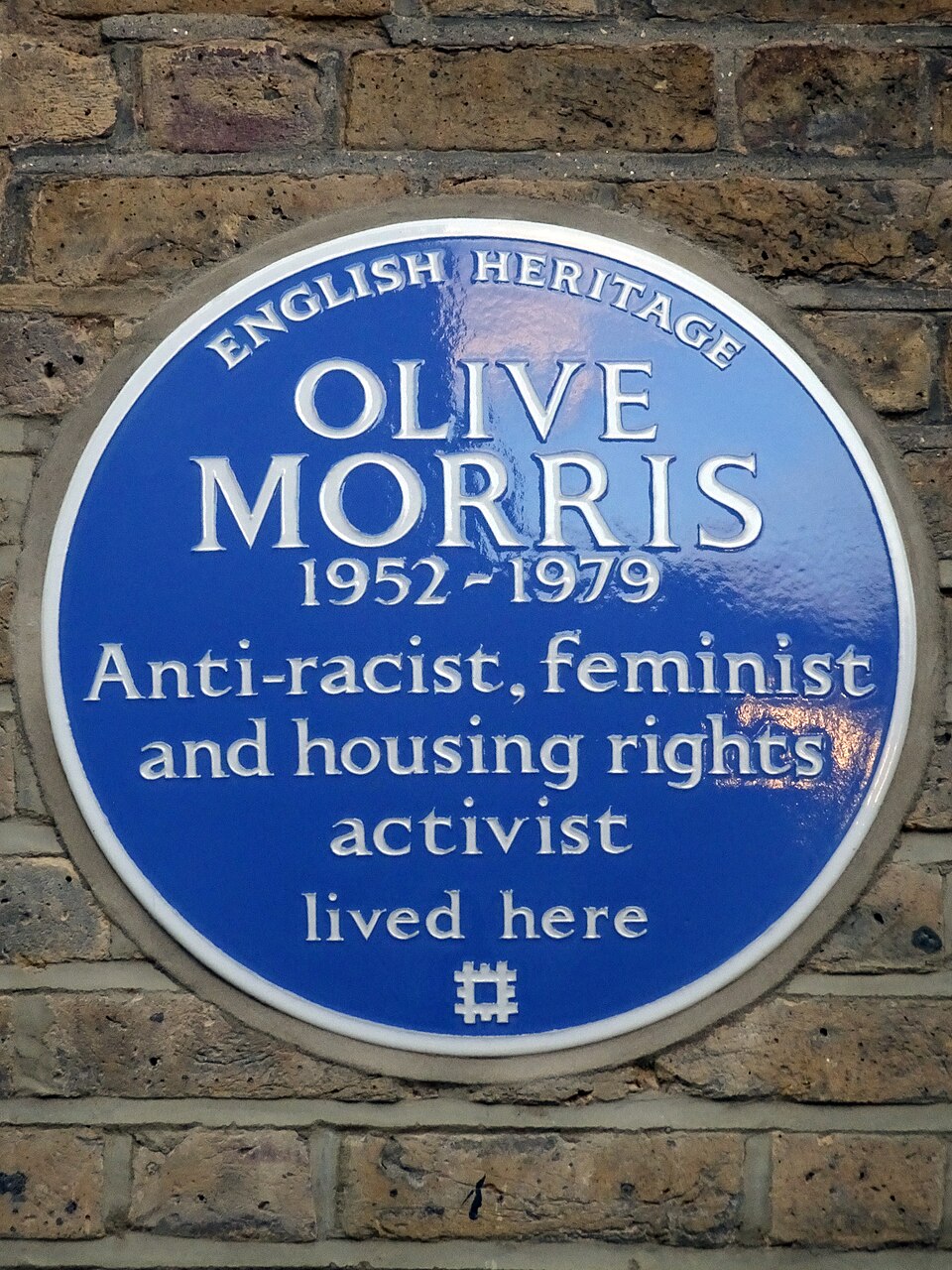
Olive Morris helped build organisations through which people could challenge the conditions of their everyday lives. Housing, schools, policing and women’s independence were connected concerns in her work. In Brixton and Manchester, she joined others in making places to meet, learn and act together. She died in 1979, aged 27, leaving a history that friends and fellow organisers would work to preserve.9, 1
Her story is especially revealing when followed through those relationships. A group, a study session or help with a housing problem can leave a quieter trace than a confrontation, yet these were substantial parts of her political life.
Learning while organising
Morris came to Britain from Jamaica as a child and grew up in south London. Her friend Liz Obi remembered her determination to continue learning after school: she worked towards O- and A-levels while holding a full-time job.
Education and activism developed together. As a young woman Morris became involved in the British Black Panther movement’s youth collective. Obi’s account describes work on problems facing Black people in schools, housing, the courts and encounters with the police. The range matters. Political activity involved responding to what neighbours and friends were experiencing, as well as reading, debating and joining demonstrations.2
Reading the account of her arrest carefully
In November 1969, when she was 17, Morris was arrested after a crowd gathered during an incident involving Nigerian diplomat Clement Gomwalk in Brixton. She was among several people arrested. A photograph taken afterwards carries her own handwritten description of having been beaten by police. The Remembering Olive Collective’s research brings that annotation into the account, alongside contemporary press reports.3
Morris denied assaulting a police officer but was convicted and given a suspended sentence.1 Keeping her account visible is essential. So is recognising the other people present, rather than retelling the incident as a solitary act of heroism.
A home and a place to meet
During the winter of 1972–73, Morris and Obi occupied empty accommodation at 121 Railton Road in Brixton. Their housing needs were part of a wider struggle over access to somewhere decent to live. They resisted attempts to remove them, and the flat also became a meeting place for Black women’s study groups.
English Heritage’s research follows the changing uses of the address. After Morris and Obi moved elsewhere, the building continued as a centre of political activity and housed Sabarr, a radical bookshop and community space. The history of the squat therefore extends beyond securing a roof for its first occupants. A place to live could also provide space for reading, discussion and practical support.1
Black women organising together
Morris helped establish the Brixton Black Women’s Group in the early 1970s. The group created space for women to discuss issues that were often pushed aside elsewhere. Black Cultural Archives places this work within a movement concerned with employment, education, health and the combined effects of racism, class inequality and sexism.
In 1978 Morris was also among the founders of the Organisation of Women of African and Asian Descent, known as OWAAD. Its organising connected women beyond one neighbourhood and supported the growth of local groups. The organisation’s name is a reminder of the alliances being made across different backgrounds.
These efforts required more than agreement that discrimination was wrong. They required women to decide priorities, develop arguments and sustain organisations of their own. The records of meetings, publications and campaigns preserved by Black Cultural Archives allow that work to be studied in detail.4
Education as a shared responsibility
In Brixton, Morris volunteered with others at the Abeng Centre, which provided supplementary schooling and youth services. Lambeth Council’s account of her educational work places it in the context of discrimination in the education system.5
A supplementary school offered an additional setting in which children could learn and be taken seriously. It also needed people prepared to give their time. Remembering the volunteers beside Morris helps make the organisation visible: the work depended on a community, even when one individual’s name is most readily remembered.
Manchester and the rights of students
In the mid-1970s Morris studied social sciences at the University of Manchester. Paul Keleman, who knew her then, recalls someone absorbed in political ideas and quick to connect university life with campaigning outside it.
One major concern was the increase in fees charged to overseas students. Morris campaigned against it even though she was not personally liable for the higher charge. Keleman describes her seeing the issue through Britain’s relationship with the countries from which students came.
Her example expands what university activism can mean. A question about fees became a question about who could study, who was expected to pay more, and what responsibilities a country carried beyond its own borders.6
Connections across the city
Morris also became involved with the Manchester Black Women’s Co-operative and community activity in Moss Side. In an oral-history interview recorded in 2009, fellow participant Diane Watt described the co-operative’s office-skills training, political discussions and links with university students.
Watt remembered Morris taking part in the Saturday school. The wider project brought local people and students together, with volunteers teaching children and opening conversations about culture, identity and future possibilities. Watt’s recollection gives substance to the phrase community organising: people shared skills, made introductions and encouraged one another to continue learning.
Her memories also include Morris’s humour and enjoyment of life. Political seriousness did not mean that every encounter was solemn. This more rounded recollection helps keep a young woman visible within the history of her work.7
A thinker as well as a campaigner
Morris’s own writing makes her political arguments available to readers. In a leaflet written with Mike McColgan, she questioned whether the Anti-Nazi League’s concentration on the National Front adequately addressed racism in Britain.
The authors welcomed people joining anti-racist activity while arguing that racism also operated through institutions, including schools, local government and policing. It was a challenge to allies to examine the ordinary systems affecting Black people’s lives. Reading the leaflet allows Morris to appear as someone developing and disputing ideas, as well as acting on them.8
After graduating in 1978, she worked in the juvenile department of Brixton Community Law Centre, continuing that concern with the institutions young people encountered.1
How the history was kept
Friends preserved Morris’s papers and photographs. Decades later, work led by artist Ana Laura López de la Torre and Liz Obi grew into the Remembering Olive Collective. Formed in 2008, the collective trained interviewers and brought together an archive that included 30 oral histories. The collection launched in 2009 and is held at Lambeth Archives.9
That preservation was itself a collective undertaking. It gives later readers the means to follow Morris through the places, arguments and friendships that shaped her life, and to recognise the many people who organised alongside her.
Sources and further reading
1. Olive Morris (1952–1979). English Heritage.
2. Liz Obi: Remembering Olive: Time to Pass the Memories On. In Do you remember Olive Morris?, Remembering Olive Collective.
3. Kimberly Springer: Stepping into the struggle. In Do you remember Olive Morris?, Remembering Olive Collective.
4. The Black Women’s Movement: Subject Guide. Black Cultural Archives.
5. My heart will always be in Brixton. Lambeth Council.
6. Paul Keleman: Olive in Manchester. In Do you remember Olive Morris?, Remembering Olive Collective.
7. Diane Watt: oral-history interview, 25 September 2009. Interview by Sheila Ruiz; transcript by Julia Morandeira. Remembering Olive Collective.
8. Olive Morris and Mike McColgan — Has the Anti-Nazi League Got It Right on Racism?. Brixton Ad-Hoc Committee against Police Repression; preserved by Remembering Olive Collective.
9. Ana Laura López de la Torre — About: Do you remember Olive Morris?. Remembering Olive Collective.
Featured image. The blue plaque commemorating Olive Morris at 121 Railton Road, Brixton, photographed in November 2024. Photograph by Spudgun67, 12 November 2024, via Wikimedia Commons. Image record · CC0
