Walter Tull’s application for an Army commission contains a question that exposes the world in which he served. Was the candidate of “pure European descent”? The answer entered on his form was “No”. In 1917 he nevertheless became a second lieutenant. That document records both a racial barrier and a man crossing it.7
His life deserves room beyond a single breakthrough. Football, family separation, skilled work and military service all belong in the account. Following those connections brings us closer to a person whose name is often asked to carry a much larger story.
A family with connections across the Atlantic
Born in Folkestone in 1888, Walter was the son of Daniel Tull, a carpenter and joiner from Barbados, and Alice Palmer, a woman from a local family. Daniel had settled in Britain in 1876. The papers preserved by their descendants include his journal and letters from his mother, Anna, who remained in Barbados.
Those surviving letters place Walter within an extended family. They show contact continuing across the Atlantic, alongside the household being made in Kent. The family archive also preserves a letter from Alice’s mother welcoming Daniel into the family. Such records add relationships and individual voices to the broad history of migration between Britain and the Caribbean.1
Childhood, loss and a changing household
Alice died in 1895, when Walter was seven. Daniel died two years later. Walter’s stepmother, Clara, faced the task of supporting the children, and a local Methodist minister helped arrange places for Walter and his older brother Edward at the Children’s Home and Orphanage in Bonner Road, Bethnal Green. They entered on 24 February 1898.
In 1900 Edward was adopted by the Warnock family in Glasgow. The brothers remained in contact, although they now grew up in different places. Walter stayed at Bonner Road, played in the home’s football team and trained as a printer.
The family’s own account also records efforts by Clara and the older children to keep in touch. Entering an institution did not erase those bonds. Remembering them avoids making the orphanage the whole of Walter’s childhood.2
A footballer recognised for his ability
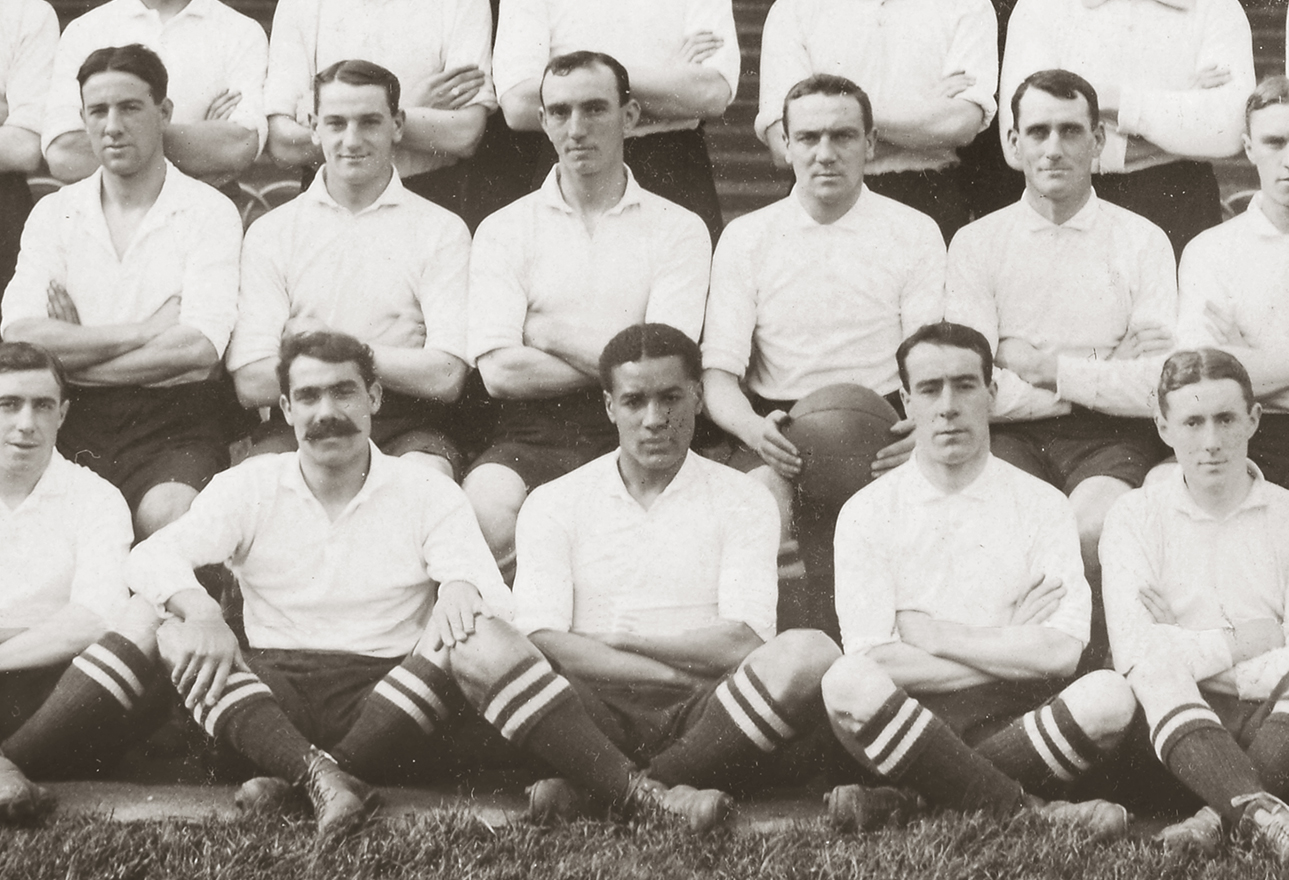
Tull developed his game at Clapton, an amateur club, while continuing his printing apprenticeship. His play attracted favourable newspaper attention and the interest of Tottenham Hotspur. In 1909 he toured Argentina and Uruguay with Spurs before signing professional terms.
The family archive identifies reports that praised his control of the ball and intelligence as a forward. It also preserves evidence of the racism he faced. During a match at Bristol City in 1909, abuse from spectators became a subject of the match reporting itself. A Football Star correspondent challenged the treatment of Tull while praising his football.
Both kinds of evidence matter. Tull was being judged, selected and discussed as a player; he was also subjected to hostility directed at his colour. An account concerned only with abuse can obscure the sporting ability that brought him into professional football.3
From Tottenham to Northampton
Tottenham’s club history records Tull’s senior debut at Sunderland on 1 September 1909, in Spurs’ first match in the top division. He made ten senior appearances and scored twice. Much of his time at the club was spent in the reserves.
In October 1911 he moved to Northampton Town, where manager Herbert Chapman wanted him as part of a transfer involving right-back Charlie Brittan. Northampton gave Tull a longer period of first-team football. The club was then playing in the Southern League.
These were working decisions within a football career: a manager’s interest, competition for places and a move to another team. They help explain why Northampton became such a substantial part of his life, rather than appearing merely as a stop between Tottenham and the Army.4
Football and the move into uniform
Tull enlisted on 21 December 1914, joining the 17th Battalion of the Middlesex Regiment, known as the Footballers’ Battalion. The National Army Museum records his subsequent service in both Middlesex Football Battalions. His sporting and military lives overlapped at first: the family archive notes that he continued playing for Northampton during the early months of training.5, 6
He went to France in November 1915. His service included illness, hospital treatment and recovery in 1916, followed by a return to active duty and service with the 23rd Middlesex. Early in 1917 he came back to Britain for officer training. This was a progression through the ranks, interrupted by the demands of wartime service, rather than a direct passage from football pitch to officer’s uniform.6
What the commission form tells us
The application now held at The National Archives gives his name, date of birth and marital status before asking about European descent. Race appeared among the particulars by which the Army assessed a candidate. The form did not treat it as incidental information.
Tull was commissioned on 30 May 1917; his name appears in the London Gazette’s official list of new second lieutenants.10 The National Army Museum describes him as one of the first Black men to receive a British Army commission. That careful wording leaves room for other early officers while recognising the significance of his appointment. His rank was second lieutenant, and his responsibilities involved commanding soldiers.7, 6, 5
The final months
Tull served in Italy after his battalion was transferred there in late 1917. He returned to France in March 1918, as the war entered another destructive phase. On 25 March, during the German Spring Offensive, he was killed in action. He was 29.6, 8
His body was never recovered. The Commonwealth War Graves Commission commemorates him on the Arras Memorial, which records soldiers with no known grave. For a family, a name on a memorial and a burial place are different things. That absence belongs alongside the public recognition of his service.8
Keeping the whole life in view
In 2021 the National Football Museum inducted Tull into its Hall of Fame. His grandnephew Edward Finlayson collected the award, linking an act of public recognition to the family that had preserved so much of the evidence.9
Walter’s brother Edward kept letters, cards, newspaper cuttings and photographs. Their survival makes it possible to trace more than a list of achievements.1 A fuller remembrance can hold together the printing apprentice, the footballer, the brother and the officer. His importance does not depend on compressing those lives into a slogan.
Sources and further reading
1. The Walter Tull Archive / Finlayson Family Archive: Tull Family History.
2. The Walter Tull Archive / Finlayson Family Archive: Walter’s Early Years.
3. The Walter Tull Archive / Finlayson Family Archive: The Football Years.
4. Tottenham Hotspur: Walter Tull.
5. National Army Museum: Walter Tull: A Soldier’s Story.
6. The Walter Tull Archive / Finlayson Family Archive: The War Years.
7. The National Archives: Source two: Walter Tull Temporary Commission.
8. Commonwealth War Graves Commission: Second Lieutenant Walter Daniel John Tull.
9. National Football Museum: Walter Tull inducted into Hall of Fame.
10. The London Gazette: Special Reserve of Officers, Infantry commissions. Supplement dated 16 June 1917, page 5970.
Featured image. Walter Tull with the Tottenham Hotspur team in 1909; he is seated at the centre of the front row. Photographer unknown; reproduced by The National Archives and shared through Wikimedia Commons. Image record · Public domain
