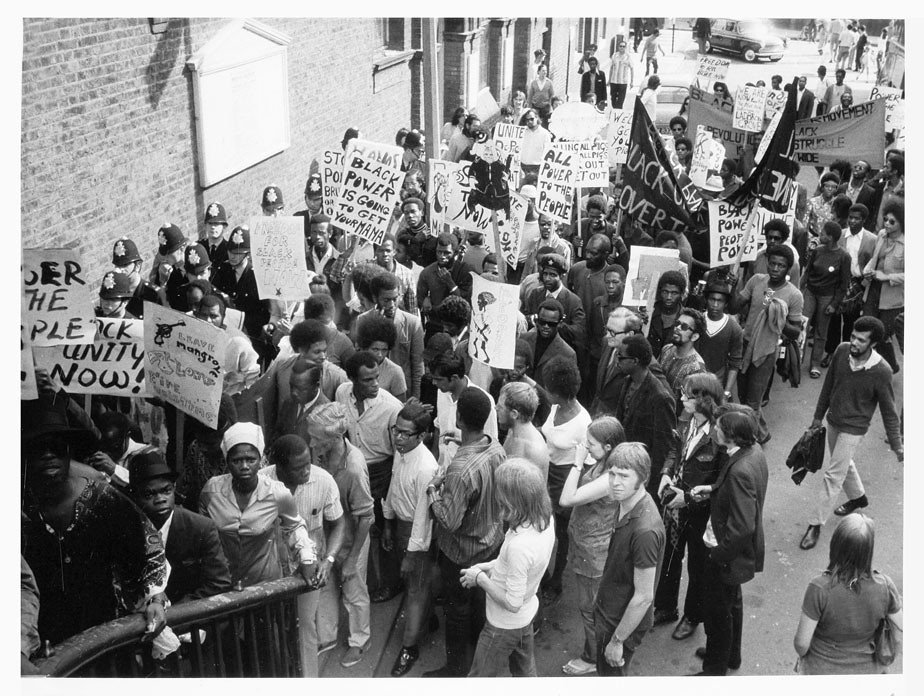
The Mangrove Nine took their name from a restaurant at the centre of a west London community. Frank Crichlow opened the Mangrove in Notting Hill in 1968. Within a few years, a campaign against repeated police raids had led to a protest, a major criminal trial and a lasting challenge to the way Black people were treated by the police.9, 1
The story begins with people defending a place that mattered to them. Following it from the restaurant to the courtroom shows how community organising, legal argument and the determination to be heard became connected.
Why the restaurant mattered
Barbara Beese, one of the defendants, later described the Mangrove as somewhere people exchanged news, shared experiences and sought advice on social and legal questions. In her recollection, its Caribbean food was one part of a much broader role.2
The George Padmore Institute records that The Hustler newspaper was produced on the premises and that the restaurant served as an informal base for Notting Hill Carnival. A business could also support a community’s public life. The connections formed around the Mangrove help explain why pressure on its owner was experienced as a threat reaching beyond one restaurant.9
A complaint before the march
In December 1969 Crichlow complained to the Race Relations Board about the refusal to renew his licence to run an all-night café at 8 All Saints Road. He challenged the way his customers had been characterised and argued that he was being discriminated against as a Black British citizen.
The surviving complaint is useful because it shows him already seeking redress through an official channel. He was asking to operate his business and disputing the account being given of it. His statement also connects the treatment of the restaurant with citizenship: he understood himself as someone entitled to equal treatment, with grounds to challenge its denial.3
Making the case in public
The Action Group for the Defence of the Mangrove explained the intended protest in a written statement. It linked the restaurant raids to police interference with parties, wedding receptions and other places where Black people gathered. The organisers said earlier complaints had failed to change the situation.
Copies went to the Home Office, the Prime Minister, the Leader of the Opposition and several Caribbean high commissioners. The statement addressed people with political and diplomatic authority as well as a local audience. It presented the march as a response to accumulated grievances, rather than an isolated dispute.4
The National Archives records twelve raids between January 1969 and July 1970, during which no evidence of illegal activity was found. That sequence provides the background to the decision to demonstrate on 9 August 1970.1
The protest and the nine defendants
Around 150 people joined the march against police harassment. Clashes broke out between police and demonstrators, and arrests followed. Nine people subsequently faced trial: Barbara Beese, Rupert Boyce, Frank Crichlow, Rhodan Gordon, Darcus Howe, Anthony Innis, Altheia Jones-LeCointe, Rothwell Kentish and Godfrey Millett.1, 9
The group included people with different roles in the community and its political organisations. The name Mangrove Nine joined them through a prosecution, but it should not erase their individuality. Each faced a case whose outcome would affect their own life.
Challenging the courtroom’s assumptions
The trial at the Old Bailey began in October 1971 and lasted 55 days. Altheia Jones-LeCointe and Darcus Howe represented themselves. Ian Macdonald, who represented Beese, worked with the defendants in developing a defence that openly challenged racism in policing and the legal process.
The defence also challenged the composition of the jury. Their demand for an all-Black jury was not granted, but two Black jurors ultimately served. Garden Court Chambers’ account of Macdonald’s involvement places this challenge within a wider effort to confront assumptions about whose experience counted in court. The defendants sought an active role in how their case was understood.5
Speaking for themselves
A contemporary report in the Post Mercury described Howe’s closing address. He challenged the account given by police witness Frank Pulley and told the jury that the case belonged within a larger historical struggle. The newspaper’s report preserves a defendant arguing about the meaning of the prosecution as well as contesting its evidence.
Self-representation gave Howe the opportunity to put that argument directly. It also required him to take on the work and exposure of conducting his defence while facing serious charges. His speech was part of a contested trial, with an outcome still to be decided.6
Beyond the courtroom, a 1971 defence pamphlet carried the title Battle for freedom at Old Bailey. Its survival records how supporters presented the case to a wider public: the question of justice for these defendants was also a political concern.7
The personal stakes
Beese’s later interview adds something that a list of courtroom tactics cannot convey. Her son was still very young, and she remembered the fear of harsh sentences if the jury accepted the police account. She also recalled the determination of the defendants to challenge what they regarded as a political attempt to criminalise them.
That memory keeps uncertainty in the story. The people going through the trial did not yet know it would be remembered as a victory. They had to make decisions while living with the possibility of imprisonment and its consequences for their families.2
What the verdicts established
In December 1971 all nine were cleared of the riot charges. Five defendants were acquitted on every charge. Four were convicted of lesser offences and received suspended sentences.
The contemporary Home Office report distinguishes the convictions: Rhodan Gordon and Altheia Jones-LeCointe were convicted of affray; Jones-LeCointe, Anthony Innis and Rupert Boyce were convicted of assaulting police. The result was a major defeat for the prosecution, but it was not an acquittal of everyone on everything.8, 5
The judge said the trial had shown evidence of “racial hatred on both sides”. His remarks included the police, giving public recognition to a problem campaigners had been describing. Open University research reproduces correspondence showing senior police officers trying to secure a retraction; the statement was not withdrawn. This was a significant acknowledgement, while the wider struggle against racist policing continued.10
Hearing the history in different voices
The 1973 documentary The Mangrove Nine, produced by John La Rose and Franco Rosso, includes interviews recorded before the final verdicts. The George Padmore Institute’s account identifies it as a way to encounter the defendants before the outcome had become settled history.9
Official records need their own careful reading. The Home Office report portrayed the defendants’ conduct as obstruction; campaign material presented their actions as a struggle for justice. Those differences are part of the evidence.8
The lasting importance of the Mangrove Nine lies in people insisting that their experiences could challenge an official account. Their case belongs in legal history, but it also belongs to the restaurant, the neighbourhood and the relationships that made a collective defence possible.
Sources and further reading
1. The Mangrove Nine. The National Archives.
2. The Woman with the Afro: The Story of Barbara Beese. Byline Times, arising from the Four Corners / Swadhinata Trust oral-history project; Jan Fuscoe interviewing Barbara Beese.
3. Frank Crichlow’s complaint to the Race Relations Board. The National Archives; Frank Crichlow.
4. Action Group statement for the Defence of the Mangrove. The National Archives; Action Group for the Defence of the Mangrove.
5. Mangrove 9, in 50 Cases / 50 Years of Doing Right, Fearing No One. Garden Court Chambers; Edited by Amy Hughes, Fiona Bawdon and Stephanie Harrison KC.
6. Why I’ll fight the heavy mob. Post Mercury, preserved by The National Archives; Contemporary newspaper reporter; reports Darcus Howe’s closing speech.
7. Battle for freedom at Old Bailey. Mangrove Nine defence campaign; preserved by The National Archives; Defence campaign.
8. The Trial of the Mangrove Nine — Home Office report extract. Home Office, reproduced by The National Archives; Home Office.
9. Mangrove Nine Documentary (1973). George Padmore Institute.
10. Andrew Gilbert: The Mangrove Nine – Fifty Years On. The Open University; includes original police and Director of Public Prosecutions correspondence.
Featured image. A photograph of the 1970 march in West London, preserved among the records relating to the Mangrove Nine. The National Archives, MEPO 31/21 (16); shared by The National Archives UK through Flickr Commons. Image record · No known copyright restrictions