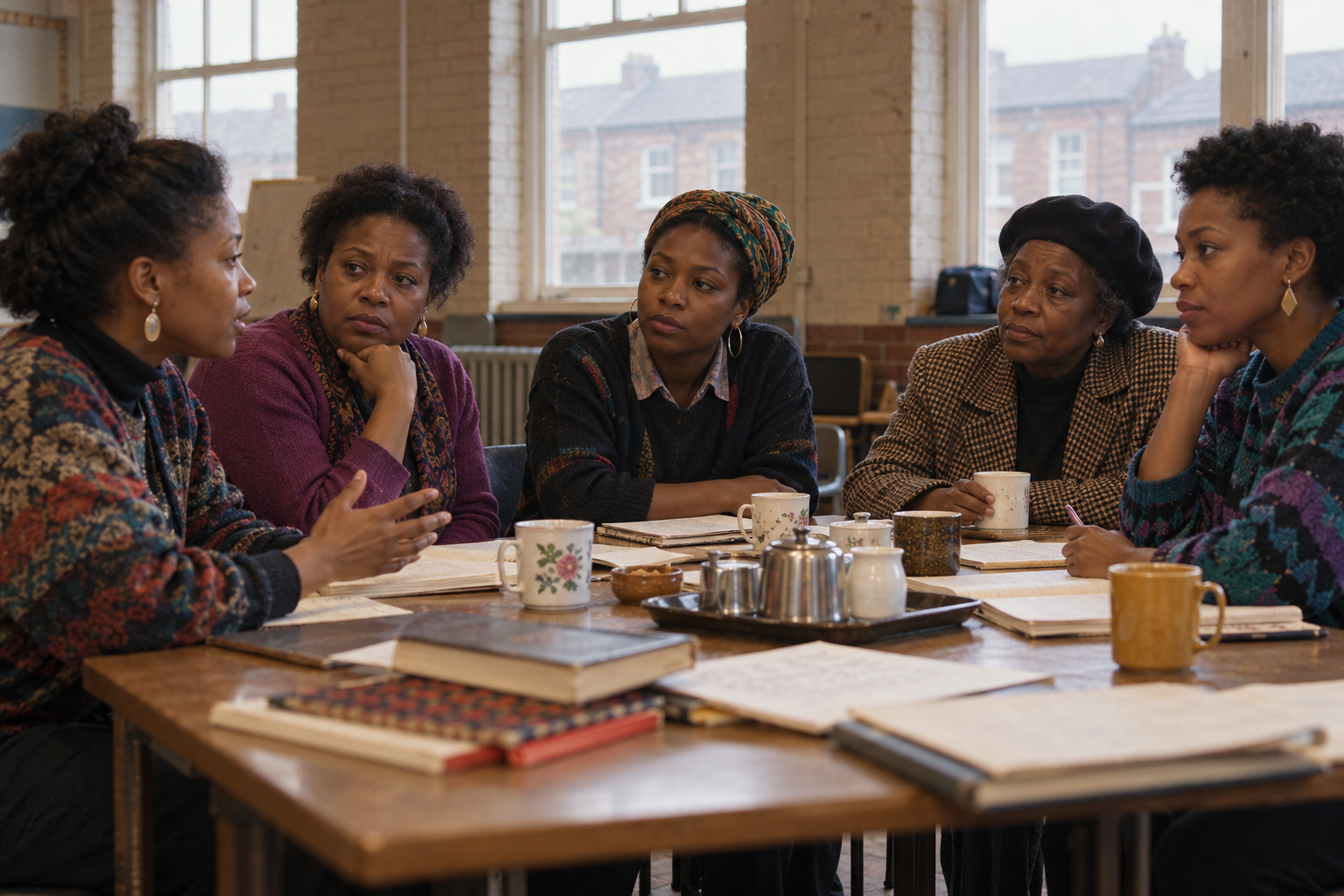
AI-created historical illustration of a fictional women’s community meeting in Manchester in the early 1980s.
At the Moss Side People’s Centre in Manchester, Abasindi brought education, culture and social support into the same community space. Founded in 1980, the cooperative grew through the work of Black women who organised activities for themselves, for children and for older people, while deciding how that work should be run.1
The women and the city
Kath Locke and Elouise Edwards were among its founders. Locke, born in 1928 to an English mother and a Nigerian father, had experienced racism in education and employment. Her campaigning connected those experiences with demands for racial and gender equality. She also pressed for Black history to be recognised in Manchester’s public spaces. The name Abasindi, drawn from a Zulu word for survivors, expressed a determination to shape life together in a city where the women already had deep roots.2
Edwards arrived from Guyana in 1961 to join her husband, Beresford. Their home became Manchester, and opposition to racism became a sustained part of their lives. The archive of her papers spans 1969 to 1999 and includes correspondence, leaflets, reports and interviews, reflecting years of involvement in local projects and the Family Advice Centre. Such material records the patient administrative work behind community campaigning: putting concerns into writing, keeping information and sustaining relationships across organisations.3
Abasindi developed from earlier organising. Olive Morris, who came to Manchester as a student in 1975, helped establish the Manchester Black Women’s Co-operative and the Black Women’s Mutual Aid Group. She died before Abasindi’s formation. Research published by the University of Manchester places these groups within a wider Black freedom movement and records their concern with access to office work and professional training. The women were responding to employment barriers through education while developing their own political networks.4
Deciding how to organise
The cooperative’s own published account explained why independence mattered. Its predecessor had depended on public funding and had been substantially controlled by men. The women wanted authority to identify their needs and organise the projects intended to meet them. The change involved questions of decision-making, resources and whose experience counted. A supportive meeting place could become a base from which women determined priorities for themselves, rather than waiting for another organisation to decide what they required.1
Its charitable purposes made the breadth of that ambition explicit. The Charity Commission records a constitution adopted in December 1985, with amendments in 1987 and 1988. The stated purposes covered education, health, support for older women and women in need, and recreational facilities. They identified women of African, Afro-Caribbean and Asian descent in Moss Side and neighbouring areas as beneficiaries. These were declared objectives, rather than a measure of what had already been achieved, but they show how learning, wellbeing and material circumstances belonged within the same understanding of community work.5
Volunteers supplied the labour, and some activities also helped finance the cooperative. Hair plaiting offered an affordable service and a setting for social contact. A craft shop made clothing, jewellery and traditional craftwork available locally. This joined the need to raise money with the value placed on cultural knowledge. Skills that women possessed could support the organisation and become something shared, taught and appreciated within it.1
Learning and cultural expression
In her account for the University of Huddersfield, former member Adele Jones recalled Abasindi’s Saturday classes in science, mathematics, English and Black history. These addressed educational difficulties in an area experiencing high youth unemployment. The combination of subjects matters: children could work on the academic knowledge expected in school while encountering histories that gave their communities a place in the curriculum. Jones also described an organisation with strong personalities and serious political discussion, but one in which participation could be enjoyable. Relationships and sociability were part of what sustained the work.6
Francia Messado joined Abasindi at sixteen. In the Women of the Soil oral-history project, she connected that experience with her development as a drummer, dancer, performer and choreographer. Her account also describes helping to develop a construction course for women with Manchester College. It follows a younger participant’s path through cultural and educational work, showing how the skills of organising could be used in different settings. Her later activities belonged to several organisations, with Abasindi forming one part of that history.7
Music and dance also connected Abasindi with other community spaces. The Nello James Foundation records that the Nello James Centre housed its drummers and dance troupe, who supported activities including the supplementary school’s summer projects. The centre also made room for local rock and reggae groups and youth drama. Abasindi’s performers participated within this broader setting, bringing their work into contact with children and other artists. Their involvement shows a practical relationship between cultural activity and education, with performance becoming one way to take part in community life.8
Health, care and a neighbourhood under pressure
Health campaigning depended on connections between local experience and professional knowledge. In the same oral-history project, Verna Davis described campaigns involving Elouise Edwards, Louise Da-Cocodia and others to secure recognition and support for people affected by sickle cell disease and thalassaemia. She identified Abasindi’s role in promoting the service. The cooperative worked alongside health campaigners and practitioners within a wider effort. Publicising a service and helping people recognise its relevance were forms of community participation in healthcare, alongside the specialised work of clinicians.7
Those relationships mattered during the Moss Side disturbances of 1981. Da-Cocodia, a nurse and community organiser who had arrived from Jamaica in 1955, helped transport injured people to hospital. She subsequently served on the Hytner Inquiry into the unrest. Her involvement illustrates the different kinds of responsibility carried by women in the local network: immediate care for people in difficulty, professional service and participation in attempts to understand what had happened. Abasindi had already been established when the disturbances occurred.2
The Moss Side People’s Centre also housed the Family Advice Centre, which offered help to residents who were reluctant to approach statutory services. Following the uprisings, the building became important to the formation of the Moss Side Defence Committee. That committee sought to defend young Black people and challenge accounts circulated by the police and press. Abasindi, the advice centre and the defence committee were distinct organisations, connected through a shared place and overlapping local concerns. Their proximity helps explain how advice, political campaigning and women’s organising could reinforce one another.9
Making Black history part of public life
The women also worked to make Manchester’s Black political history visible. A collection assembled by Kath Locke preserves material about the 1945 Pan-African Congress and its later commemorations. Among the catalogued items is a letter dated 7 October 1985 from Elouise Edwards at Abasindi, inviting its recipient to the unveiling of a commemorative plaque. The plaque marked forty years since the congress and was placed on Chorlton Town Hall. This was a tangible claim on the city’s public memory: the history of anti-colonial organisation belonged on its buildings as well as in private recollections.10
Edwards’s work extended to preserving people’s accounts of their own lives. The University of Manchester’s guide to the RACE Centre identifies twenty-six interviews in the Roots Oral History Project donated by Maria Noble and Edwards. Recorded with members of Manchester’s African and Caribbean communities in the 1980s and 1990s, they preserve life stories that might otherwise have remained within families. The guide also stresses the value of community members conducting interviews themselves. The questions people ask, and the experiences they recognise as significant, help determine what a historical record contains.12
Photographs offer another view. The Elouise Edwards Photograph Collection includes Abasindi alongside images of festivals, sport, play and political demonstrations. Much of the material concerns Moss Side and Hulme during the 1970s and 1980s. Its images of campaigns for housing and playgrounds place organised protest beside the activities of everyday life. Preserving both allows a community to be understood beyond moments of crisis. The people appearing in these records had recreational, cultural and family lives as well as causes for which they marched.11
Telling a collective history
Diana Watt and Adele Jones brought participants’ experiences into a sustained written account with Catching Hell and Doing Well: Black Women in the UK — the Abasindi Cooperative, published in 2015. Photographs, poems and press cuttings accompany its examination of the organisation. Bringing these different forms together preserves more than an institutional chronology. It allows personal memories, cultural expression and public records to sit alongside one another, showing the varied ways in which women understood their involvement and represented it to others.13
That collective approach was emphasised when the Institute of Contemporary Arts programmed Watt and Jones in its Sistrens in the Struggle symposium. Its description presented their book as an endeavour involving the women of Abasindi, beyond the two names on the cover. The programme placed their history alongside discussions of Black British feminism, urban life and the cultural politics of lovers’ rock. Community organising and cultural expression could be examined together, with the participants’ own account of Abasindi contributing to a wider conversation about Black women’s lives in Britain.14
Other forms of remembrance remain part of Manchester’s landscape. The Kath Locke Centre opened in 1996, named for the community activist. Abasindi drummers marked its opening. The organisation running the Zion Community Resource Centre took on the new health centre, giving it a name associated with local activism and self-help. This was a later initiative with its own institutional history. Its connection to Abasindi lay in the people, principles and cultural participation carried forward from earlier community work.9
At a Rekindling Nello James community event, archivists displayed material produced by Abasindi alongside photographs and records of local advice work. Former volunteers, students and residents shared their memories of community spaces. The RACE Centre’s account describes an effort to preserve those recollections together with the existing documents. Such encounters allow records to return to the communities they describe, where people can recognise places, contribute context and explain why a building or an activity mattered in their lives.15
The surviving photographs leave room for that variety: children at play, people gathering, cultural activities and demands for change. They help keep Abasindi within the everyday history of Manchester. Its women built an organisation through the time, skills and knowledge they contributed, while maintaining relationships that extended beyond it. Recovering that work gives names and substance to the collective effort behind community life.11
Sources and further reading
1. Archives+ partnership, Manchester Central Library; 23 October 2018: Abasindi Co-operative – Black History Month.
2. Ahmed Iqbal Ullah RACE Centre and Education Trust: Women’s Stories in our Archives: IWD 2020.
3. Ahmed Iqbal Ullah RACE Centre / University of Manchester: Elouise Edwards Collection: collection-level catalogue.
4. Felix Reilly, History@Manchester, University of Manchester; 13 October 2019: “Black women who have struggled to make our efforts possible”: Olive Morris and the Legacy of Black Power in Manchester.
5. Charity Commission for England and Wales: Abasindi, charity 700368: governing document and charitable objects.
6. University of Huddersfield; original interview with Adele Jones, 22 December 2015: Black women’s Abasindi Co-operative in troubled 1980s Moss Side.
7. FIRST CUT Media & Performing Arts: Black Women’s Activism in Manchester: Women of the Soil oral-history project.
8. Nello James Foundation: Arts, Sports & Youth: Creativity, Confidence & Community Spirit.
9. The Big Life Group: Hulme and Moss Side Heritage Trail: Kath Locke Centre and Moss Side People’s Centre.
10. Ahmed Iqbal Ullah RACE Centre / University of Manchester: Pan-African Congress 1945 and related celebratory events: Kath Locke collection, GB3228.34.
11. Ahmed Iqbal Ullah RACE Centre and Education Trust: The Elouise Edwards Photograph Collection.
12. University of Manchester Library: Ahmed Iqbal Ullah RACE Centre Collections: oral histories.
13. Diana Watt and Adele Jones; UCL Institute of Education Press, 2015; University of Huddersfield research record: Catching Hell and Doing Well: Black Women in the UK – the Abasindi Cooperative.
14. Institute of Contemporary Arts: Sistrens in the Struggle: Black Women in Britain – a Symposium.
15. Ahmed Iqbal Ullah RACE Centre and Education Trust: Documenting the Places That Hold Global Majority Memories.