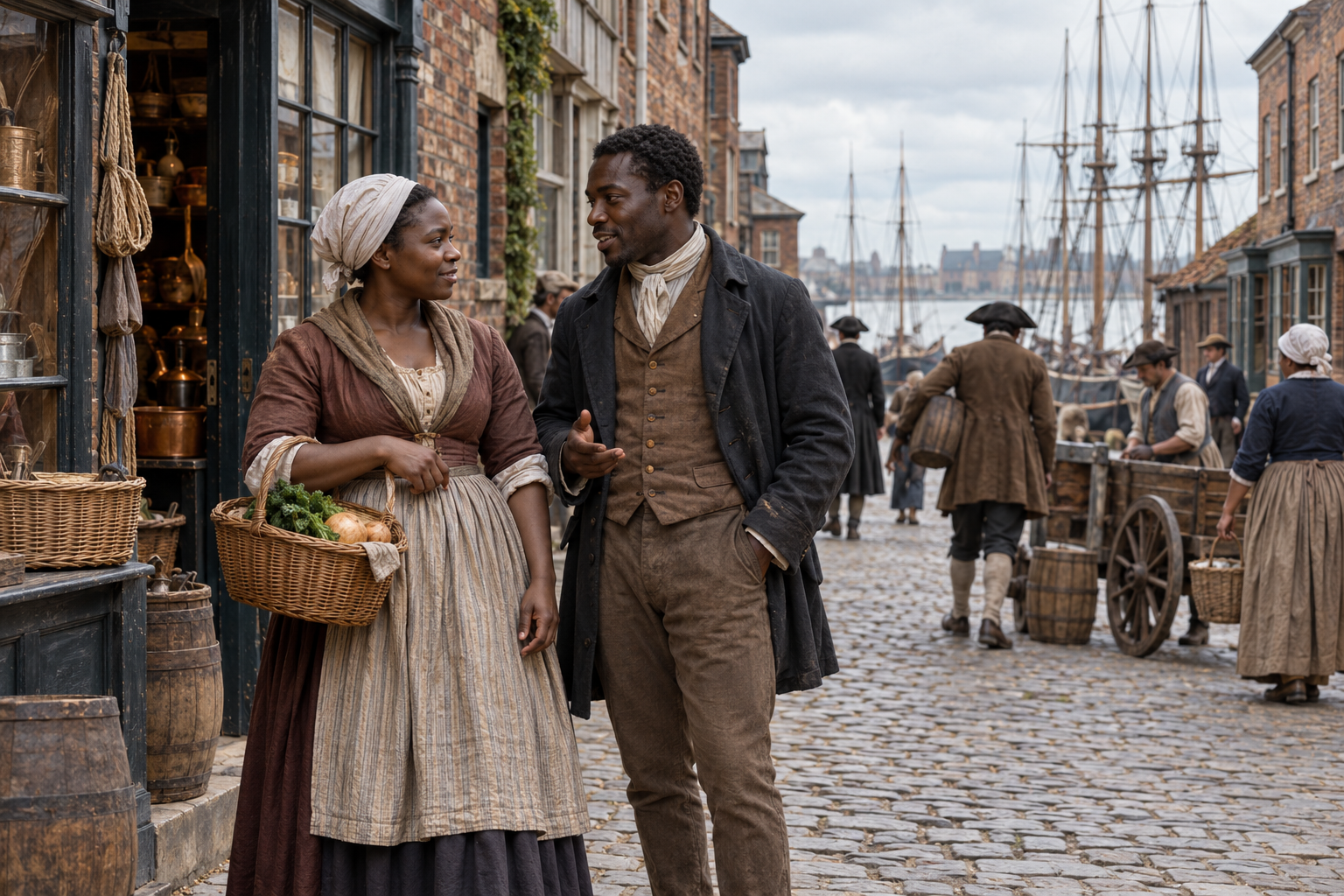
AI-created historical illustration of a fictional East End street scene around 1770.
On 6 June 1743, a young woman called Sabinah escaped from the Hannah, a ship bound for Jamaica. Eleven days later, an advertisement in the Daily Advertiser offered three guineas for her return, with an extra ten shillings if someone put her aboard before a stated deadline. The notice described her as about nineteen. Its most revealing detail was the advertiser’s suspicion that other Black people around Whitechapel, Rag Fair or Rotherhithe had helped her leave. The writer wanted readers to assist a recapture. Read from another direction, the advertisement points towards Black Londoners who might assist one another.1
That possibility must remain distinct from proof. The notice does not identify a helper, describe Sabinah’s route or tell us where she found shelter. A further advertisement in September repeated the demand for her return. It establishes that she was still being sought publicly; it does not establish her eventual fate. What survives is the record of her departure and of someone else’s determination to reverse it. Even this limited evidence places her within a London connected to the Caribbean, the river and possible sources of local support.1
The East End as a place of work and movement
Sabinah’s story belongs to a much longer Black presence in the eastern districts of London. Historian Simon Newman’s research into seventeenth-century escape advertisements identifies the expanding neighbourhoods north of the Thames, including Wapping, Shadwell, Ratcliff, Limehouse and Stepney, as a major concentration of these records. These places connected ships and their captains with houses, businesses and streets on shore. London could therefore be both a destination in a coerced journey and a place where a person attempted to leave that journey behind. Movement through the port created connections that could serve sharply different purposes.2
The language of employment requires care. In early records, a person described as a servant might be a wage earner, someone bound by an agreement, or someone treated as property. The vocabulary alone cannot settle their status. Nor did everyone described as Black in early modern London come from Africa: such terms could also be applied to South Asian people. Individual evidence matters. A history of Black working lives becomes less accurate if it turns every servant into an enslaved person, or every journey into a freely chosen migration.2
A child in Bethnal Green
In July 1701, the London Gazette advertised for Cuffee, a boy of about twelve who had left Justice Jory in Bethnal Green approximately eight weeks earlier. His clothing included a brown coat and blue waistcoat, stockings and cap. The notice said that he spoke English well and no other language. It offered a reward for returning him. The description places a child accustomed to English-speaking life within the history of this neighbourhood. His pursuer considered his disappearance serious enough to bring it before the newspaper’s readers.3
Newman’s investigation identifies Jory as Joseph Jory, a plantation owner with connections to Nevis who became a London justice of the peace and a director of the Royal African Company. Jory’s family occupied Kirby’s Castle, a large Bethnal Green house with a separate brewhouse and coach house. Wealth derived from colonial slavery could support an English household and a position of local authority. Cuffee had left the control of an adult with both resources and connections. The eight-week interval reported in the notice records the duration of his absence when Jory appealed for help.3
A young person called Stepney
A September 1710 advertisement described another boy, aged about fifteen or sixteen, whose recorded name was Stepney. He had left Isaac Barber, commander of the Camwood Merchant, then at Gravesend. The notice offered him a supposedly kind reception if he returned, but also promised two guineas and expenses to anyone who secured him and delivered him to William Smith, a chemist in Goodman’s Fields. It warned against taking him in, claiming that he was a bound apprentice. Reassurance, payment and intimidation appeared together in the same small notice.4
Stepney’s name should not be mistaken for a birth certificate: the advertisement does not establish that he was born in the district. It does, however, connect his pursuit with a local tradesman and a ship downriver. Smith’s premises could receive a captive even though Smith was not identified as the boy’s master. This is a concrete example of how the effort to control a Black person’s labour extended beyond one household or vessel. The advertiser sought cooperation from people who might encounter the boy while going about their own business.4
Ann near Limehouse Bridge
Women’s working lives also appear in these notices. An advertisement catalogued in January 1712 concerns a maid near Limehouse Bridge, whose partly damaged name is read as Ann. She was about twenty-one and spoke English well. Twenty shillings were offered to anyone who secured her and notified either the man described as her master or a contact in Lombard Street. Ann’s ability to speak English is a specific recorded skill; her birthplace, pay and precise duties are not recorded. The notice sought possession of her person, without setting out a contract or an account of stolen belongings. Her decision to leave places a woman’s labour and freedom within this local history, even though the surviving text tells us little about the life she hoped to make afterwards.5
Pompey’s trumpet and Jack’s ship
Another advertisement, from the early 1720s, sought a man named Pompey who had left Captain George Winter of Bethnal Green. Alongside descriptions of scars and clothing, it recorded that Pompey could play the trumpet. He wore two jackets, one described as a sailor’s jacket, and a coloured shirt. A guinea was offered for securing or returning him. His occupation remains uncertain, but the trumpet preserves a musical ability his pursuer considered recognisable. His life included knowledge and practice that the demand for his return did not otherwise explain. Paying attention to that skill helps us see the person within a notice designed to make him identifiable to strangers.6
On 5 June 1743, the day before Sabinah’s recorded escape, a man called Jack left the sloop Charming Molly, lying at Coal Stairs. The advertisement described him as twenty-seven, a native of Bermuda and a fluent English speaker. Nathaniel Butterfield, the vessel’s owner, also claimed ownership of Jack. The notice listed a blue jacket, speckled shirt, striped trousers and a leather cap. It offered five guineas and expenses for his return, or for securing him and informing the appropriate contact. One contact was Alexander Allen, a rope maker in Back Lane near Sun Tavern Fields, Shadwell.7
Jack’s notice makes the connections between Atlantic travel and East End trades unusually clear. A rope maker’s address became part of a search for a person who had escaped from a ship. The account does not tell us Jack’s exact work aboard, and there is no evidence that he and Sabinah knew one another. Their separate escapes nevertheless show why the river must remain central to this history: people claimed as property could leave vessels within reach of London, while those pursuing them called upon contacts ashore.7
The Grigg household in Wapping
Parish records reveal another kind of connection: a continuing family home. On 18 November 1706, Ann Grigg and her daughters Phoebe and Elizabeth were baptised at St John’s, Wapping. The register described Ann as Black, a native of Barbados and thirty years old. Phoebe was ten; Elizabeth was seven months old. Thomas Grigg was named as Ann’s husband and the children’s father, and the family’s address was Parrot Alley. These entries connect Barbados with a particular household in the East End.8
In July 1707, another daughter, Anne, appears in the register at the same address; Thomas is identified as a mariner. The entries therefore record family continuity from one year to the next. Ann’s journey to Britain and any earlier enslavement remain unknown. Here the records describe her through her relationships as a wife and mother, and locate the family in a household connected with maritime work. They identify a mother, a father, three daughters and a home, giving this history a domestic dimension that advertisements for recapture cannot provide.8
Faith, sociability and the meaning of freedom
Baptism could connect Black Londoners with congregations and with people who might support them. It could also carry expectations about freedom that enslavers disputed. Newman’s study of slavery’s decline in Britain shows that people sometimes sought baptism or marriage while attempting to establish independent lives, but legal authorities did not generally accept that baptism itself ended enslavement. A parish entry should therefore be read as evidence of participation in Christian and local life, rather than treated as an automatic certificate of emancipation.9
Social life extended across the city. A London Chronicle report from February 1764 described fifty-seven Black men and women eating, drinking and dancing at a Fleet Street public house. The musicians were Black too, playing instruments that included violins and French horns. Fleet Street was outside the East End, and the report does not identify its guests’ homes. Its relevance is the wider London world it reveals: Black people organised gatherings and entertainment for themselves. Nothing connects Pompey to this particular occasion, but the report helps make room in this history for recreation and musical life alongside labour and resistance.10
Relief and pressure to leave
Later in the century, the White Raven tavern in Whitechapel became associated with assistance to London’s Black poor. Research by UCL archaeologists and community historians identifies it as a place where relief was distributed during the 1786–87 Sierra Leone settlement project. That assistance became conditional on resettlement in West Africa. The tavern’s history therefore raises a harder question than whether charity existed: what choices remained when help with immediate need was tied to leaving the country? A place of gathering and assistance could also become part of an organised departure.11
The distinction between practical freedom and security remained important. The 1772 Somerset judgment prevented forced removal from England into colonial slavery; it did not amount to a general parliamentary abolition of slavery throughout the empire. Newman argues that the actions of people who had already escaped and established freer lives were fundamental to the transformation inside Britain. Following the East End’s less famous residents brings that argument into focus. Freedom involved everyday decisions about leaving a master, finding connections and making a home, as well as proceedings in court.9
Recovering a local history
Tower Hamlets’ Communities of Liberation project has brought Ann, Pompey, Sabinah and other early Black residents into public view through archival research undertaken with local people. Their stories change the scale at which Black London can be understood. Alongside the lives of celebrated writers and campaigners lie a maid near a bridge, a man with a trumpet and people whose names survived because someone wanted them returned. These records do not recover whole lives. They do establish that the East End’s Black history belongs within the ordinary history of its streets, work and community.12
Sources and further reading
1. Daily Advertiser; transcribed by the University of Glasgow, Runaway Slaves in Britain: Advertisements seeking Sabinah, Daily Advertiser, 17 June and 14 September 1743 (records 207–208).
2. Simon P. Newman; University of London Press: Freedom Seekers: Escaping from Slavery in Restoration London, chapter 3.
3. Simon Newman, History Workshop: Freedom Seekers in Restoration London: Cuffee and Joseph Jory.
4. Daily Courant; transcribed by the University of Glasgow, Runaway Slaves in Britain: Advertisement seeking Stepney, Daily Courant, 27 September 1710 (record 89).
5. London Gazette; transcribed by the University of Glasgow, Runaway Slaves in Britain: Advertisement seeking Ann, London Gazette, 29 January 1712 (record 90).
6. Daily Courant; transcribed by the University of Glasgow, Runaway Slaves in Britain: Advertisement seeking Pompey from Captain George Winter (record 128; catalogued as Daily Courant, 24 February 1721).
7. Daily Advertiser; transcribed by the University of Glasgow, Runaway Slaves in Britain: Advertisement seeking Jack from the Charming Molly, Daily Advertiser, 18 June 1743 (record 209).
8. Nadege Forde-Vidal, researcher’s account with parish-register reproductions: Migration Stories from Across Britain in the 18th Century: The Grigg Family.
9. Simon P. Newman, Law and History Review / Cambridge University Press, 2025: Taken Not Given: The End of Slavery in Britain.
10. London Chronicle; reproduced by Spread the Word: London Chronicle report, 16–18 February 1764, reproduced in Runaways London Teaching Resource, page 12.
11. UCL Archaeology South-East, 21 October 2025: Amplifying the stories of Black Londoners from the 18th Century.
12. Tower Hamlets Local History Library & Archives, Idea Store: Communities of Liberation: current exhibition.